Volume Formulas
Related Pages
Geometry Formulas
Volume Formulas Explained
Explanations For The Surface Area Formulas
More Geometry Lessons
In these lessons, we provide:
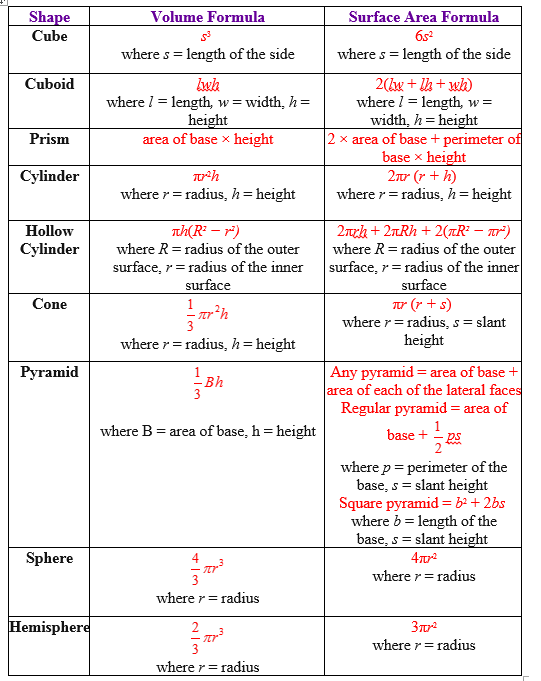
- A table of volume formulas and surface area formulas used to calculate the volume and surface area of three-dimensional geometrical shapes: cube, cuboid, prism, solid cylinder, hollow cylinder, cone, pyramid, sphere and hemisphere.
- A more detailed explanation (examples, solutions & worksheets) of each volume formula.
Table Of Volume Formulas And Surface Area Formulas
The following table gives the volume formulas for solid shapes or three-dimensional shapes. Scroll down the page if you need more explanations about the volume formulas, examples on how to use the formulas and worksheets.
Geometry Worksheets
Practice your skills with the following worksheets:
Printable & Online Geometry Worksheets
Volume Of A Cube
A cube is a three-dimensional figure with six matching square sides. The figure below shows a cube with sides s.
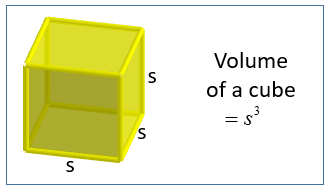
If s is the length of one of its sides, then the volume of the cube is s × s × s
Volume of the cube = s3
Worksheets and More Examples:
Worksheets on the volume and surface area of cubes
More examples about the volume of cubes
More examples about the surface area of cubes
How To Find The Volume Of A Cube?
The formula for the volume of a cube is s × s × s = s3, where s is the length of a side of the cube.
Example:
Find the volume of a cube with sides = 4cm
Volume Of A Rectangular Solid
A rectangular solid is also called a rectangular prism or a cuboid.
In a rectangular solid, the length, width and height may be of different lengths.
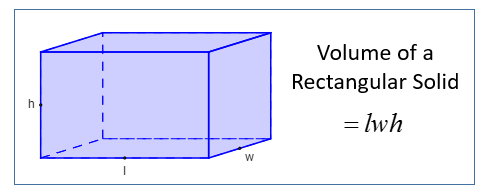
The volume of the above rectangular solid would be the product of the length, width and height that is
Volume of rectangular solid = lwh
Worksheets And More Examples:
Worksheets on volume and surface area of cuboids
More examples about the volume of cuboids
More examples about the surface area of cuboids
How To Find The Volume Of A Rectangular Prism Or Cuboid?
The formula for the volume of a cuboid is l × w × h = lwh, where l is the length, w is the width and h is the height of the rectangular prism. This video will give two examples of finding the volume of a rectangular prism.
Examples:
- Find the volume of a rectangular prism with sides 25 feet, 10 feet and 14 feet.
- Find the volume of a rectangular prism with sides 5.4 inches, 7.5 inches and 18.3 inches.
Volume Of A Prism
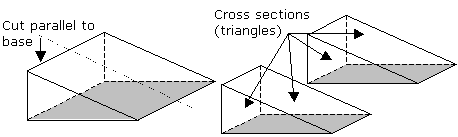
A prism is a solid that has two parallel faces which are congruent polygons at both ends. These faces form the bases of the prism. The other faces are in the shape of rectangles. They are called lateral faces. A prism is named after the shape of its base.
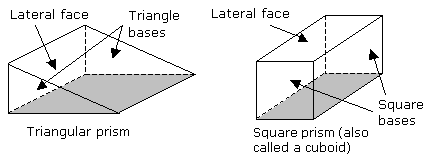
When we cut a prism parallel to the base, we get a cross section of a prism. The cross section has the same size and shape as the base.
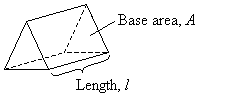
The volume of a right prism is given by the formula:
Volume of prism = Area of base × length
V = Al
where A is the area of the base and l is the length or height of the prism.
Worksheets and More Examples:
Worksheets on surface area & volume of prisms & pyramids
More examples about the volume of prisms
More examples about the surface area of prisms
How To Find The Volume Of A Triangular Prism?
This video shows how to determine which is the base and the height of the triangular prism.
Example:
Find the value of a triangular prism, use the following formula:
Volume = (area of base) × height
Volume Of A Cylinder
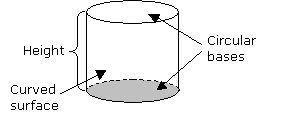
A cylinder is a solid that has two parallel faces which are congruent circles. These faces form the bases of the cylinder. The cylinder has one curved surface. The height of the cylinder is the perpendicular distance between the two bases.
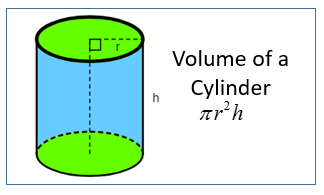
The volume of a cylinder is given by the formula:
Volume = Area of base × height
V = π r2h
where r = radius of cylinder and h is the height or length of cylinder.
Worksheets and More Examples:
Worksheets to calculate volume of cylinders
Worksheets to calculate surface area of cylinders
Worksheets on volume and surface area of cylinders
Worksheets on surface area of of cylinders and pipes
More examples about the volume of cylinders
More examples about the surface area of cylinders
How to find the volume of a cylinder?
Example:
Find the volume of a cylinder with radius 9 and height 12
Volume Of A Hollow Cylinder
Sometimes you may be required to calculate the volume of a hollow cylinder or tube.
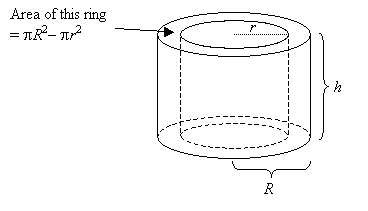
Volume of hollow cylinder

where _R_ is the radius of the outer surface and _r_ is the radius of the inner surface.
Volume of hollow containers - cylinder and cone
How you can find the volume of a hollow cylinder and a cone using the formula of volume of prism and
pyramid?
Examples:
- Given a pipe with length = 12cm, outer diameter = 2m and thickness = 40cm. Calculate the amount of concrete used?
- Given that an ice-cream cone has a diameter of 65mm, height of 15cm and thickness of 2mm. Calculate the volume of wafer in the cone.
Volume Of A Cone
A cone is a solid with a circular base. It has a curved surface which tapers (i.e. decreases in size) to a vertex at the top. The height of the cone is the perpendicular distance from the base to the vertex.
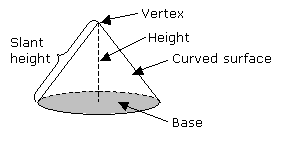
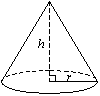
The volume of a cone is given by the formula:
Volume of cone = 1/3 × Area of base × height
V = 1/3 πr2h
where r is the radius of the base and h is the height of the prism.
Worksheets and More Examples:
Worksheets to calculate volume of cones
More examples about the volume of cones
More examples about the surface area of cones
How to find the volume of a cone?
Example:
Find the volume of a cone with radius is 12ft and height is 16ft.
Volume of a Pyramid
A pyramid is a solid with a polygonal base and several triangular lateral faces. The lateral faces meet at a common vertex. The height of the pyramid is the perpendicular distance from the base to the vertex. The pyramid is named after the shape of its base. For example a rectangular pyramid or a triangular pyramid.
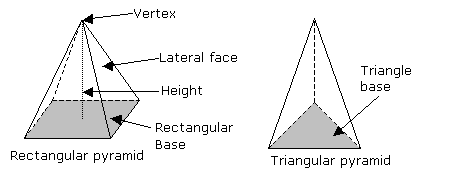
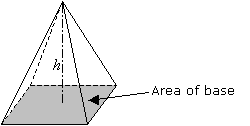
The volume of a pyramid is given by the formula:
Volume of pyramid = 1/3 × Area of base × height
V = 1/3 Ah where A
is the area of the base and h is the height of the pyramid.
Worksheets and More Examples:
Worksheet to calculate the volume of square pyramids
Worksheets on volume of prisms and pyramids
More examples about the volume of pyramids
More examples about the surface area of pyramids
How to find the volume of a pyramid?
Make sure that you use the vertical height to substitute into the formula and not the slant height.
Example:
Find the volume of a pyramid with sides = 9ft, vertical height = 5ft and slant height = 8ft.
Volume of a Sphere
A sphere is a solid in which all the points on the round surface are equidistant from a fixed point, known as the center of the sphere. The distance from the center to the surface is the radius.
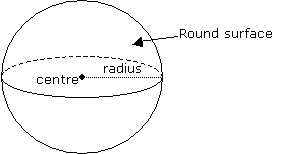
Volume of sphere = 4/3 πr3
where r is the radius.
How to find the volume of a sphere?
Example:
Find the volume of air in the ball with radius = 3cm
Volume of a hemisphere
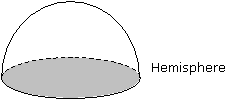
A hemisphere is half a sphere, with one flat circular face and one bowl-shaped face.
Volume of hemisphere 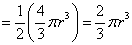 where r is the radius.
Worksheets and More Examples:
Worksheet to calculate the volume of spheres
Worksheets to calculate the surface area of spheres
More examples about the volume of spheres
More examples about the surface area of spheres
How to find the volume of a hemisphere?
Example:
Find the volume of water in a bowl with diameter = 33cm
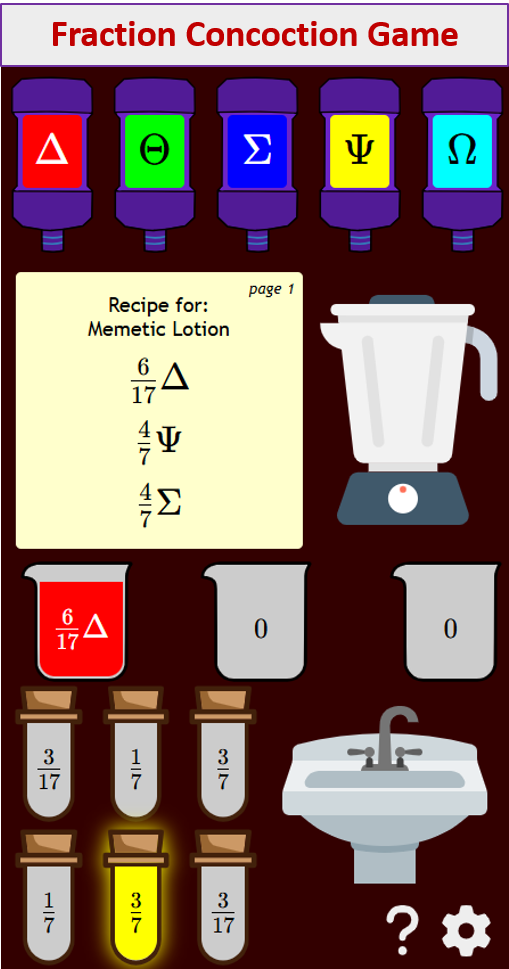
Try out our new and fun Fraction Concoction Game.
Add and subtract fractions to make exciting fraction concoctions following a recipe. There are four levels of difficulty: Easy, medium, hard and insane. Practice the basics of fraction addition and subtraction or challenge yourself with the insane level.
We welcome your feedback, comments and questions about this site or page. Please submit your feedback or enquiries via our Feedback page.