

Animal Facts: Platypus
More Amazing Animal Facts
In this page we will look at the platypus.
If you have any interesting or funny facts about animals or would like to find out more information about a particular animal, please fill up the Feedback form and we will be happy to add it to our list of animal facts.
Are platypuses venomous?
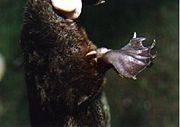
Indeed they are. It is one of the few venomous mammals; the male platypus has a spur on the hind foot that injects venom capable of killing small animals and causing severe pain in humans. Female platypuses do not have this spur.
The platypus is a semi-aquatic mammal that lives in eastern Australia and Tasmania. Although it is a mammal, it lays eggs instead of giving birth to live young.
The picture below shows the venom spur on the platypuses’ leg.
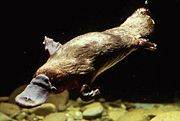
The bizarre appearance of this egg-laying, venomous, duck-billed, beaver-tailed, otter-footed mammal baffled European naturalists when they first saw it, with some considering it an elaborate fraud. The unique features of the Platypus make it an easily recognizable and iconic symbol of Australia; it has appeared as a mascot at national events and is featured on the reverse of the Australian 20 cent coin.
The Platypus is an excellent swimmer and spends much of its time in the water foraging for food. Uniquely among mammals it propels itself when swimming by alternate rowing motion with the front two feet; although all four feet of the Platypus are webbed. The hind feet (which are held against the body) do not assist in propulsion, but are used for steering in combination with the tail.
The Platypus is a carnivore: it feeds on annelid worms and insect larvae, freshwater shrimps, and yabbies (freshwater crayfish) that it digs out of the riverbed with its snout or catches while swimming. It utilizes cheek-pouches to carry prey to the surface where they are eaten. The Platypus needs to eat about 20% of its own weight each day. This requires the Platypus to spend an average of 12 hours each day looking for food.
The platypus is a strange mix of different traits, including a venomous spur used in male to male combat.
The secrets of platypus revealed
| Check out our most popular games! | ||
|---|---|---|
 Fraction Concoction |
 Fact Family Game |
 Number Bond Garden |
 Online Addition Subtraction Game |
 Penguin Solitaire |
 Sawayama Solitaire |
 Ark Solitaire |
 Eldritch Invasion |
 Shenzhen Solitaire |
Check out more Solitaire games here.
We welcome your feedback, comments and questions about this site or page. Please submit your feedback or enquiries via our Feedback page.