Geometry - Nets Of Solids
Related Pages
Nets Of 3D Shapes
3D Nets Animations
More Geometry Lessons
In these lessons, we will learn
- What is meant by the net of a solid?
- Nets of the following solids: cube, rectangular prism or cuboid, triangular prisms, pyramids, cylinders and cones.
- How to use nets to find surface area?
What Is Meant By The Net Of A Solid?
A geometry net is a 2-dimensional shape that can be folded to form a 3-dimensional shape or a solid. Or a geometry net is a pattern made when the surface of a three-dimensional figure is laid out flat showing each face of the figure. A solid may have different nets.
Here are some steps to determine whether a net forms a solid:
- Make sure that the solid and the net have the same number of faces and that the shapes of the faces of the solid match the shapes of the corresponding faces in the net.
- Visualize how the net is to be folded to form the solid and make sure that all the sides fit together properly.
Nets are helpful when we need to find the surface area of the solids.
Nets Of Prisms, Pyramids, Cylinders And Cones
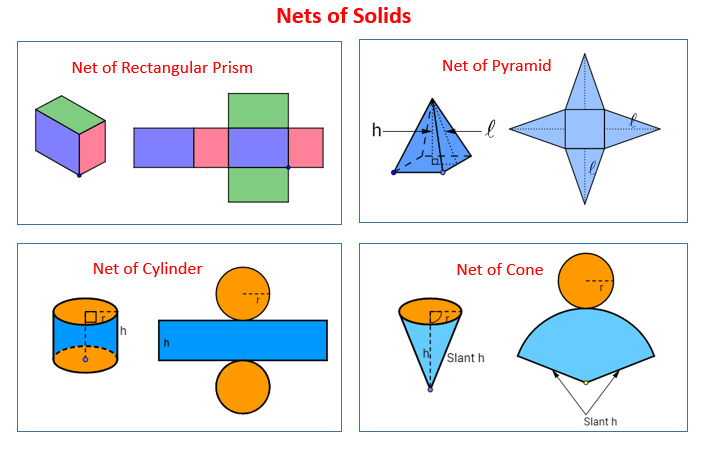
Here are some examples of nets of solids: Prism, Pyramid, Cylinder and Cone. Scroll down the page for more examples and solutions.
-
Nets & Surface Area Worksheets
Printable
Nets of Solid Figures
Find Surface Area using Nets
Surface Area of Rectangular Prisms
Surface Area of Right Prisms
Surface Area of Solids (include composite solids)Online
Surface Area of Cylinder
Surface Area of Sphere
Surface Area of Solids I
Surface Area of Solids II
Surface Area of Solids III
Surface Area of Solids IV
Surface Area of Solids V
Surface Area of Cylinders & Pipes
Surface Area of Cylinders & Spheres
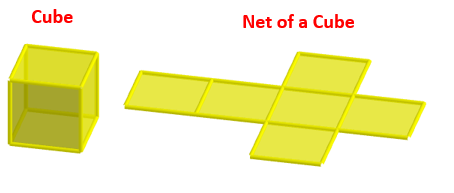
What Is The Net Of A Cube?
A cube is a three-dimensional figure with six equal square faces.
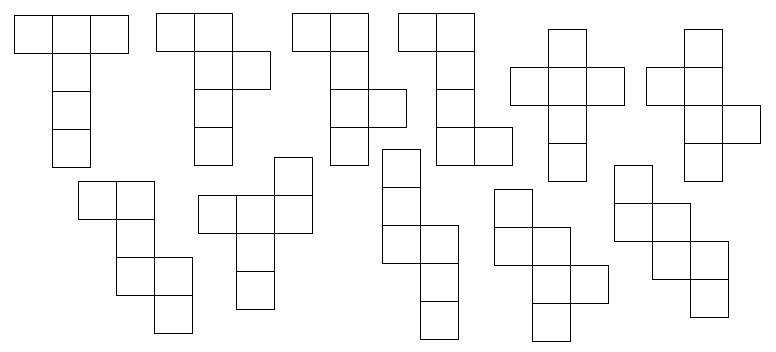
How many nets are there for a cube?
There are altogether 11 possible nets for a cube as shown in the following figures.
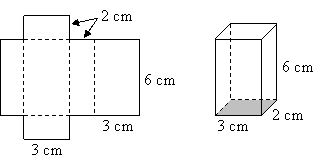
What is the net of a rectangular prism or cuboid?
A rectangular prism or cuboid is formed by folding a net as shown:
Interactive animations for nets of solids
For animations to explore how 3D shapes unfold into nets and how nets fold to form geometric
solids, see: 3D Nets Animations
How to Draw a Net:
- Imagine the 3D shape unfolded.
- Determine all the faces that make up the 3D shape.
- Start by drawing one of the faces, usually the base.
- Draw the other faces connected to the base, making sure they are the correct size and shape.
- Draw the other faces, if any.
- Mentally fold the net to make sure it forms the correct 3D shape.
How to draw a net of a rectangular prism or cuboid?
How to create different nets of a cube and rectangular prism?
Nets of prisms and pyramids.
Learn about faces, edges and vertices.
Analyze the net of a cylinder to determine volume and surface area
The diagram below shows a net for a cylinder.
a. Suppose the net is assembled. Find the volume of the cylinder.
b. Find the surface area of the cylinder.
How to use nets and 3-dimensional figures to find surface area of cubes and prisms?
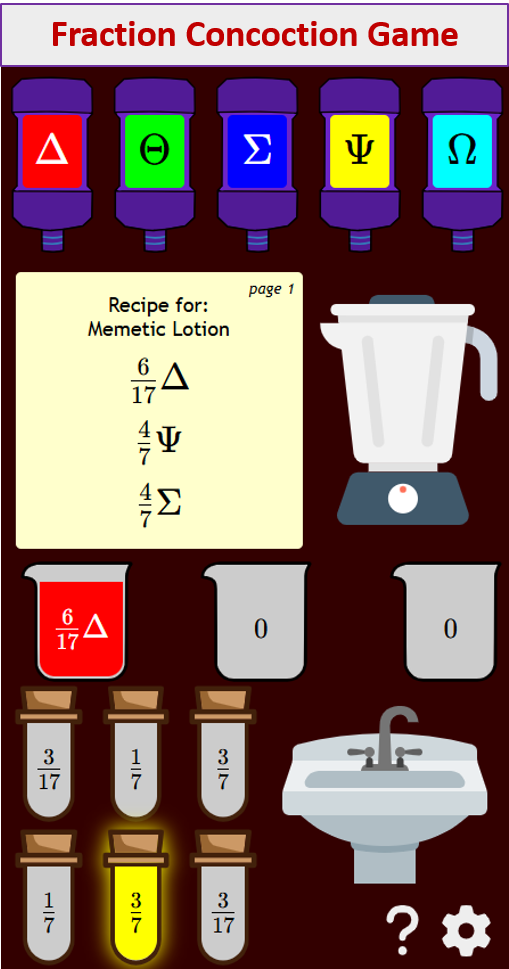
Try out our new and fun Fraction Concoction Game.
Add and subtract fractions to make exciting fraction concoctions following a recipe. There are four levels of difficulty: Easy, medium, hard and insane. Practice the basics of fraction addition and subtraction or challenge yourself with the insane level.
We welcome your feedback, comments and questions about this site or page. Please submit your feedback or enquiries via our Feedback page.