Complex Number Games and Worksheets
Related Pages:
More Math Games
Math Worksheets
Welcome to the Complex Number zone.
Complex Number Games
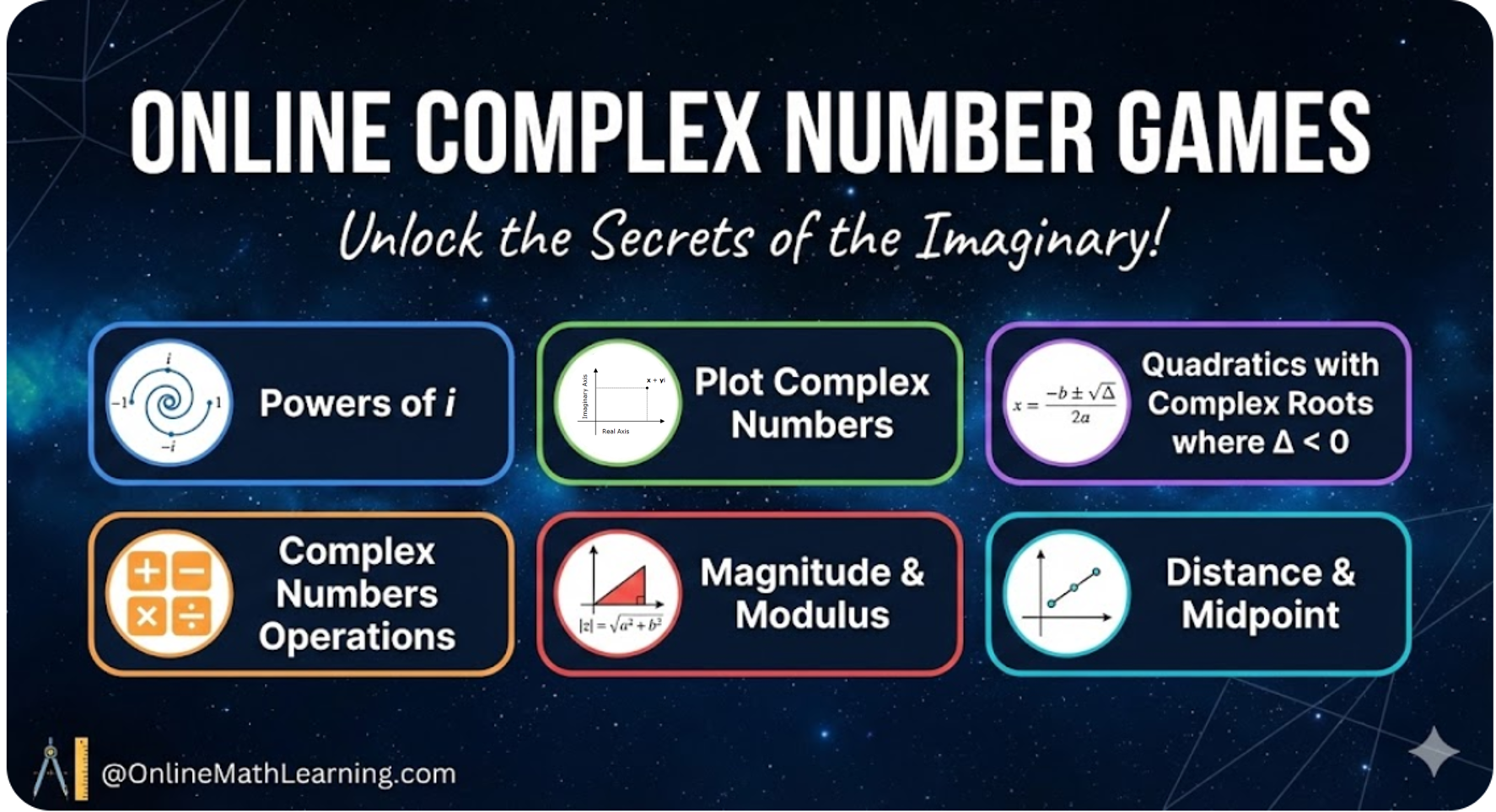
Complex numbers might seem “imaginary,” but they are essential for everything from electrical engineering to quantum physics. These games transform abstract a + bi concepts into interactive challenges, helping students visualize the complex plane and master operations with ease.
| Powers of i Game |
|---|
| The Goal: Simplify in for any integer n. Students learn to navigate the four-step cycle: i1 = i, i2 = -1, i3 = -i, and i4 = 1. |
| Key Concept: Recognizing the cyclic nature of powers of i. |
| Best for: Building the foundational speed needed for higher-level complex multiplication. |
| Play now: Powers of i Game |
| Plot Complex Numbers |
|---|
| The Goal: Correctly place complex numbers on the Argand plane. The game treats the Real part as the x-axis and the Imaginary part as the y-axis. |
| Key Concept: Visualizing a + bi as a coordinate (a, b). |
| Best for: Students transitioning from standard Cartesian coordinates to the complex plane. |
| Play now: Plot Complex Numbers |
| Quadratics with Complex Roots |
|---|
| The Goal: Solve quadratic equations where the discriminant (D = b2 - 4ac) is negative. Players learn to express solutions using i instead of simply saying “no real solution.” |
| Key Concept: Applying the quadratic formula to find conjugate pairs. |
| Best for: Moving beyond the limitations of real number algebra. |
| Play now: Complex Roots Challenge |
| Add & Subtract Complex Numbers |
|---|
| The Goal: Combine like terms by grouping real parts with real parts and imaginary parts with imaginary parts. |
| Key Concept: (a + bi) ± (c + di) = (a ± c) + (b ± d)i. |
| Best for: Reinforcing basic algebraic grouping rules within a new number system. |
| Play now: Add & Subtract Complex Numbers |
| Multiply Complex Numbers |
|---|
| The Goal: Use the FOIL method or distributive property to multiply two complex numbers, remembering to simplify i2 to -1. |
| Key Concept: Mastery of the identity i2 = -1 during expansion. |
| Best for: Preventing the common mistake of leaving i2 in the final answer. |
| Play now: Multiply Complex Numbers |
| Divide Complex Numbers |
|---|
| The Goal: Rationalize the denominator by multiplying the numerator and denominator by the complex conjugate. |
| Key Concept: Utilizing the conjugate (a - bi) to eliminate i from the denominator. |
| Best for: Mastering precision and multi-step algebraic manipulation. |
| Play now: Divide Complex Numbers |
| Magnitude & Modulus |
|---|
| The Goal: Calculate the “absolute value” or distance from the origin for a complex number using the Pythagorean theorem. |
| Key Concept: |
| Best for: Connecting complex numbers to geometry and trigonometry. |
| Play now: Magnitude of Complex Numbers |
| Distance between 2 Complex Numbers |
|---|
| The Goal: Find the distance between two points on the complex plane. |
| Key Concept: Applying the distance formula \(\sqrt{(a_2-a_1)^2 + (b_2-b_1)^2}\). |
| Best for: Understanding the spatial relationships between different complex values. |
| Play now: Distance between 2 Complex Numbers |
| Midpoint between 2 Complex Numbers |
|---|
| The Goal: Find the center point between them on the complex plane. |
| Key Concept: Applying the midpoint formula \(\left(\frac{a_1+a_2}{2} + \frac{b_1+b_2}{2}i\right)\). |
| Best for: Understanding the spatial relationships between different complex values. |
| Play now: Midpoint between 2 Complex Numbers |
More Complex Number Worksheets
Printable
Add & Subtract Complex Numbers
Multiply Complex Number
Rationalize Complex Number
Operations with Complex Numbers
Quadratic Equation with Complex Solutions
Online
Powers of i: Positive Exponents
Powers of i: Negative Exponents
Complex Number Addition
Complex Number Subtraction
Complex Number Multiplication
Complex Number Division
Complex Number: Magnitude (Absolute Value)
Distance Between Two Complex Numbers
Midpoint of Two Complex Numbers
| Check out our most popular games! | ||
|---|---|---|
 Fraction Concoction |
 Fact Family Game |
 Number Bond Garden |
 Online Addition Subtraction Game |
 Penguin Solitaire |
 Sawayama Solitaire |
 Ark Solitaire |
 Eldritch Invasion |
 Shenzhen Solitaire |
Check out more Solitaire games here.
We welcome your feedback, comments and questions about this site or page. Please submit your feedback or enquiries via our Feedback page.