Indices
Related Topics:
More Lessons for GCSE Maths
Math Worksheets
Examples, solutions, and videos to help GCSE Maths students learn about indices.
The rules of indices, also known as rules of exponents, are a set of fundamental algebraic rules that define how to perform operations involving powers (or indices). An index (or exponent) tells you how many times to multiply a base number by itself. For example, in an, a is the base and n is the index/exponent.
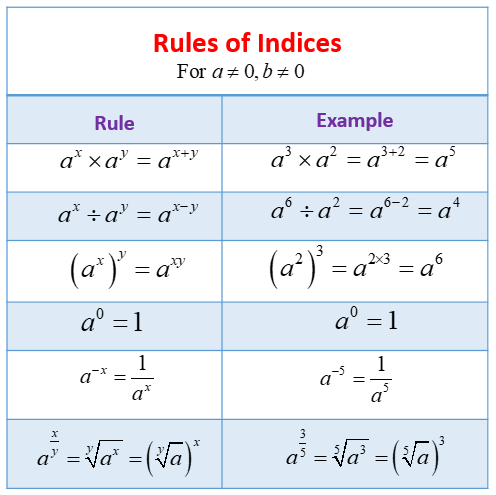
The following diagrams show the rules of indices or laws of indices. Scroll down the page for more examples and solutions on how to use the rules of indices.
Indices Worksheets
Practice your skills with the following worksheets:
Printable & Online Indices Worksheets
| Free Exponent Games Online | ||
|---|---|---|
| Multiply Exponents | Divide Exponents | Power of a Power |
| Power of a Product | Negative Exponents | Fractional Exponents |
-
Product Rule (Multiplication)
When multiplying powers with the same base, you add the exponents.
Rule: am × an = am+n -
Quotient Rule (Division)
When dividing powers with the same base, you subtract the exponents.
Rule: \(\frac{a^{m}}{a^{n}}=a^{m-n}\) (where \(a\neq 0\)) -
Power Rule (Power of a Power)
When raising a power to another exponent, you multiply the exponents.
Rule: \(\left( a^{m} \right)^{n}=a^{mn}\) -
Zero Exponent Rule
Any non-zero number raised to the power of zero is equal to 1.
Rule: a0 = 1 (where a ≠ = 0) -
Negative Exponent Rule
A base raised to a negative exponent is equal to the reciprocal of the base raised to the positive exponent.
Rule: \(a^{-n}=\frac{1}{a^{n}}\) (where \(a\neq 0\)) -
Fractional (Rational) Exponent Rule
A fractional exponent indicates a root. The numerator of the fraction is the power, and the denominator is the root.
Rule: \(a^{\frac{m}{n}}=\left( \sqrt[n]{a} \right)^{m}=\sqrt[n]{a^{m}}\)
GCSE Revision Video - Index Notation
Indices GCSE Maths
revision Higher level worked exam questions (include fractional and negative powers)
Maths : Indices - Introduction
Indices or powers are used to write statements involving repeated multiplication in shorthand.
GCSE Maths - Rules of Indices
(Negative and Fractional Powers) A Star Higher
| Check out our most popular games! | ||
|---|---|---|
 Fraction Concoction |
 Fact Family Game |
 Number Bond Garden |
 Online Addition Subtraction Game |
 Penguin Solitaire |
 Sawayama Solitaire |
 Ark Solitaire |
 Eldritch Invasion |
 Shenzhen Solitaire |
Check out more Solitaire games here.
We welcome your feedback, comments and questions about this site or page. Please submit your feedback or enquiries via our Feedback page.