Cyclic Quadrilaterals - Quadrilaterals Inscribed Within Circles
Related Pages
Circles
Tangents Of Circles
These lessons cover the various angle properties of quadrilaterals which are inscribed within circles.
We will learn what a cyclic quadrilateral is and the related angle properties.
- Opposite angles of a cyclic quadrilateral are supplementary.
- Exterior angle of a cyclic quadrilateral is equal to the interior opposite angle.
We will also prove that the opposite angles of a cyclic quadrilaterals are supplementary.
What Is A Cyclic Quadrilateral?
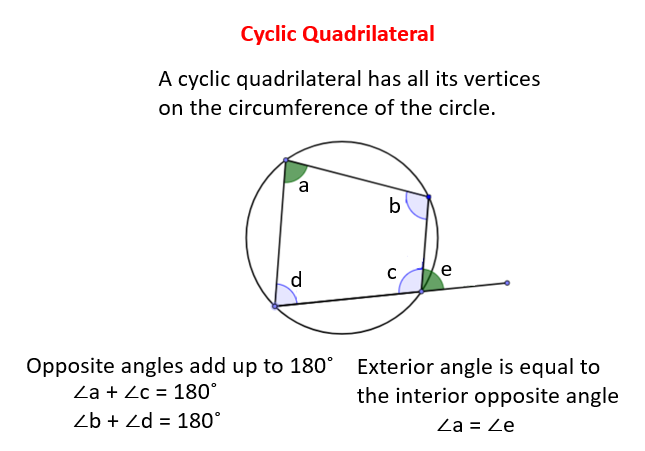
A cyclic quadrilateral is a quadrilateral with its 4 vertices on the circumference of a circle.
The following diagram shows a cyclic quadrilateral and its properties. Scroll down the page for more examples and solutions.
Geometry Worksheets
Practice your skills with the following worksheets:
Printable & Online Geometry Worksheets
Explore Circle Theorems
Explore the theorems interactively by dynamically changing the angles.
Circle Theorems (Interactive)
Cyclic quadrilaterals are also called inscribed quadrilaterals or chordal quadrilaterals.
Properties Of A Cyclic Quadrilateral
Property 1: In a cyclic quadrilateral, the opposite angles are supplementary i.e. they add up to 180˚.
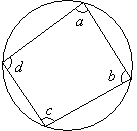
∠a + ∠c = 180˚, ∠b + ∠d = 180˚
Property 2: The exterior angle of a cyclic quadrilateral is equal to the interior opposite angle.
Example:
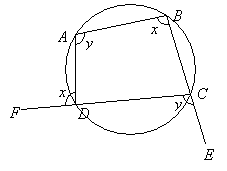
The exterior angle ∠ADF is equal to the corresponding interior angle ∠ABC.
The exterior angle ∠DCE is equal to the corresponding interior angle ∠DAB.
How To Use The Properties Of A Cyclic Quadrilateral To Find Missing Angles?
Example:

AC is a diameter of the circle. Find the value of x.
Solution:
∠ABC = 90˚ (angle of semicircle)
∠ABD + ∠DBC = ∠ABC
∠ABD + 36˚ = 90˚
∠ABD = 54˚
∠ABD + x = 180˚ (interior opposite angles of a cyclic quadrilateral)
x = 180˚ – 54˚ = 126˚
Example:
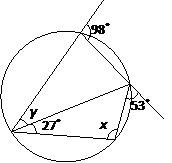
Find the values of x and y in the following figure.
Solution:
x = 98˚ (Corresponding opposite angles of a cyclic quadrilateral )
y + 27˚ = 53˚ (Corresponding opposite angles of a cyclic quadrilateral)
y = 26˚
Using The Properties Of A Cyclic Quadrilateral To Find Missing Angles
A quadrilateral is cyclic when its four vertices lie on a circle.
Opposite angles in a cyclic quadrilateral adds up to 180˚.
How To Find Missing Angles Using The Properties Of A Cyclic Quadrilateral?
Opposite angles in a cyclic quadrilateral adds up to 180˚.
Interior opposite angles are equal to their corresponding exterior angles.
Find the missing angles using central and inscribed angle properties.
Can you find the relationship between the missing angles in each figure?
Circle Theorems - Alternate Segment Theorem And Cyclic Quadrilaterals
Exam Practice Question Example:
ABCD is a cyclic quadrilateral within a circle centre O. XY is the tangent to the circle at A.
Angle XAB = 58°, Angle BAD = 78°, Angle DBC = 34°. Prove that AB is parallel to CD.
Proof That The Opposite Angles Of A Cyclic Quadrilateral Are Supplementary
This video shows how to prove that opposite angles in a cyclic quadrilateral are supplementary.
It is based on the theorem: Angle at the center is twice angle at the circumference.
Circle Geometry: Cyclic Quadrilateral
What is the relationship between the angles of a quadrilateral that is inscribed in a circle?
This video shows how to prove that opposite angles in a cyclic quadrilateral are supplementary.
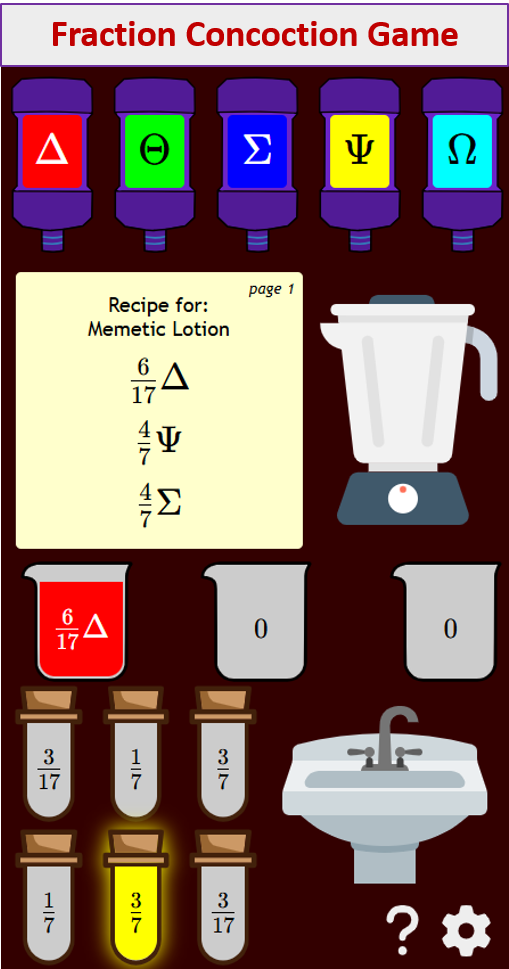
Try out our new and fun Fraction Concoction Game.
Add and subtract fractions to make exciting fraction concoctions following a recipe. There are four levels of difficulty: Easy, medium, hard and insane. Practice the basics of fraction addition and subtraction or challenge yourself with the insane level.
We welcome your feedback, comments and questions about this site or page. Please submit your feedback or enquiries via our Feedback page.