Circle Theorems
Circle theorems are a set of geometric rules that describe the relationships between angles, lines, and segments within a circle. They are fundamental in geometry and are used to solve problems involving circles, especially in finding unknown angles or lengths.
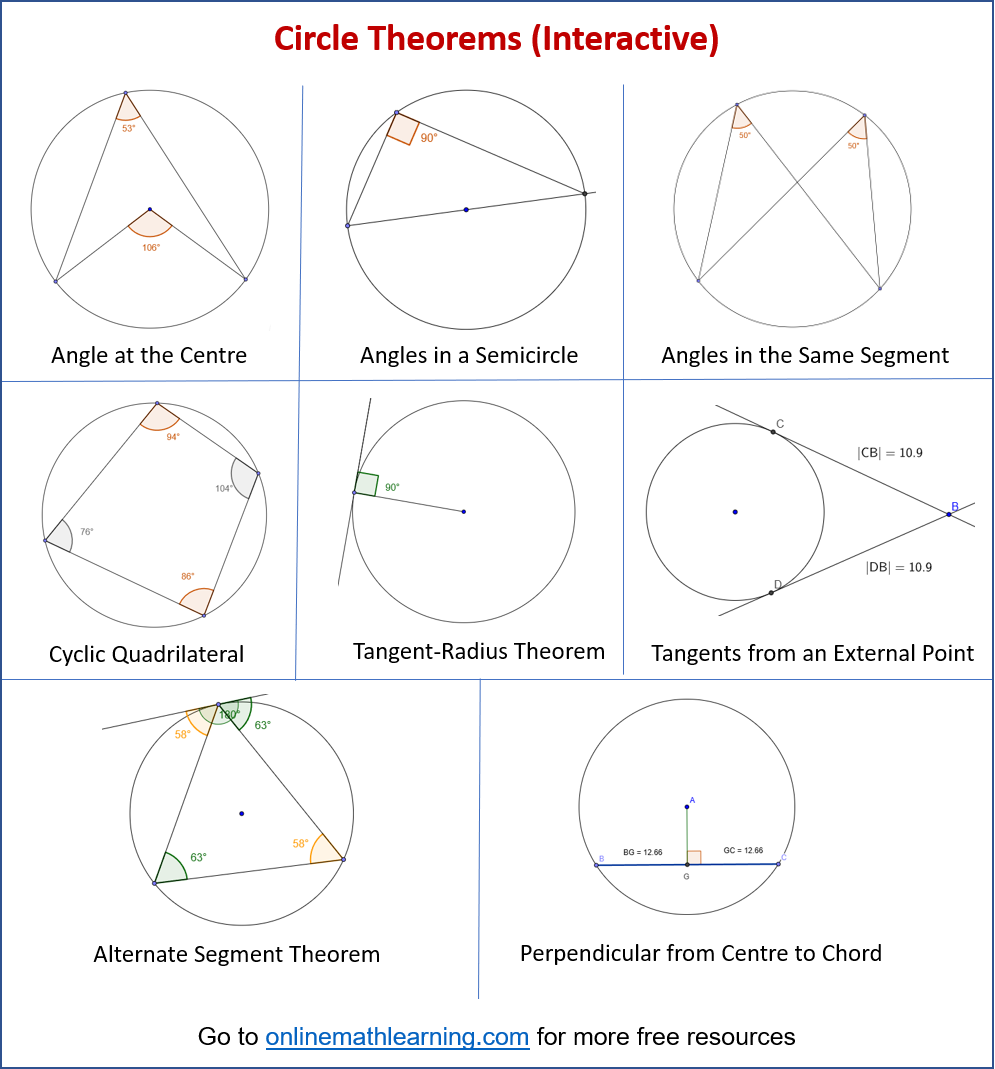
The following diagram gives some examples of circle theorems. Scroll down the page for more examples and explore each circle theorem dynamically.
Geometry Worksheets
Practice your skills with the following Geometry worksheets:
Printable & Online Geometry Worksheets
Here are some of the commonly used circle theorems. Explore the theorems interactively by dynamically changing the angles. Move the points to see how the angles and sides change according to each theorem.
1. Angle at the Centre is Twice the Angle at the Circumference
Theorem: The angle subtended by an arc at the center of a circle is twice the angle subtended by the same arc at any point on the remaining part of the circumference.
2. Angles in a Semicircle
Theorem: The angle inscribed in a semicircle is a right angle (90°).
3. Angles in the Same Segment
Theorem: Angles subtended by the same arc in the same segment of a circle are equal.
4. Opposite Angles in a Cyclic Quadrilateral
Theorem: The opposite angles of a cyclic quadrilateral (a quadrilateral whose all four vertices lie on the circumference of a circle) are supplementary (add up to 180°)
5. Tangent-Radius Theorem
Theorem: The tangent to a circle at any point is perpendicular to the radius at the point of contact.
6. Tangents from an External Point
Theorem: The lengths of two tangents drawn from an external point to a circle are equal.
7. Alternate Segment Theorem
Theorem: The angle between a tangent and a chord through the point of contact is equal to the angle in the alternate segment.
8. Perpendicular from Centre to Chord
Theorem: A perpendicular drawn from the center of a circle to a chord bisects the chord.
In these lessons, we will learn
- inscribed angles
- a circle theorem about inscribed angles which is sometimes called the Bow Theorem. It states that the inscribed angles subtended by the same arc or chord are equal.
Inscribed Angles
We will first look at what is meant by inscribed angle or angle at the circumference.
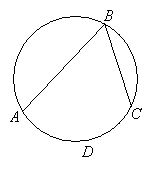
An inscribed angle has its vertex on the circle. ∠ABC, in the diagram below, is called an inscribed angle. The angle is also said to be subtended by (i.e. opposite to) arc ADC or chord AC.
∠ABC is also called an angle at the circumference.
Bow Theorem (also called Angles in the Same Segment)
Now we will look at the Bow Theorem.
The theorem states that:
The inscribed angles subtended by the same arc or chord are equal.
Arcs that contain equal angles are equal.
Angles in the same segment are equal.
The angles at the circumference subtended by the same arc are equal.
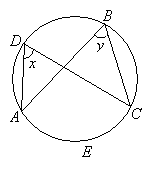
∠x = ∠y because they are subtended by the same arc AEC.
You can see from the above diagram that the inscribed angles form a “bow-tie”. That is why it is sometimes called the bow theorem.
Example:
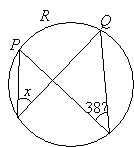
Find the value of ∠x in the figure below.
Solution:
∠x = 38˚ because they are both subtended by the same arc PRQ.
What is the inscribed angle property and how it can be used to find missing angles
(1) Inscribed angles from equal arcs are equal.
(2) Arcs that contain equal angles are equal.
Two useful properties when solving problems that involve inscribed angles
(1) The measure of the inscribed angle is half the measure of the central angle.
(2) Inscribed angles that intercept congruent arcs are congruent.
Inscribed Angles and Quadrilaterals and Arcs
What is the relationship between an inscribed angle and its intercepted arc?
The angle is half the arc (or the arc is twice the angle). Also, if a quadrilateral is inscribed in a circle, opposite angle are supplementary.
How theorems about inscribed angles can be used to solve a problem in high school geometry?
| Check out our most popular games! | ||
|---|---|---|
 Fraction Concoction |
 Fact Family Game |
 Number Bond Garden |
 Online Addition Subtraction Game |
 Penguin Solitaire |
 Sawayama Solitaire |
 Ark Solitaire |
 Eldritch Invasion |
 Shenzhen Solitaire |
Check out more Solitaire games here.
We welcome your feedback, comments and questions about this site or page. Please submit your feedback or enquiries via our Feedback page.