Polygons: Examples
Related Pages
Polygons
Angles Of Polygons
Quadrilaterals
Cyclic Quadrilaterals
More Geometry Lessons
Learning about polygons is a fundamental part of geometry.
In this lesson, we will learn
- what is a polygon Click here
- types of polygons Click here
- simple or complex,
- convex or concave,
- equilateral,
- equiangular,
- regular or irregular
- names of polygons Click here
- worksheets Click here
Polygon
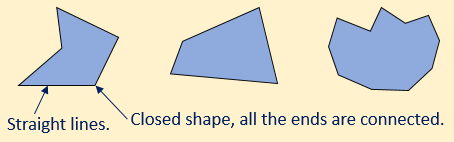
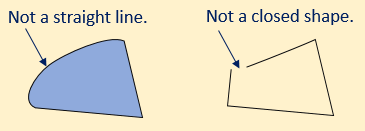
A polygon is a closed shape that has three or more sides. Each side is a line segment. The line segments form the sides of the polygon. The sides meet at vertices (corners) and no curves or gaps are allowed.
The following are examples of polygons:
The following figures are not polygons:
Types of Polygons
Simple Polygons or Complex Polygons
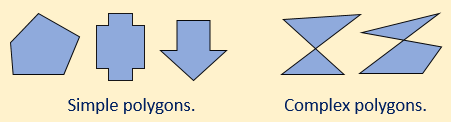
The sides of a simple polygon do not intersect. In a simple polygon, the line segments meet in pairs to form the vertices. Usually the word "simple" is omitted and the word "polygon" is used to mean "simple polygon".
A complex polygon has intersecting sides.
Convex Polygons or Concave Polygons
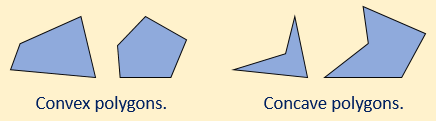
A convex polygon has all angles less than 180°.
A concave polygon has at least one angle greater than 180°. (memory tool: concave has a "cave" in it)
Equilateral Polygon
An equilateral polygon is a polygon which has all sides of the same length. A rhombus is an example of an equilateral polygon.
Equiangular Polygon
An equiangular polygon is a polygon whose interior angles are equal. A rectangle is an example of an equiangular polygon.
Regular Polygons or Irregular Polygons
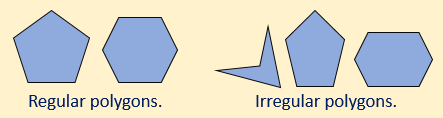
A regular polygon is a polygon with equal sides and equal angles otherwise it is an irregular polygon. A regular polygon is both equilateral and equiangular.
Names of Polygons
Some polygons have special names, depending on the number of sides they have.
The following table gives the names and properties of polygons with different number of sides. Scroll
down the page for more examples and solutions.
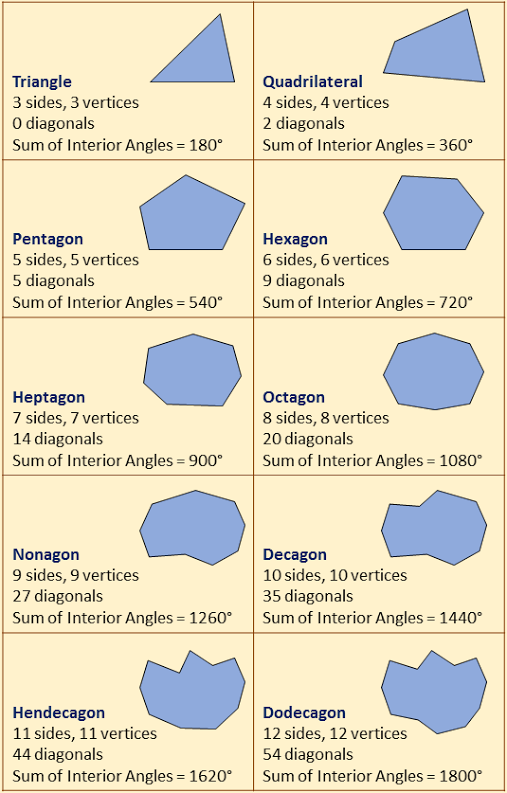
For polygons with more sides, it is easier and quite common to use a number to indicate the number of sides. For eg. 15-gon or 23-gon.
Worksheets
Practice your skills with the following geometry worksheets:
Printable & Online Geometry Worksheets
Practice the names of polygons with the following worksheets:
Number of Sides In Polygons - Give the
number of sides.
Names of Polygons - Give
the names of polygons.
How to define a polygon?
How to distinguish between concave and convex polygons?
How to name polygons?
What is the difference between a regular and irregular polygons?
The following video explains what are polygons, defines regular and irregular polygons and their features.
Interior Angles in Convex Polygons
The following video will show you the different types of polygons based on their sides and angles measures.
Examples of classifying polygons
Convex Hexagon, Concave Octagon, Convex Equilateral Nonagon.
Summary:
- Polygons are closed, 2D shapes made of straight sides.
- They are classified by the number of sides they have.
- Regular polygons have equal sides and equal angles.
- Convex polygons have all interior angles less than 180 degrees, while concave polygons have at least one angle greater than 180 degrees.
- There are formulas to calculate the sum of interior angles and the measure of individual angles in regular polygons.
| Check out our most popular games! | ||
|---|---|---|
 Fraction Concoction |
 Fact Family Game |
 Number Bond Garden |
 Online Addition Subtraction Game |
 Penguin Solitaire |
 Sawayama Solitaire |
 Ark Solitaire |
 Eldritch Invasion |
 Shenzhen Solitaire |
Check out more Solitaire games here.
We welcome your feedback, comments and questions about this site or page. Please submit your feedback or enquiries via our Feedback page.