Lessons & Resources On Matrices
Need help on matrices?
What are matrices?
These lessons on matrices include: what are matrices, operations on matrices, determinants and
inverses of matrices, using matrices to solve systems of equations, Gauss-Jordan Method,
Row Reducing Method, Matrix Row Transformation, Cramer’s Rule and using determinants to find the area of shapes.
Matrix Introduction
What is a Matrix?
A matrix is simply a rectangular arrangement of numbers (or other mathematical objects like symbols or expressions) organized into rows and columns. Think of it like a table of numbers.
Rows: The horizontal lines of numbers. Columns: The vertical lines of numbers.
Why are Matrices Important?
Matrices (singular: matrix, plural: matrices) have many uses in real life. They are used in many areas of math, science, and computer science, including:
Solving systems of equations: Matrices provide a compact way to represent and solve multiple equations at once. Computer graphics: Matrices are used to transform objects in 3D space (rotation, scaling, translation). Physics: Matrices are used to represent physical quantities and transformations. Data analysis and machine learning: Matrices are used to store and manipulate large datasets.
One application would be to use matrices to represent a large amount of data in a concise manner so that we can process the data in various ways more conveniently. For example, the sales of different types of pre-packed food from 3 stalls during a given period of time could be shown in the form of a table here:
| Stall A | Stall B | Stall C | |
| Packs of noodles sold | 36 | 21 | 43 |
| Packs of rice sold | 27 | 56 | 35 |
This table can be represented as a matrix:

This matrix could then be added with another that represents the sales for a different period of time to get the total for the two periods of time, etc.
Introductory Lessons Focusing Mostly On 2×2 Matrices
More Lessons On Matrices
(include introductory as well as more advanced materials.)
- Add & Subtract Matrices
- Multiply Matrices
- Determinant of a Matrix
- Inverse of a Matrix
- Solve Systems of Equation using Matrix Inverse
- Solve Systems of Equation using Row Transformations
- Solve Systems of Equation using Cramer's Rule
- Find Area using Determinants
Matrices Calculator with step-by-step solutions
Introduction to Matrices, Complex Numbers,
Matrices, Systems of Linear Equations,
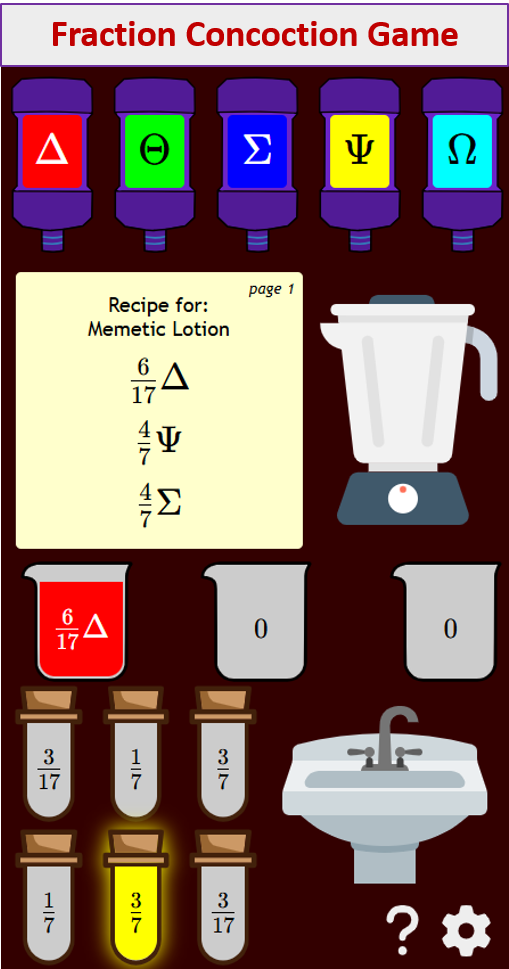
Try out our new and fun Fraction Concoction Game.
Add and subtract fractions to make exciting fraction concoctions following a recipe. There are four levels of difficulty: Easy, medium, hard and insane. Practice the basics of fraction addition and subtraction or challenge yourself with the insane level.
We welcome your feedback, comments and questions about this site or page. Please submit your feedback or enquiries via our Feedback page.