Slicing Solids Worksheets
Related Topics:
More Math Worksheets
More Printable Math Worksheets
7th Grade Math
Examples, solutions, videos, and worksheets to help grade 7 students describe rectangular regions that result from slicing a right rectangular prism by a plane perpendicular to one of the faces and describe polygonal regions that result from slicing a right rectangular pyramid by a plane perpendicular to the base and by another plane parallel to the base.
Printable “Solid Shapes” Worksheets:
Nets of Solid Figures
Find Surface Area using Nets
Volume of Rectangular Prisms
Volume of Composite Rectangular Prisms
Slicing Solids
Slicing Solids
Slicing Rectangular Prism
A rectangular prism is a three-dimensional solid with six faces, where each face is a rectangle. The faces are paired, with opposite faces being congruent. A rectangular prism has three dimensions: length (l), width (w), and height (h).
Slicing a rectangular prism refers to cutting the prism along a plane, resulting in a cross-section. The shape of the cross-section depends on the orientation and position of the slice relative to the prism.
Types of Slices in a Rectangular Prism
Horizontal Slice (Parallel to the Base):
The cross-section will be a rectangle that has the same length and width as the base of the prism.
Vertical Slice (Perpendicular to the Base):
If you slice the prism vertically along a plane parallel to one of the sides, the cross-section will be a rectangle.
Slicing Square-based Pyramid
A square-based pyramid is a three-dimensional solid with a square base and four triangular faces that converge at a single point called the apex. The apex is directly above the center of the square base.
Slicing a square-based pyramid refers to cutting the pyramid along a plane, which results in a cross-section. The shape of the cross-section depends on the orientation and position of the slice relative to the pyramid.
Types of Slices in a Square-Based Pyramid
Horizontal Slice (Parallel to the Base):
The cross-section will be a smaller square. The size of this square depends on the height at which the slice is made. The closer the slice is to the base, the larger the square; the closer the slice is to the apex, the smaller the square.
Vertical Slice (Through the Apex):
If the slice passes through the apex and is vertical (perpendicular to the base), the cross-section will be an isosceles triangle. The base of this triangle will be a side of the square base, and the two other sides will correspond to two of the triangular faces of the pyramid.
Vertical Slice (Not Through the Apex):
If the slice is vertical but does not pass through the apex, the cross-section can be a trapezoid. The trapezoid is formed because the slice cuts through two of the triangular faces, creating two parallel sides of different lengths.
Have a look at this video if you need to review how to slice solids.
Click on the following worksheet to get a printable pdf document.
Scroll down the page for more Slicing Solids Worksheets.
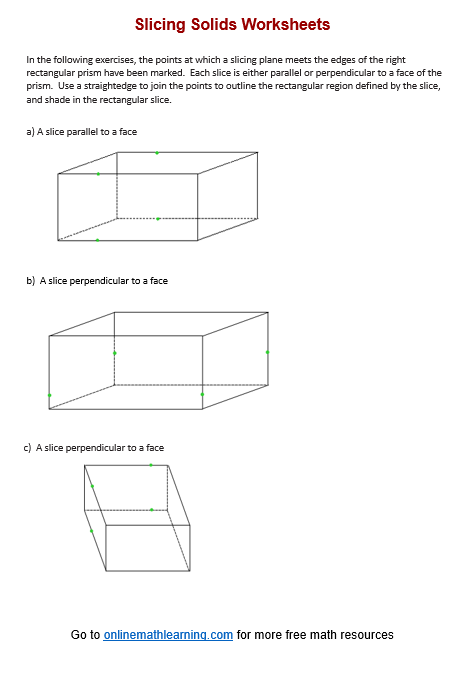
More Slicing Solids Worksheets
Printable
(Answers on the second page.)
Slicing Solids Worksheet #1 (rectangular prisms)
Slicing Solids Worksheet #2 (rectangular prisms)
Slicing Solids Worksheet #3 (square-based pyramids)
Related Lessons & Worksheets
Slicing a Rectangular Prism
Slicing a Pyramid
| Check out our most popular games! | ||
|---|---|---|
 Fraction Concoction |
 Fact Family Game |
 Number Bond Garden |
 Online Addition Subtraction Game |
 Penguin Solitaire |
 Sawayama Solitaire |
 Ark Solitaire |
 Eldritch Invasion |
 Shenzhen Solitaire |
Check out more Solitaire games here.
We welcome your feedback, comments and questions about this site or page. Please submit your feedback or enquiries via our Feedback page.