Multiplication (Partial Sums)
Related Pages
Math Games
Multiplication Games
Multiplication Worksheets
This Multiplication (Partial Sums) is a great way to put your multiplication skills to the test in a fun environment. By practicing, you’ll start to recognize the answers instantly.
Multiplication (Partial Sums)
Multiplication using partial sums (also known as partial products) is a method where you break down each number into its place values, multiply the parts separately, and then add up the results. This method helps visualize the multiplication process and is often used as a stepping stone to the standard multiplication algorithm.
The best way to get good at multiplication is to do it often. This Multiplication (Partial Sums) is an interactive and engaging web-based application designed to help users practice and improve their multiply by multiple of tens skills through mental math.
Once you have mastered the all the multiplication times tables using the Multiplication Tables Game then proceed to this game which requires you to multiply tens and hundreds. You can use a simple shortcut to multiply by tens and hundreds: multiply the non-zero parts of the numbers, then add the zeros from the original numbers to the result. For example, to multiply 30 by 50, multiply 3 by 5 (which is 15), then add the two zeros from 30 and 50, resulting in 1500. Scroll down the page if you need a more detailed explanation.
The Game has an option for a 60-second timer, encouraging players to solve the multiplication problems quickly and efficiently.
2-Digit x 2-Digit Multiplication
Partial Products
Score: 0 / 0
How to Play the Multiplication (Partial Sums)
The game is designed to help you practice your Multiply Tens & Hundreds skills in a fun environment.
Here’s how to play:
- Timed Option: Check the timer if you want enable the 60 second timer. Click “Start Game”.
- Look at the Problem: You’ll see two numbers at the top of the purple box. Your goal is to multiply them.
- Enter Your Answer: Type your answer into the box with the question mark ?.
- Check Your Work: Click the yellow Check button (or press the Enter key). The game will tell you if you’re correct. If you are wrong, you will be shown the correct answer.
- Get a New Problem: Click the blue Next button (or press Enter again) for a new multiplication problem.
Your score is tracked at the top, showing how many you’ve gotten right out of the total you’ve tried. - Back to Menu Click “Back to Menu” to restart the game.
Here’s how it works:
Break down the numbers: Express each number in expanded form, showing the value of each digit based on its place value (e.g., 36 becomes 30 + 6).
Multiply the parts: Multiply each part of the first number by each part of the second number. These individual products are the “partial sums” or “partial products.”
Add the partial products: Add all the individual products together to get the final answer.
Example:
Let’s multiply 36 x 24 using partial sums:
Break down: 36 = 30 + 6 and 24 = 20 + 4
Multiply:
30 x 20 = 600
30 x 4 = 120
6 x 20 = 120
6 x 4 = 24
Add: 600 + 120 + 120 + 24 = 864
Therefore, 36 x 24 = 864.
Strategies to Multiply Tens and Hundreds
To multiply by tens and hundreds, you can use a simple shortcut:
- Multiply the non-zero digits:
Identify the non-zero digits in the numbers you are multiplying. For example, in 30 x 50, the non-zero digits are 3 and 5. Multiply these together (3 x 5 = 15). - Count the zeros:
Count the total number of zeros in the original numbers. In the example, 30 has one zero, and 50 has one zero, for a total of two zeros. - Add the zeros to the result:
Attach the counted zeros to the product of the non-zero digits. In our example, 15 with two zeros becomes 1500.
The video gives a clear, step-by-step approach to walk through the process of multiplying by tens, hundreds, and thousands.
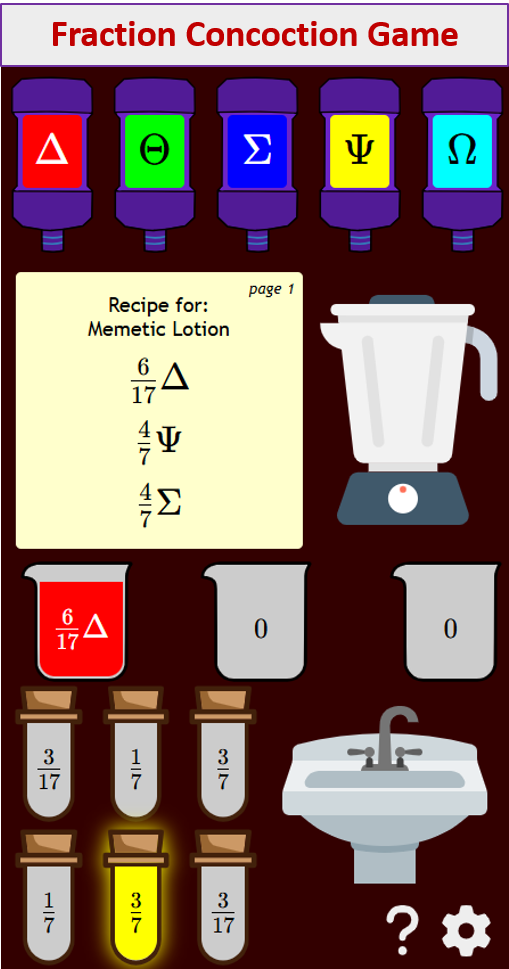
Try out our new and fun Fraction Concoction Game.
Add and subtract fractions to make exciting fraction concoctions following a recipe. There are four levels of difficulty: Easy, medium, hard and insane. Practice the basics of fraction addition and subtraction or challenge yourself with the insane level.
We welcome your feedback, comments and questions about this site or page. Please submit your feedback or enquiries via our Feedback page.