Sample Space In Probability
Related Pages
More Lessons On Probability
Probability Tree Diagrams
Dependent Events
In these lessons, we will learn simple probability, experiments, outcomes, sample space and probability of an event.
Sample Space
In the study of probability, an experiment is a process or investigation from which results are observed or recorded.
An outcome is a possible result of an experiment.
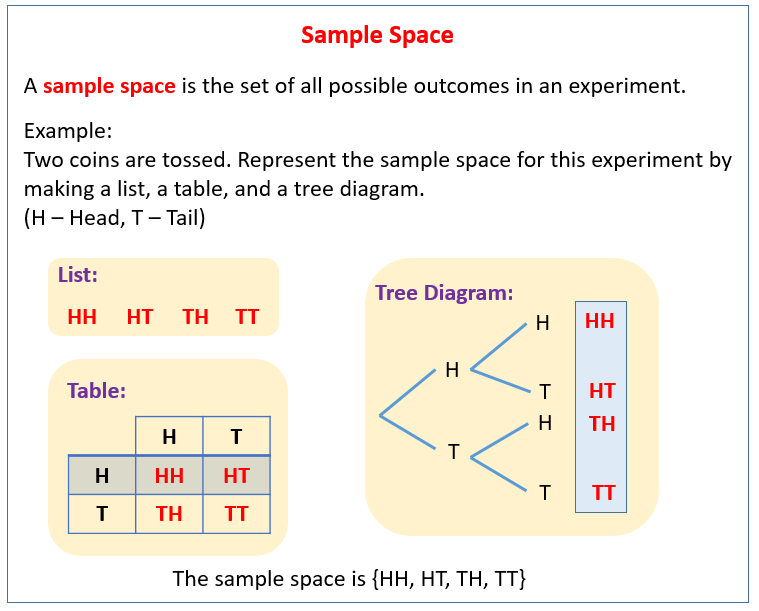
A sample space is the set of all possible outcomes in the experiment. It is usually denoted by the letter S. Sample space can be written using the set notation, { }.
The following diagram shows how the sample space for an experiment can be represented by a list, a table, and a tree diagram. Scroll down the page for examples and solutions.
Probability Worksheets
Practice your skills with the following probability worksheets.
Printable & Online Probability Worksheets
How to Determine a Sample Space:
To determine the sample space, you need to systematically list every single possible result of your experiment.
Here are common methods:
- Listing Outcomes: For simple experiments, just list all possibilities.
- Tree Diagrams: For experiments with multiple stages, a tree diagram can help visualize and list all combined outcomes.
- Tables/Grids: For experiments with two main events (like rolling two dice), a table or grid can help organize all pairs of outcomes.
- Counting Principles: For more complex scenarios, the Fundamental Counting Principle or combinations/permutations formulas can help determine the number of outcomes, even if you don’t list them all.
Experiment 1: Tossing a coin
Possible outcomes are head or tail.
Sample space, S = {head, tail}
Experiment 2: Tossing a die
Possible outcomes are the numbers 1, 2, 3, 4, 5, and 6
Sample space, S = {1, 2, 3, 4, 5, 6}
Experiment 3: Picking a card
In an experiment, a card is picked from a stack of six cards, which spell the word
PASCAL.
Possible outcomes are P, A 1, S, C, A 2 and L.
Sample space, S = {P, A 1, S, C, A 2 L}.
There are 2 cards with the letter ‘A’
Experiment 4: Picking 2 marbles, one at a time,
from a bag that contains many blue and red marbles.
Possible outcomes are: (Blue, Blue), (Blue, Red), (Red, Blue) and (Red, Red).
Sample space, S = {(B,B), (B,R), (R,B), (R,R)}.
A simple explanation of Sample Spaces for Probability
Sample Space Of An Event
Sample space is all the possible outcomes of an event. Sometimes the sample space is easy to determine. For example, if you roll a dice, 6 things could happen. You could roll a 1, 2, 3, 4, 5, or 6.
Sometimes sample space is more difficult to determine, so you can make a tree diagram or a list to help you figure out all the possible outcomes.
Example 1:
You are ordering pizza. You can choose a small, medium or large pizza and you can choose cheese
or pepperoni. What are the possible ways that you could could order a pizza? How many combinations
could you have?
Example 2:
Daisy has 3 pairs of shorts, 2 pairs of shoes and 5 t-shirts. How many outfits can she make?
This lesson is on finding simple probabilities and sample spaces.
Example:
When you roll a die,
- what is the sample space?
- P(5)
- P(Even)
- P(Prime)
- P(7)
Example:
Use the spinner below to answer the following questions:
- What is the sample space?
- P(Blue)
- P(Orange or Green)
- P(Not Red)
- P(Purple)
The following video explains simple probability, experiments, outcomes, sample space and probability of an event. It also gives an example of a simple probability problem.
Example:
A jar contains five balls that are numbered 1 to 5. Also, two of the balls are yellow and the others
are red. They are numbered and colored as shown below.
- Find the probability of randomly selecting a red ball.
- Find the probability of randomly selecting an even number ball.
Lists and Sample Spaces - Probability
Example:
Entrees - Ribs, Chicken
Sides - Mac and Cheese, Veggies, Mashed Potatoes
Drinks - Water, Coffee, Milk
What are the different possibilities for the menu?
Explains three methods for listing the sample space of an event and introduces conditional probability: List, Table, Tree Diagram.
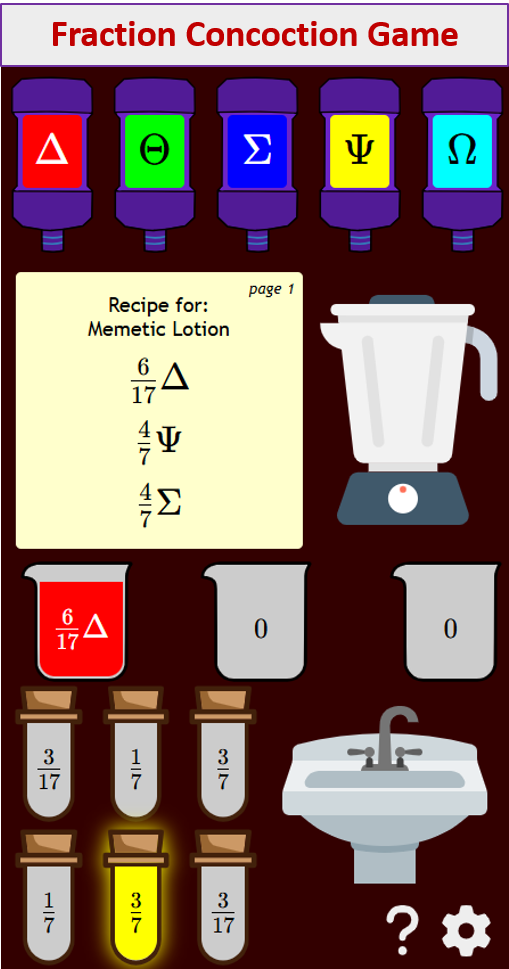
Try out our new and fun Fraction Concoction Game.
Add and subtract fractions to make exciting fraction concoctions following a recipe. There are four levels of difficulty: Easy, medium, hard and insane. Practice the basics of fraction addition and subtraction or challenge yourself with the insane level.
We welcome your feedback, comments and questions about this site or page. Please submit your feedback or enquiries via our Feedback page.