Magnitude of a Vector
Related Pages
Vectors
Equal Vectors
Vector Multiplication
Vector Geometry
In these lessons, we will learn how to find the magnitude of 2-dimensional vectors and 3-dimensional vectors.
Magnitude of a Vector
The magnitude of a vector (or modulus of a vector) is a scalar quantity that represents its length or size. It tells you “how much” of a quantity the vector represents, without regard to its direction.
Think of a vector as an arrow pointing from a starting point to an ending point. The magnitude is the length of that arrow
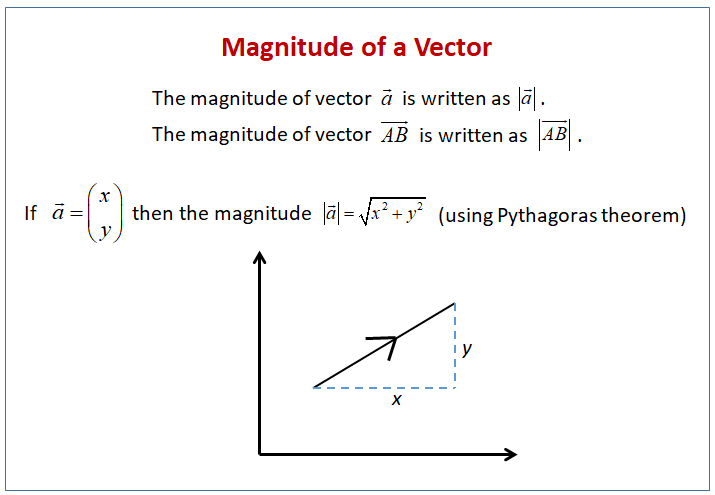
The following diagram shows how to find the magnitude of a 2-D vector. Scroll down the page for more examples and solutions to calculate the magnitudes of 2-D and 3-D vectors.
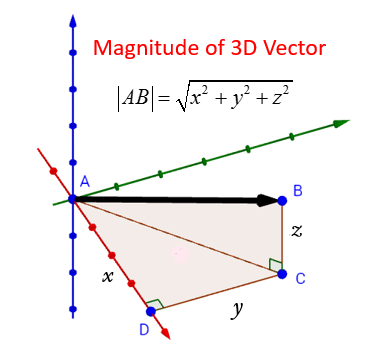
The following diagram shows how to find the magnitude of a 3-D Vector.
How to Calculate the Magnitude of a Vector
The formula for the magnitude of a vector is derived from the Pythagorean theorem, as a vector’s components can be thought of as the legs of a right triangle, and the magnitude is its hypotenuse.
-
In Two Dimensions (2D)
If a vector v has components (x,y), its magnitude is calculated as:
\(\left| v \right|=\sqrt{x^{2}+y^{2}}\)
Example: Find the magnitude of vector \textbf{v}=\left( 3,4 \right)
\(\left| v \right|=\sqrt{3^{2}+4^{2}}=5\) -
In Three Dimensions (3D)
If a vector v has components (x,y,z), its magnitude is calculated as:
\(\left| v \right|=\sqrt{x^{2}+y^{2}}+z^{2}\)
Example: Find the magnitude of vector \(\textbf{w}=\left( 2,-3,6 \right)\)
\(\left| w \right|=\sqrt{2^{2}+(-3)^{2}+6^{2}}=7\)
Example (2D vector):
Express each of the following vectors as a column vector and find its magnitude.
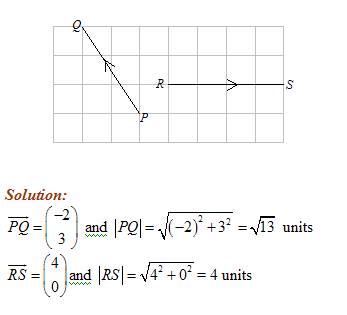
Key characteristics of magnitude:
- It is always a non-negative value (either positive or zero). A magnitude of zero means the vector is a “zero vector” (a point).
- It is a scalar quantity, meaning it has no direction.
- It is often denoted by double vertical bars around the vector symbol, like ||v|| or single vertical bars, |v|.
Videos
Vectors in 2D
Adding vectors geometrically, scalar multiplication, how to find the magnitude and direction angle of a vector.
A vector with initial point at the origin and terminal point at (a, b) is written <a, b>.
Geometrically, a vector is a directed line segment, while algebraically it is an ordered pair.
Example:
Find the magnitude and the direction angle for u = <-3, 4>
Vectors: magnitude of a vector in 2D.
Example:
Find the magnitude of the following vectors:
a = 4i - 3j
b = -2i + 5j
Vectors in 3D
A vector can also be 3-dimensional.
The following video gives the formula, and some examples of finding the magnitude,
or length, of a 3-dimensional vector.
Example:
Find the magnitude:
a = <3, 1, -2>
b = 5i -j + 2k
Vectors : Magnitude of a vector 3D.
Examples:
- Find the magnitude of a = 4i + 3j + 2k
- If A(3, -5, 6) and B(4, 1, 3) find the length AB.
| Check out our most popular games! | ||
|---|---|---|
 Fraction Concoction |
 Fact Family Game |
 Number Bond Garden |
 Online Addition Subtraction Game |
 Penguin Solitaire |
 Sawayama Solitaire |
 Ark Solitaire |
 Eldritch Invasion |
 Shenzhen Solitaire |
Check out more Solitaire games here.
We welcome your feedback, comments and questions about this site or page. Please submit your feedback or enquiries via our Feedback page.