

Multiply a Vector by a Scalar
A scalar quantity has a magnitude but no direction.
In vectors, a fixed numeric value is called a scalar.
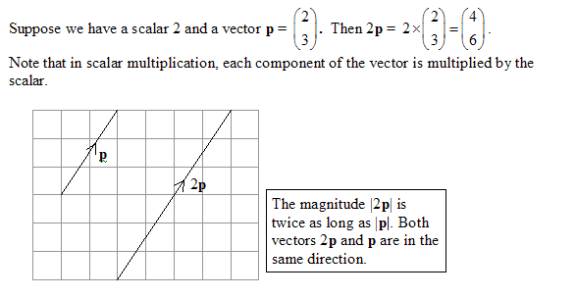
A vector can be multiplied by a scalar.
When a vector x is multiplied by 3, the result is 3x.
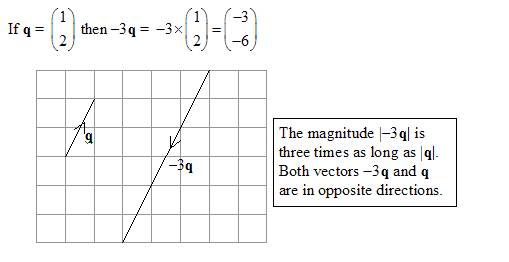
When a vector x is multiplied by –2, the result is –2x.
In the above examples, 3 and –2 are scalars.
Multiplying a Vector by a Scalar
How to multiply a vector by a scalar including some algebraic properties of scalar multiplication.
Discuss the concept of a linear combination of vectors and shows an example of drawing a geometric sum/difference of 3 vectors.
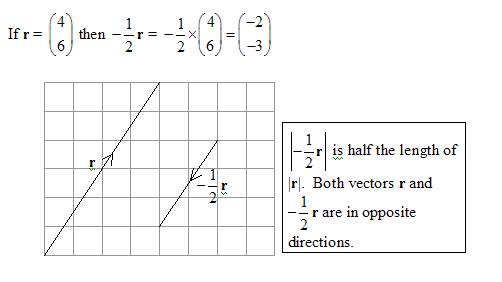
Multiplying a vector by a scalar (real number) means taking a multiple of a vector.
Two vectors are said to be collinear when they are drawn tail to tail and they lie on the same line.
If a and b are two non-collinear vectors in the plane, then any other vector can be written as a linear combination of a and b.
Properties of Scalar Multiplication
Let v be any vector and k be a scalar. Then kv is a vector and kv is |k| times as long as v.
• If k > 0, kv has the same direction as v.
• If k < 0, kv has the opposite direction as v.
• If k = 0, kv is the zero vector.
Examples:
1. Given the vector 75 km/h [N 50° E] draw twice this vector.
2. OF = 3b and OE = 2a, write each of the following in terms of a and b.
a) EF
b) OG
How to show geometrically what multiplication of a vector by a scalar is?
Understanding multiplying vectors by scalars
Examples:
w = (1,2)
Find 3w
Find -2w
| Check out our most popular games! | ||
|---|---|---|
 Fraction Concoction |
 Fact Family Game |
 Number Bond Garden |
 Online Addition Subtraction Game |
 Penguin Solitaire |
 Sawayama Solitaire |
 Ark Solitaire |
 Eldritch Invasion |
 Shenzhen Solitaire |
Check out more Solitaire games here.
We welcome your feedback, comments and questions about this site or page. Please submit your feedback or enquiries via our Feedback page.