Transformed Trig Graph Game
Related Pages
Printable Math Worksheets
Online Math Quizzes
Math Games
Math Worksheets
We can visualize trigonometry by looking at the transformed graphs for the Sine and Cosine waves. This game is a step-up in difficulty from the Basic Trig Graph Game for Sine, Cosine, Tangent, Cotangent, Secant, and Cosecant.
Transformed Trig Graph Quiz/Game
This game, “Transformed Trig Graphs,” is a training tool designed to help you master the functional transformations of Sine and Cosine waves. Instead of just identifying the basic function, you have to decode how the wave that has been stretched, moved, and shifted. Scroll down the page for a more detailed explanation.
Analyze the Wave:
How to Play
- Select Game Mode & Level:
Graph to Equation: Analyze a plotted trigonometric graph and select the matching equation.
Equation Breakdown: Deconstruct a given equation into its specific transformations (stretches, reflections, phase shifts, and vertical shifts).
Mixed Challenge: Test your skill across both graph identification and transformation breakdown.
Level 1–3: Adjust complexity from simple amplitude and period changes to full multi-parameter transformations. - Analyze the Function:
Identify key parameters using y = A · f(B(x - C)) + D.
Look at amplitude (|A|), vertical reflection (A < 0), period factor (B), phase shift (C), and vertical shift/midline (D). - Submit Your Answer:
Choose the correct multiple-choice equation or select parameters from the drop-down menus, then click Check Answer. - Review Step-by-Step Feedback:
Read the instant explanation to verify your mathematical reasoning or identify missed parameters.
Explore Our Learning Zones
Select a destination below to jump directly to our interactive math games, printable activity sheets, or self-grading online worksheets.
| Learning Destination | What You'll Find Inside | Best For |
|---|---|---|
| Math Games: By Topics By Grades |
Gamified math challenges, speed drills, live score tracking, and instant feedback. | Independent tablet/computer time, fun review, and smartboard group warm-ups. |
| Printable Worksheets | Clean, ready-to-print problem sets, step-by-step guides, and visual math charts. | Offline homework, written practice, tests, and physical classroom centers. |
| Online Worksheets | Digital, fill-in-the-blank practice sheets with auto-grading and step-by-step hints. | Paperless assignments, remote learning, and quick self-assessments. |
Transformation of Trig Graphs
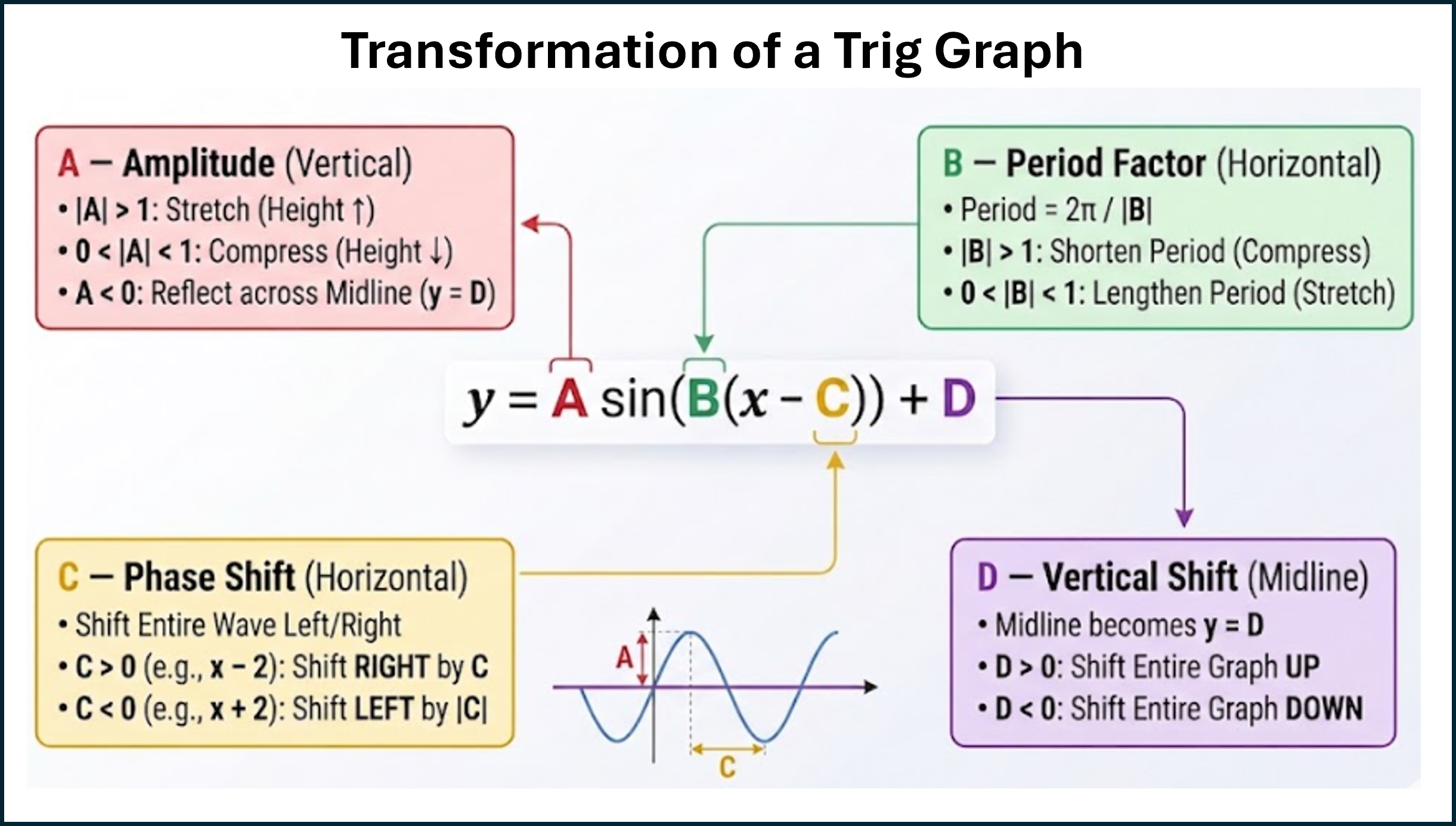
Transforming trigonometric graphs is like using a set of remote controls to stretch, squish, and move a wave. The standard “parent” functions, y = sin(x) and y = cos(x), are manipulated using the general formula:
y = A · f(B(x - C)) + D
Each letter represents a specific physical change to the wave.
Amplitude (A): The Height
The coefficient A controls the vertical stretch or compression. It measures the distance from the center “midline” to the peak (or trough).
If |A| > 1: The graph stretches vertically (becomes taller).
If 0 < |A| < 1: The graph shrinks vertically (becomes flatter).
Negative A: If A is negative, the entire graph is reflected over the horizontal axis (it flips upside down).
Period (B): The Width
The value B affects the horizontal stretch or compression. It tells you how many cycles happen within the standard 2π space.
Formula for Period: \(P = \frac{2\pi}{B}\)
If B > 1: The graph is horizontally compressed (the wave repeats more frequently).
If 0 < B < 1: The graph is horizontally stretched (the wave slows down).
Phase Shift (C): Horizontal Movement
The value C moves the graph left or right. This is often the trickiest part because the sign in the parentheses is “counter-intuitive."
(x - C): The graph shifts to the right.
(x + C): The graph shifts to the left.
Note: If there is a B value, you must factor it out (e.g., sin(2x - π) becomes sin(2(x - π/2))) to find the true phase shift.
Vertical Shift (D): The Midline
The constant D at the end of the equation moves the entire graph up or down.
It defines the new midline (the equilibrium point the wave oscillates around).
- D: Moves the graph up.
- D: Moves the graph down.
Example Strategy
Imagine the graph shows a wave that:
Is centered at y = 1 (Vertical Shift is +1).
Goes up to y=3 and down to y=-1 (Distance from center is 2, so Amplitude is 2).
Starts at its peak on the y-axis (It’s a cos function).
You would look for the button that says:
y = 2cos(x) + 1
Have a look at this lesson on Transformation of Trig Function Graphs
Graphing Trig Functions
| Check out our most popular games! | ||
|---|---|---|
 Fraction Concoction |
 Fact Family Game |
 Number Bond Garden |
 Online Addition Subtraction Game |
 Penguin Solitaire |
 Sawayama Solitaire |
 Ark Solitaire |
 Eldritch Invasion |
 Shenzhen Solitaire |
Check out more Solitaire games here.
We welcome your feedback, comments and questions about this site or page. Please submit your feedback or enquiries via our Feedback page.