Factoring Quadratic Equations - Common Factors
Related Pages
More Lessons for Algebra
Math Worksheets
In this algebra lesson, we will discuss how factoring can be used to solve Quadratic Equations, which are equations of the form:
ax2 + bx + c = 0 where a, b and c are numbers and a ≠ 0.
Factoring a quadratic equation using common factors is often the simplest and first method you should look for when solving a quadratic equation.
What is a Common Factor?
A common factor is a number, a variable, or a combination of both that divides evenly into every term of an expression. The Greatest Common Factor (GCF) is the largest such factor.
When you factor out a common factor, you’re essentially performing the reverse of the distributive property.
Steps to Factor Out the GCF:
- Identify the GCF of all coefficients and variables in the quadratic.
- Divide each term by the GCF and rewrite the expression.
- Write the GCF outside parentheses, with the remaining expression inside.
When to Use This Method
You primarily use the common factors method to solve a quadratic equation when:
- The quadratic equation is missing the constant term (c = 0), meaning it’s in the form ax2 + bx = 0. In this case, ‘x’ will always be a common factor.
- All three terms (ax2, bx, and c) share a common numerical factor. You can factor this out to simplify the equation before using other factoring methods or the quadratic formula.
If there’s no common factor (other than 1), move to other factoring methods like:
Difference of Squares, Perfect Square Trinomials
Factoring Quadratics, a = 1
Factoring Quadratics, a ≠ 1
Factoring Quadratics by Completing the Square
Factoring Quadratics using the Quadratic Formula.
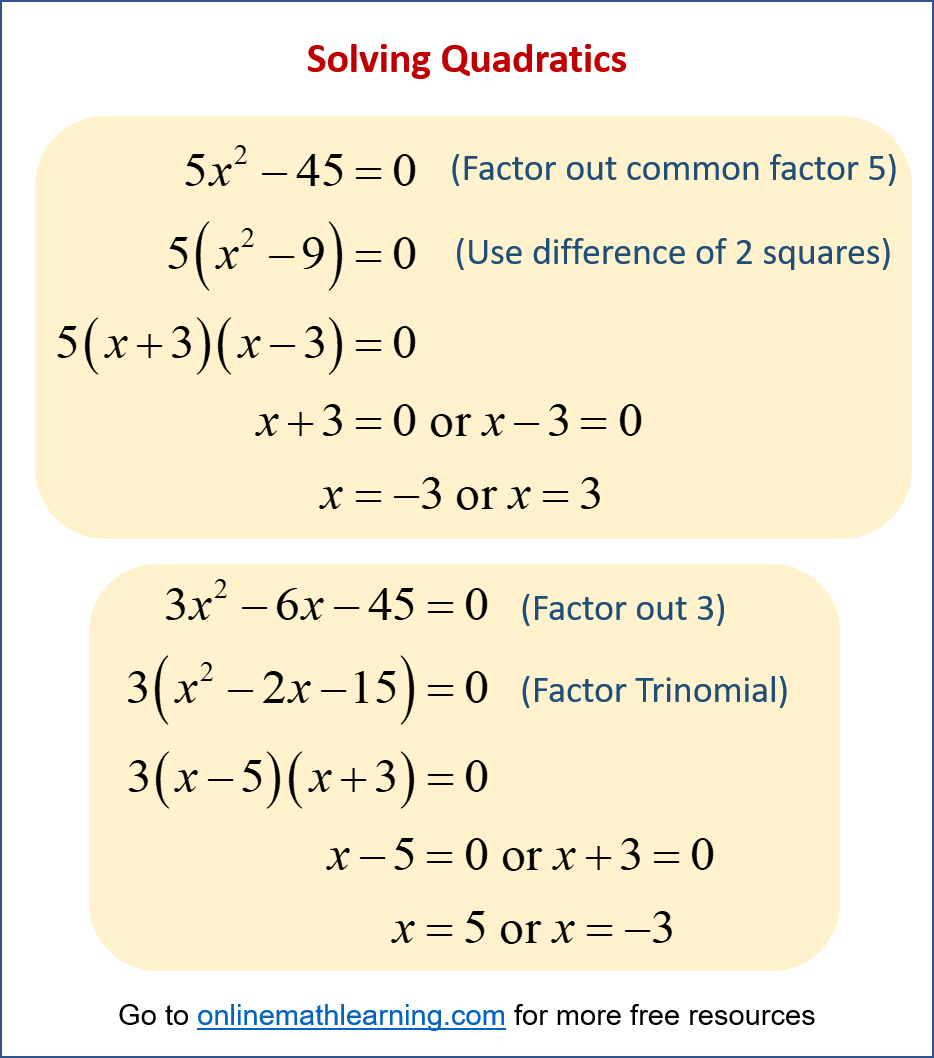
The following diagram shows some examples of solving quadratics by first factoring the GCF. Scroll down the page for more examples.
Algebra Worksheets
Practice your skills with the following worksheets:
Printable & Online Algebra Worksheets
Factoring Out Common Factors
We can factorize quadratic equations by looking for values that are common.
| Example: | x2 + 3x = 0 |
| We find that the two terms have x in common. We “take out” x from each term. | |
| x(x + 3) = 0 | |
| We have two factors when multiplied together gets 0. We know that any number multiplied by 0 gets 0. So, either one or both of the terms are 0 i.e. | |
x = 0 or x + 3 = 0 ⇒ x = -3 isolate variable x |
This tells us that the quadratic equation x2 + 3x = 0 can have two values (two solutions) for x which are x = 0 or x = –3
How to solve a quadratic equation by factoring out the greatest common factor?
Examples:
Solve
x2 + 4x = 0
14x2 - 35x = 0
Factoring and solving quadratic equations by factoring out the greatest common factor
Examples:
Solve
12x2 + 18x = 0
4x2 = 20x
How to factor and solve quadratic equations when the first step is to factor out the greatest common factor before apply other factoring techniques?
Examples:
Factor
5x2 - 45 = 0
3x2 - 6x - 45 = 0
Factoring Completely
The first step in all factoring problems is to check to see if a Greatest Common Factor can be factored out of the original polynomial.
Example:
Factor
3x2 + 6x - 24
Factoring Out The Greatest Common Factor
To find the GCF of a polynomial
- Write each term in factored form.
- Identify the factors common to all terms.
- Factor out the GCF.
Examples:
Factor out the GCF
- 2x4 - 16x2
- 4x2y3 + 20xy2 + 12xy
- -2x3 + 8x2 - 4x
- -y3 - 2y2 + y - 7
Check out our most popular games!
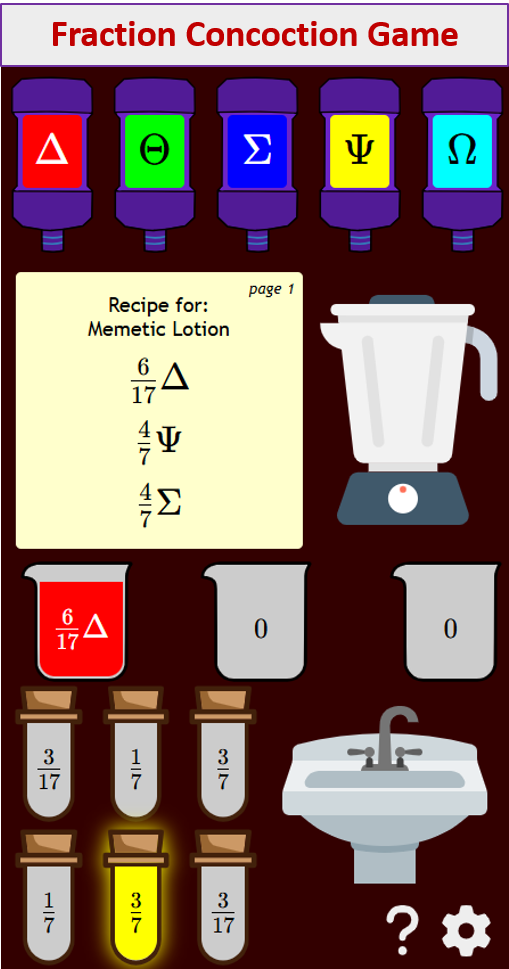
Fraction Concoction Game:
Master fractions in the lab: mix, add, and subtract beakers to create the perfect concoction!
Fact Family Game:
Complete fact families and master the link between addition & subtraction and multiplication & division.

Number Bond Garden:
Clear the board by matching number pairs that sum to ten in this garden-themed mental math puzzle.

Online Addition Subtraction Game:
Practice your addition and subtraction skills to help the penguin find its mummy.

We welcome your feedback, comments and questions about this site or page. Please submit your feedback or enquiries via our Feedback page.