Prime Factorization using Factor Trees
These lessons, with videos, examples, and solutions, help Grade 6 students learn prime factorization using factor trees.
Related Pages
Prime Factorization Using Repeated Division
Prime Factorization Using Factor Trees
More Lessons for Grade 6 Math
Math Worksheets
How to work out the prime factorization of a composite number using factor trees?
The following diagrams show how to find the Prime Factorization of a number using Factors Trees and using Repeated Division. Scroll down the page for examples and solutions.
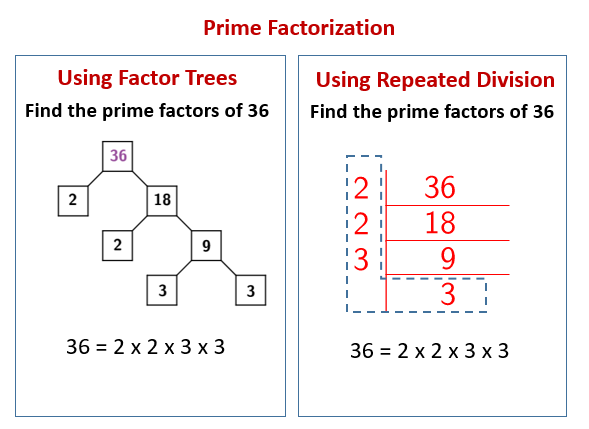
Prime and Composite Numbers
A prime number is a natural number greater than1 that has only two factors: one and itself.
A composite number is a natural number that has more than two factors.
The number 1 is neither prime nor composite.
Prime Factorization
To determine the prime factorization of a natural number, we need to find the prime numbers that wen multiplied together gives us the original number.
Do not confuse prime factorization with the factors of a number. The factors of a number are any two numbers whose product give the original number. Factors do not need to be prime.
Example:
Determine prime factorization of each number
- 24
- 54
- 120
- 625
Example:
Determine prime factorization of 60
Example:
Determine prime factorization of 168
Example:
Determine prime factorization of 630
How to determine the prime factorization of a number using a factor tree?
Using a factor tree to find the prime factorization of 12.
Using a factor tree to find the prime factorization of 72
Finding the prime factorization of a number using factor trees
| Check out our most popular games! | ||
|---|---|---|
 Fraction Concoction |
 Fact Family Game |
 Number Bond Garden |
 Online Addition Subtraction Game |
 Penguin Solitaire |
 Sawayama Solitaire |
 Ark Solitaire |
 Eldritch Invasion |
 Shenzhen Solitaire |
Check out more Solitaire games here.
We welcome your feedback, comments and questions about this site or page. Please submit your feedback or enquiries via our Feedback page.