Angle Properties - Find the Angle Problems
These lessons give a summary of the different angle properties and how they can be used to find missing angles.
Related Pages
Pairs Of Angles
Corresponding Angles
Alternate Interior Angles & Alternate External Angles
More Geometry Lessons
“Find the angle” problems are very common in tests like the SAT, GRE or the GCSE.
In these geometry problems, you’re given some information about a geometric figure (like lines, triangles, quadrilaterals, circles, etc.) and asked to determine the measure of one or more unknown angles.
In order to answer this type of questions,
- you would need to know some commonly used angle properties.
- you would need to practice lots of such problems. The more you practice, the easier it becomes to “see” which properties need to be applied.
Some Common Angle Properties
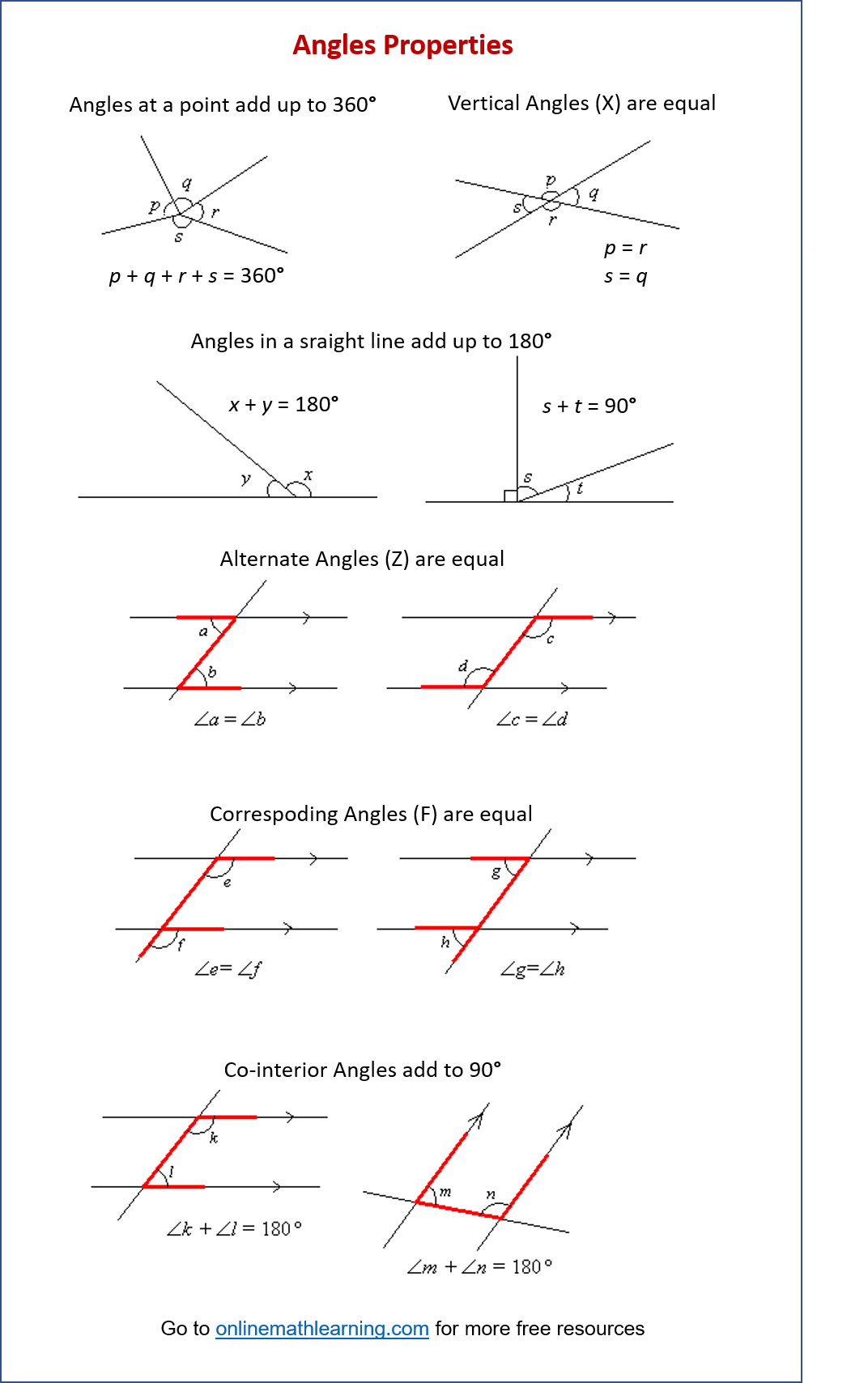
The following diagram shows some common angle properties: angles at a point, vertical angles, complementary angles, supplementary angles, alternate angles, corresponding angles, and so-interior angles. Scroll down the page for more examples and solutions.
Geometry Worksheets
Practice your skills with the following worksheets:
Printable & Online Geometry Worksheets
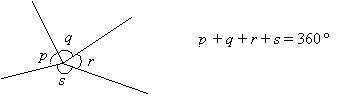
Angles at a point
The sum of angles at a point is 360˚.
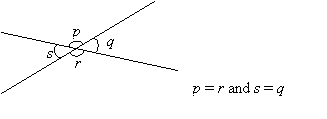
Vertical Angles
Vertically opposite angles (formed by two intersecting lines) are equal.
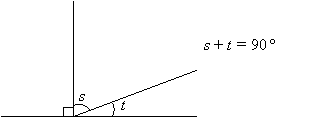
Complementary Angles
The sum of complementary angles is 90˚.
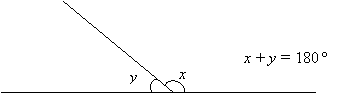
Angles on a Straight line
Angles on a straight line (linear pair) add up to 180˚.
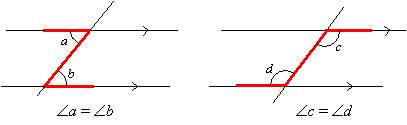
Alternate Interior Angles
When a transversal line intersects two parallel lines, special angle relationships are formed.
Alternate interior angles are equal.
(Angles found in a Z-shaped figure)
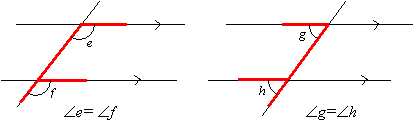
Corresponding Angles
When a transversal line intersects two parallel lines, special angle relationships are formed.
Corresponding angles are equal.
(Angles found in a F-shaped figure)
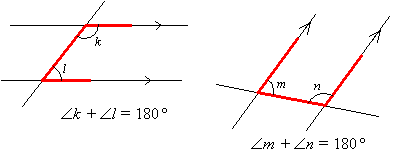
Co-Interior Angles
Co-Interior angles are supplementary. Supplementary angles are angles that add up to 180˚.
(Angles found in a C-shaped or U-shaped figure)
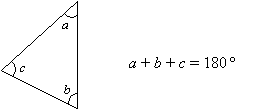
The sum of angles in a triangle is 180˚.
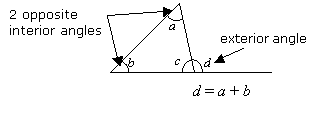
An exterior angle of a triangle is equal to the sum of the two opposite interior angles.
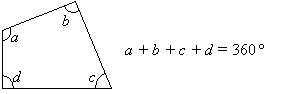
The sum of interior angles of a quadrilateral is 360˚.
Videos
How to use the above angle properties to solve some “find the angle” problems?
Find the Measure of the Missing Angle
Angles and Parallel Lines : solving problems
Finding missing angles on two parallel lines, using corresponding angles and angles in a triangle.
Angles formed by Parallel Lines and Transversals
How to use Properties of Vertical Angles, Corresponding Angles, Interior Angles of a Triangle, and Supplementary Angles to find all the angles in a diagram. Other Properties discussed include Alternate Interior Angles, Alternate Exterior Angles, Complementary Angles, and the Exterior and Opposite Interior Angles of a triangle.
| Check out our most popular games! | ||
|---|---|---|
 Fraction Concoction |
 Fact Family Game |
 Number Bond Garden |
 Online Addition Subtraction Game |
 Penguin Solitaire |
 Sawayama Solitaire |
 Ark Solitaire |
 Eldritch Invasion |
 Shenzhen Solitaire |
Check out more Solitaire games here.
We welcome your feedback, comments and questions about this site or page. Please submit your feedback or enquiries via our Feedback page.