Derivative Of The Natural Log Function
Related Pages
Natural Logarithm
Logarithmic Functions
Derivative Rules
Calculus Lessons
In these lessons, we will learn how to find the derivative of the natural log function (ln).
Derivatives of logarithmic functions
Derivatives of logarithmic functions are fundamental in calculus. They provide a way to find the rate of change of a logarithmic function. There are two main forms to consider: the natural logarithm and logarithms with other bases.
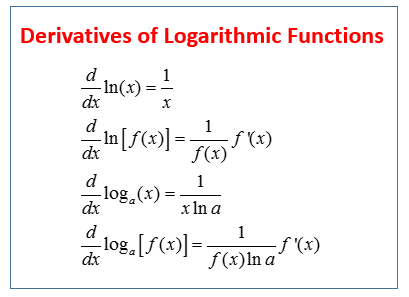
The following are the formulas for the derivatives of logarithmic functions:
Calculus & Logarithm Games/Worksheets
Practice your skills with the following worksheets:
Calculus Games and Worksheets
Printable & Online Logarithm Worksheets
- Natural Logarithm:
\(\frac{d}{dx}\left( \text{ln }x \right)=\frac{1}{x}\) - Natural Logarithm with Chain Rule:
\(\frac{d}{dx}\left( \text{ln }u \right)=\frac{1}{u}\cdot \frac{du}{dx} \) - Logarithm with Base a:
\(\frac{d}{dx}\left( \text{log}_ax \right)=\frac{1}{x\text{ ln }a}\) - Logarithm with Base a and Chain Rule:
\(\frac{d}{dx}\left( \text{log}_au \right)=\frac{1}{u\text{ ln }a} \cdot \frac{du}{dx} \)
Natural Log (ln)
The Natural Log is the logarithm to the base e, where e is an irrational constant approximately equal to 2.718281828. The natural logarithm is usually written ln(x) or loge(x).
The natural log is the inverse function of the exponential function. They are related by the
following identities:
eln(x) = x
ln(ex) = x
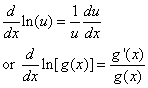
Derivative Of ln(x)

Using the Chain Rule, we get
Example:
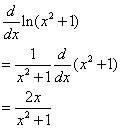
Differentiate y = ln(x2 +1)
Solution:
Using the Chain Rule, we get
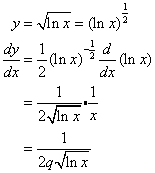
Example:
Differentiate 
Solution:
Derivatives Of Logarithmic Functions
The derivative of the natural logarithmic function (ln[x]) is simply 1 divided by x. This derivative can be found using both the definition of the derivative and a calculator. Derivatives of logarithmic functions are simpler than they would seem to be, even though the functions themselves come from an important limit in Calculus.
What Are The Formulas For Finding Derivatives Of Logarithmic Functions And How To Use Them To Find Derivatives?
Examples:
Find the derivatives for the following logarithmic functions:
- f(x) = ln(x2 + 10)
- f(x) = √x ˙ ln(x)
- f(x) = ln[(2x + 1)3/(3x - 1)4]
- y = [loga(1 + ex)]2
Derivatives Of Logarithmic Functions
Find the derivatives for the following logarithmic functions:
Examples:
- y = ln(x2 x)
- y = (log7 x)1/3
- y = ln(x4˙sin x)
- y = lnx/[1 + ln(2x)]
Derivatives Of The Natural Log Function (Basic)
How to differentiate the natural logarithmic function?
Examples:
Determine the derivative of the function.
- f(x) = 2ln(x)
- f(x) = ln(4x)
Derivatives Of The Natural Log Function With The Chain Rule
How to differentiate the natural logarithmic function using the chain rule?
Example:
Determine the derivative of the function.
f(x) = 5ln(x3)
The Derivative Of The Natural Log Function
We give two justifications for the formula for the derivative of the natural log function. If you want to see where this formula comes from, this is the video to watch.
| Check out our most popular games! | ||
|---|---|---|
 Fraction Concoction |
 Fact Family Game |
 Number Bond Garden |
 Online Addition Subtraction Game |
 Penguin Solitaire |
 Sawayama Solitaire |
 Ark Solitaire |
 Eldritch Invasion |
 Shenzhen Solitaire |
Check out more Solitaire games here.
We welcome your feedback, comments and questions about this site or page. Please submit your feedback or enquiries via our Feedback page.