Classifying Triangles
Related Pages
Types Of Triangles
Special Right Triangles
Area Of Triangles
More Geometry Lessons
These lessons help Grade 6 students learn how to classify triangles based on sides and angles.
A triangle is a polygon with three edges (sides) and three vertices (corners or angles). They can be classified them in two primary ways: based on the lengths of their sides and based on the measures of their angles.
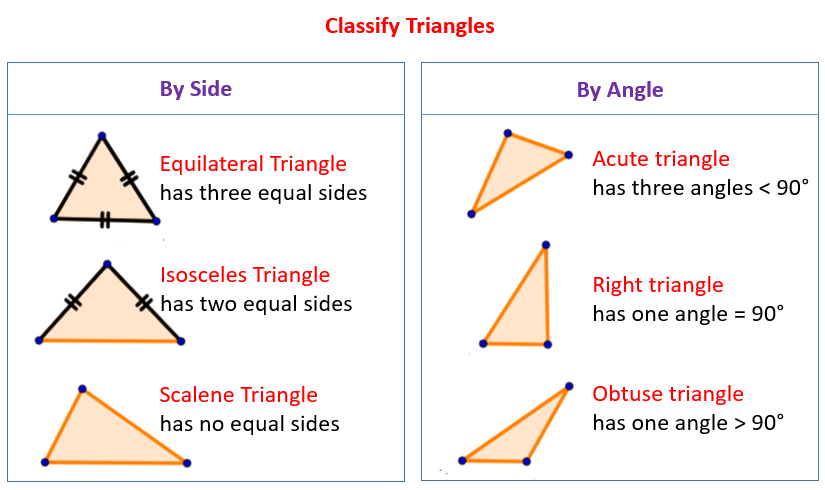
The following figures show how to classify triangles based on sides and angles. Scroll down the page for more examples and solutions.
Geometry Worksheets
Practice your Geometry skills with the following worksheets:
Printable & Online Geometry Worksheets
Classification Based on Sides
This classification looks at how many sides of the triangle are equal in length.
-
Equilateral Triangle
Definition: All three sides are equal in length.
Properties:
All three interior angles are also equal.
Each angle measures 60° -
Isosceles Triangle
Definition: At least two sides are equal in length.
Properties:
The angles opposite the two equal sides (called base angles) are also equal in measure.
An equilateral triangle is a special type of isosceles triangle where all three sides are equal. -
Scalene Triangle
Definition: All three sides are of different lengths.
Properties:
All three interior angles are also different in measure.
No sides are equal, and no angles are equal.
Classification Based on Angles
This classification looks at the measure of the interior angles of the triangle. Remember that the sum of the interior angles of any triangle is always 180°.
-
Acute Triangle
Definition: All three interior angles are acute angles (each measuring less than 90°). -
Right Triangle
Definition: One interior angle is a right angle (exactly 90°).
Properties:
The side opposite the right angle is called the hypotenuse and is always the longest side.
The other two angles are acute and are complementary (they add up to 90°).
The Pythagorean theorem (a2 + b2 = c2) applies to right triangles. -
Obtuse Triangle
Definition: One interior angle is an obtuse angle (measuring greater than 902 but less than 1802).
Properties:
It can only have one obtuse angle, as having two would make the sum of angles exceed 1802.
The other two angles must be acute.
Classify Triangles Based On Sides And Angles
Learn to classify triangles based on sides and angles.
You can combine these classifications to describe a triangle more precisely:
Acute Isosceles Triangle: Two sides equal, all angles less than 90°.
Obtuse Isosceles Triangle: Two sides equal, one angle greater than 90°.
Acute Scalene Triangle: All sides different, all angles less than 90°.
Obtuse Scalene Triangle: All sides different, one angle greater than 90°.
Right Scalene Triangle: All sides different, one 90° angle.
Right Isosceles Triangle: Two sides equal, one 90° angle (the other two angles are 45°).
Classifying Triangles Song
Learn to classify triangles based on sides and angles.
Lyrics:
Isosceles triangles have two equal sides
like this mountain we’re about to climb;
and since one angle’s over ninety degrees,
an obtuse triangle is what we see.
If you add up every angle,
there are one hundred eighty degrees in a triangle.
If the length is equal on every side,
we say it’s equilateral, like this road sign;
and since every angle’s less than 90 degrees,
an acute triangle it will also be.
If skateboard ramps are your scene,
with three different sides they’re called scalene.
That triangle would also be called right
if a ninety degree angle is inside.
There are two ways to classify triangles:
by their sides and their angles,
like sails out on the high seas
can be right or isosceles.
Or look at the foot of this goose;
it’s scalene and obtuse.
When you break pool balls with a cue,
they’re equilateral and acute.
| Check out our most popular games! | ||
|---|---|---|
 Fraction Concoction |
 Fact Family Game |
 Number Bond Garden |
 Online Addition Subtraction Game |
 Penguin Solitaire |
 Sawayama Solitaire |
 Ark Solitaire |
 Eldritch Invasion |
 Shenzhen Solitaire |
Check out more Solitaire games here.
We welcome your feedback, comments and questions about this site or page. Please submit your feedback or enquiries via our Feedback page.