Classify Numbers Game/Worksheet
Related Pages
Printable Math Worksheets
Online Math Quizzes
Math Games
Math Worksheets
This Classify Numbers Game/Worksheet is a great way to put your skills to the test in a fun environment. By practicing, you’ll start to work out the answers efficiently.
Classify Numbers Game/Worksheet
Welcome to the Classify Numbers Challenge! This game is an interactive math game designed to help you learn how to classify Real Numbers. The game generates a random number (which could be a fraction, a negative integer, a square root, or a basic counting number) and asks you to classify it by sorting it into its correct mathematical sets. A number may belong to more than one set and you need to select all that are correct. Scroll down the page for a more detailed explanation.
How to Play
The game is structured as a 10-stage diagnostics run. Each stage presents a new scenario and a fresh dataset plotted on your dashboard.
-
Analyze the Number: Every round, a new number will appear at the center of the classification matrix.
-
Scan for Traps: Take a close look at the number. Ask yourself: Does it simplify? (For example, if you see \(\sqrt{9}\), remember that it is just the number 3).
-
Select Your Sets: Click on ALL the checkboxes that apply to the number. Remember, if a number belongs to a small inner family, it automatically belongs to all the larger families surrounding it.
-
Check Your Work: Click Verify Properties to lock in your choice. The game will give you instant feedback, award you 100 points for a perfect classification, and provide an explanation detailing why the number fits where it does.
How the Math Works
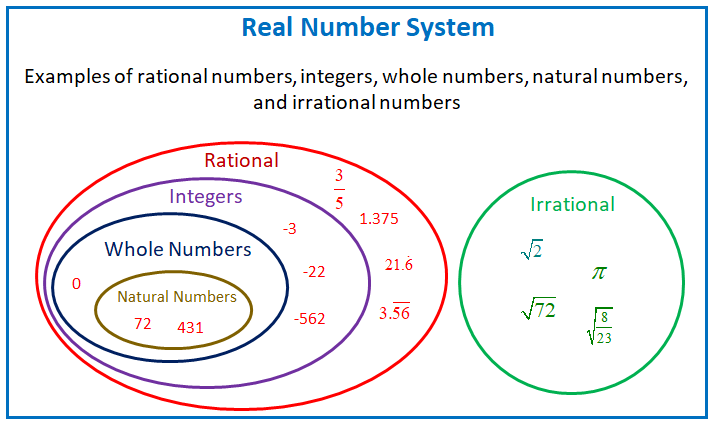
To score perfectly, you need to understand the structural layers of the Real Number System. The system is divided into two entirely separate kingdoms: Rational and Irrational.
The Rational Kingdom
Rational numbers (\(\mathbb{Q})\) are any numbers that can be written cleanly as a fraction of two integers \((\frac{a}{b})\).
Inside this kingdom, there are tightly nested subsets:
Natural Numbers \((\mathbb{N})\): These are your standard “counting numbers” (1, 2, 3, 4, …). They are the smallest, deepest subset in the nest.
Whole Numbers \((\mathbb{W})\): This family includes all the natural numbers, but invites one extra member to the party: 0 (0, 1, 2, 3, …).
Integers \((\mathbb{Z})\): This layer expands to include all whole numbers plus their negative twins (…, -3, -2, -1, 0, 1, 2, …). No fractions or decimals allowed yet.
Rational Numbers \((\mathbb{Q})\): The outer boundary of this kingdom. It includes all the integers below it, plus any terminating decimals (2.5), fractions \((\frac{3}{4})\), or infinitely repeating patterns (0.333…).
The Nesting Rule: If a number is a Natural number, it is automatically a Whole number, an Integer, and a Rational number.
The Irrational Wilderness
Irrational Numbers \((\mathbb{I})\): These are numbers that cannot be written as a fraction. If you look at them as decimals, their numbers go on forever without ever repeating or forming a predictable pattern.
Examples: π (3.14159…) or the square roots of non-perfect squares like \(\sqrt{2}\) and \(\sqrt{5}\).
Because a number cannot be both a clean fraction and an endless chaotic decimal at the same time, a number will never be both Rational and Irrational.
Classify Real Numbers
| Check out our most popular games! | ||
|---|---|---|
 Fraction Concoction |
 Fact Family Game |
 Number Bond Garden |
 Online Addition Subtraction Game |
 Penguin Solitaire |
 Sawayama Solitaire |
 Ark Solitaire |
 Eldritch Invasion |
 Shenzhen Solitaire |
Check out more Solitaire games here.
We welcome your feedback, comments and questions about this site or page. Please submit your feedback or enquiries via our Feedback page.