Solving Challenging Word Problems (Mixed Operations)
Related Pages
Math Word Problems
Singapore Math Word Problems
More Algebra Lessons
In these lessons, we will learn to solve math word problems that involve mixed operations.
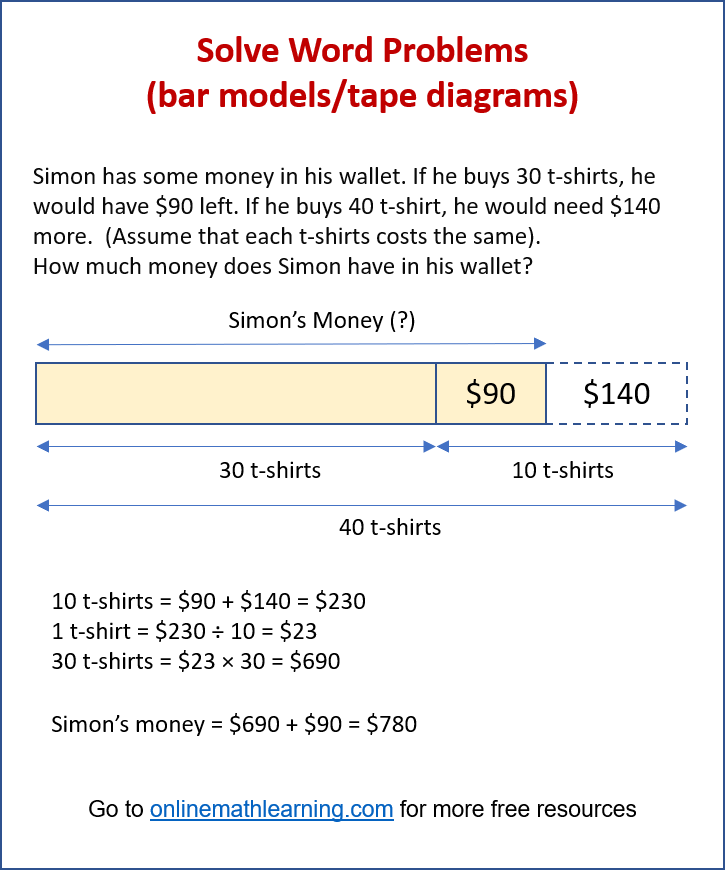
Here are some examples of mixed operations word problems. These problems are slightly more challenging, but they also illustrate how helpful the block diagrams can be. The block diagrams or tape diagrams (Common Core) can be used to help solve word problems that would usually require algebra.
The following diagram gives an example of a word problem solved using bar models or tape diagrams. Scroll down the page for more examples and solutions.
Word Problems Worksheets
Practice your skills with the following word problems worksheets:
Printable & Online Word Problems Worksheets
Example:
Two bowls and three plates cost $1421. The cost of the plate is half the cost of the bowl. What is
the cost of the bowl?
Solution:
Step 1: Draw a block diagram to illustrate the number of bowls
and plates. (In this diagram, the bowls are shown as orange blocks and the plates as blue blocks.)
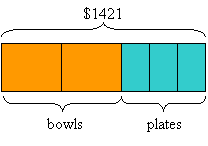
Step 2: Since a bowl costs twice as much as a plate, we can replace one orange block (bowl) with two blue blocks (plate).
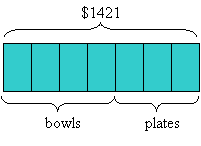
Step 3: Looking at the block diagram, find the cost of each plate.
7 blue blocks = 1421
1 blue block = 1421 ÷ 7 = 203
The cost of each plate is $203.
The cost of each bowl is 203 × 2 = $406.
Example:
A factory makes 4250 bars of chocolate. There were three kinds of chocolate bars – creamy,
milky and white. The number of white chocolate bars was 715 more than the number of milky chocolate
bars. The number of creamy chocolate bars was 5 times the number of milky chocolate bars. How many
creamy chocolate bars did the factory make?
Solution:
Step 1: Draw a block diagram to illustrate the different types of
chocolate bars. (In this diagram, the creamy chocolate bars are shown as orange blocks, the milky
chocolate bars as blue blocks and the white chocolate bars as red blocks.)
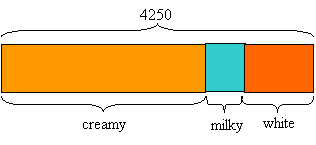
Step 2: Since the number of creamy chocolate bars was 5 times the
number of milky chocolate bars, we can replace one orange block (creamy) with 5 blue blocks (milky).
Since the number of white chocolate bars was 715 more than the number of milky chocolate bars, we
replace one red block with one blue block + 715.
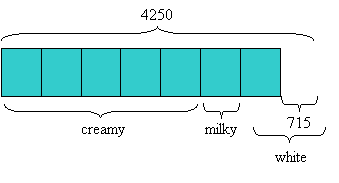
Step 3: Looking at the block diagram, find the number of milky
chocolate bars (blue block)
4250 – 715 = 3535
7 blue blocks = 3535
1 blue block = 3535 ÷ 7 = 505
The number of milky chocolate bars made was 505.
Step 4: Calculate the number of creamy chocolate bars.
The number of creamy chocolate bars was 5 times the number of milky chocolate bars = 5 × 505 = 2525
Videos
How to solve word problems with four types of bar models - Comparing, Taking Out, Combining, Missing Part?
Examples:
- Each week, Dwight calculated that he spends 2/3 of his allowance on food and 1/9 on video games. How much did he spend on food and video games?
- Marvin bought 1/2 pound of gummy bears. He ate 1/3 pound on his way to school. How much of gummy bears does Marvin have left?
- A recipe needs 7/8 teaspoons of salt and 2/5 teaspoons of sugar. How much more salt is needed than sugar?
- For the last hour Mr. Negron was awake, he spent 4/8 of the hour making homework and 1/8 of the hour talking. He spent the rest of the hour watching TV. What fraction of the hour did he spend watching TV?
Example:
Julian and Stacey need 8 liters of water to fill a tank. Stacey filled the tank with 3 11/12 liters of water.
Julian poured 1 2/5 liters less than Stacey into the tank. How much water is still needed to fill the tank?
How to solve part-whole word problems with bar modeling?
Examples:
- Danika bought some nail polish for $51. This was 3/5 of her money. How much money did she have to begin with?
- Henry bought 520 cookies for the math competition. If 3/4 were eaten, how many did he have left over?
- Betsy made cupcakes to bring to work. After the Science Department ate 2/7 and the Math Department ate 64, she had 1/7 left. How many cupcakes did Betsy make?
- Fran sold 108 chocolate chip and Snickerdoodle cookies at her lemonade stand. If she made 36 Snickerdoodle cookies, how many chocolate chip cookies did she make? How much money did she earn selling the chocolate chip cookies if she sold them in bags of 6 for $1.25 and she sold all of the bags.
- Two lbs. of nactarines and one lb. of bananas cost $3.15. Two lbs. of nectarines and three lbs. of bananas cost $5.65. Find the cost of one lb. of bananas.
- Two tennis balls and one racquet cost $75. Two tennis balls and three racquets cost $215. Find the cost of one racquet.
- Carter raised money for a walk-a-thon. On Monday, he earned $0.75 per lap. On Tuesday, he earned $0.80 a lap and on Wednesday, he earned $0.95 a lap. If he walked 36 laps on Monday, 50% as many laps on Wednesday as on Monday, how much money did Carter earn for the walk-a-thon?
How to solve comparison word problems with bar modeling?
Examples:
- Alex, Sonia and Tini have a total of $580. Sonia has $120 more than Alex, and Toni has $190 more than Sonia. How much money does Toni have?
- Trevor bought a ski jacket, gloves and helmet on clearance for $242 altogether. The jacket cost $71 more than the gloves while the gloves cost $27 less than the helmet. How much did the jacket cost?
- A hard drive costs twice as much as a 64 GB jump drive and a 32 GB jump drive costs half as much as a 64 GB jump drive. If the hard drive costs $140, find the total cost.
- Tracy earned 3/4 as much as Julie. Shannon earned 2/3 as much as Tracy. Julie earned $44. How much less did Shannon earn than Tracy?
- Sadie spent twice as much money as Kim. Kim spent $150 less than Jason. Jason spent $45 more than Sadie. How much money did they spend altogether?
- Harlis is five years younger than Janae. Sherry is three times as old as Janae. Together, Harlis’ and Janae’s total age is 20 years less than Sherry’s age. How old is Sherry?
- Josh has 3/4 as many jelly beans as Lisa. Lisa has 4/5 as many jelly beans as Curt. If Curt has 28 more jelly beans than Josh, how many jelly beans do they have altogether?
Check out our most popular games!
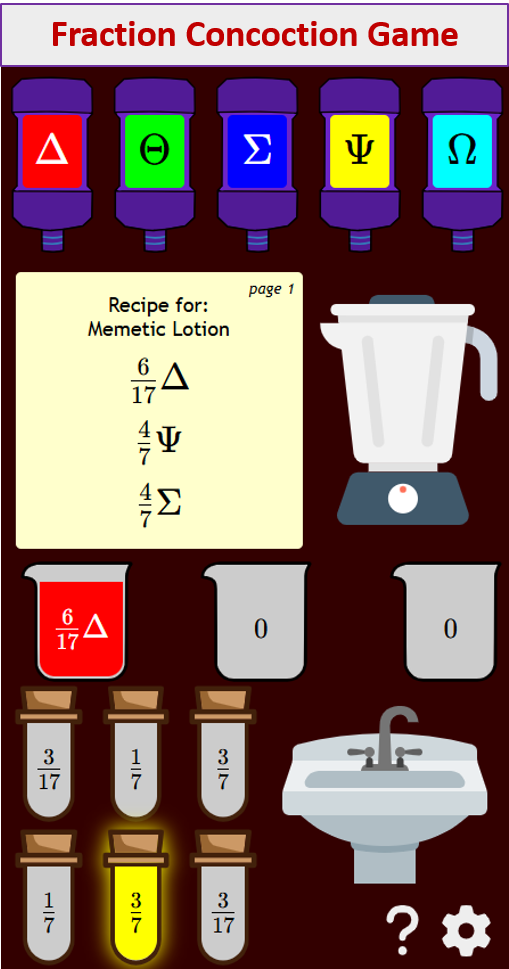
Fraction Concoction Game:
Master fractions in the lab: mix, add, and subtract beakers to create the perfect concoction!
Fact Family Game:
Complete fact families and master the link between addition & subtraction and multiplication & division.

Number Bond Garden:
Clear the board by matching number pairs that sum to ten in this garden-themed mental math puzzle.

Online Addition Subtraction Game:
Practice your addition and subtraction skills to help the penguin find its mummy.

We welcome your feedback, comments and questions about this site or page. Please submit your feedback or enquiries via our Feedback page.