

Problem Solving Skills
Related Topics:
The following are some examples of problem solving strategies.
Explore it//Act it/Try it (EAT) method (Basic)
Explore it//Act it/Try it (EAT) method (Intermediate)
Explore it//Act it/Try it (EAT) method (Advanced)
Finding a Pattern (Intermediate)
Find A Pattern (Basic)
In this lesson, we will look at some basic examples of Find a Pattern method of problem solving strategy.
Example:
Study carefully the following diagram.

Number of Dots |
1 |
2 |
3 |
4 |
5 |
Number of Lines |
6 |
11 |
16 |
21 |
26 |
a) How many lines are there if the figure has 7 dots?
b)
How many lines are there for a figure with 12 dots?
c)
How many dots are there if the figure has 46 lines?
d)
How many dots are there for a figure with 136 lines?
Solution:
The pattern is first dot 6 lines; each additional dot adds 5 lines.
a) If the figure has 7 dots then it has 6 + (6 × 5) = 36 lines.
b) If the figure with 12 dots then it has 6 + (11 × 5) = 61 lines.
c)
If the figure has 46 lines then it has (46 – 6) ÷ 5 + 1 = 9 dots.
d)
If a figure with 136 lines then it has (136 – 6) ÷ 5 + 1 = 27 dots.
Example:
The number of lilies in a lake was found to be increasing according to following table.
Week 1 |
Week 2 |
Week 3 |
Week 4 |
Week 5 |
|
Number of Lilies |
4 |
8 |
16 |
32 |
64 |
a) How many lilies will there be in week 7?
b)
How many lilies will there be in week 9?
c)
In which week will there be 4096 lilies?
d)
If half of the lake was covered with lilies in Week 16, then in which week was a quarter of the lake covered with lilies?
Solution:
The pattern is: Number of lilies doubles each week.
a) In week 7, there will be 256 lilies.
b)
In week 9, there will be 1024 lilies.
c)
There be 4096 lilies in week 11.
d)
A quarter of the lake covered with lilies in week 15
Example:
The figure shows a string of beads with two parts hidden by block A and B. What would be the least number of beads under each block (the string of beads are joined under B)?

Solution:
The pattern of beads: 3 white followed by 2 black, 4 white followed by one black.

Example:
Study the following sequence and find the value of X and the value of Y.
5 |
7 |
10 |
12 |
15 |
17 |
20 |
22 |
X |
27 |
30 |
Y |
Solution:
The pattern is +2, +3, +2, +3, … ;
X = 25, Y = 32
Example:
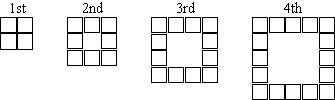
The diagram below shows a series of squares formed by small square tiles. Complete the table below.
1st |
2nd |
3rd |
4th |
5th |
6th |
10th |
15th |
|
Number of tiles |
4 |
8 |
12 |
16 |
Solution:
The pattern: each subsequent square increases by 4 tiles.
1st |
2nd |
3rd |
4th |
5th |
6th |
10th |
15th |
|
Number of tiles |
4 |
8 |
12 |
16 |
20 |
24 |
40 |
60 |
Try the free Mathway calculator and
problem solver below to practice various math topics. Try the given examples, or type in your own
problem and check your answer with the step-by-step explanations.

We welcome your feedback, comments and questions about this site or page. Please submit your feedback or enquiries via our Feedback page.


