Prime Numbers and Composite Numbers
In this lesson, we will learn
- prime numbers
- composite numbers
- why 1 is not a prime number
What is a Prime Number?
A prime number is a whole number that has exactly two factors, 1 and itself.
For example
The number 29 has exactly two factors, which are 1 and 29.
So, 29 is a prime number.
The prime numbers up to 100 are
2, 3, 5, 7, 11, 13, 17, 19, 23, 29, 31, 37, 41, 43, 47, 53, 59, 61, 67, 71, 73, 79, 83, 89, 97
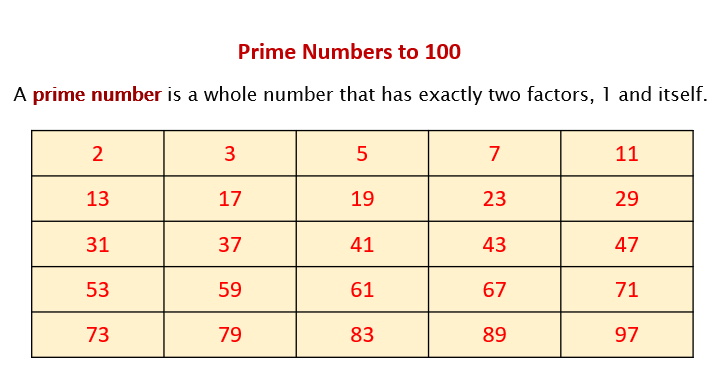
We can use the Sieve of Eratosthenes to find all prime numbers up to any given limit.
The number 2 is the only prime that is even. All other even numbers have 2 as a factor and so they are composite numbers.
Twin primes are pairs of primes whose difference is 2.
(3, 5), (5, 7) and (11, 13) are examples of twin primes.
What is a Composite Number?
A number that has more than 2 factors is called a composite number.
For example:
The number 28 has six factors which are 1, 2, 4, 7, 14, and 28.
So, 28 is not a prime number. It is a composite numbers.
Example:
Determine whether each of the following number is prime.
a) 43
b) 57
Solution:
a) 43 is only divisible by 1 and 43. It is a prime number.
b) 57 ÷ 3 = 19. It is not a prime number.
What are relatively prime numbers?
When two composite numbers have no common factors (other than 1), they are said to be relatively prime. For example, the numbers 8 and 15 are relatively prime.
How to identify prime numbers?
How to distinguish between prime numbers and composite numbers?
A prime number is a number greater than 1, which is only divisible by 1 and itself.
Recognizing prime and composite numbers
Example:
Determine whether the following numbers are prime, composite or neither:
24, 2, 1, 17
Is 1 a prime number?
No, the number 1 is not a prime number because it has only one factor.
Another reason is related to the Fundamental Theorem of Arithmetic as explained in the following video.
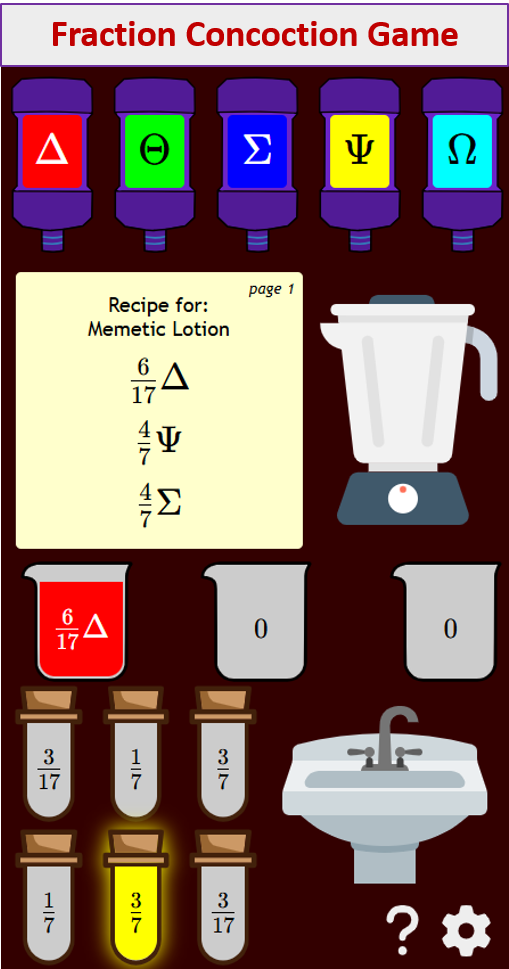
Try out our new and fun Fraction Concoction Game.
Add and subtract fractions to make exciting fraction concoctions following a recipe. There are four levels of difficulty: Easy, medium, hard and insane. Practice the basics of fraction addition and subtraction or challenge yourself with the insane level.
We welcome your feedback, comments and questions about this site or page. Please submit your feedback or enquiries via our Feedback page.