Population Mean And Sample Mean
Related Pages
Mean
Center Of A Distribution
Central Tendency
More Statistics Lessons
The arithmetic mean is the average of a group of numbers and is computed by summing all numbers and dividing by the number of numbers. The arithmetic mean is also usually just called the mean.
The population mean and the sample mean both represent the average of a set of values, but they differ in terms of the group they describe.
In these lessons, we will distinguish between the population mean and sample mean.
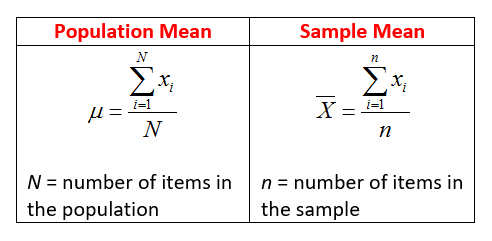
The following table gives the formula for the population mean and the formula for the sample mean. Scroll down the page for examples and solutions on the differences between the population mean and sample mean and how to use them.
Statistics Worksheets
Practice your skills with the following worksheets:
Printable & Online Statistics Worksheets
A population is a collection of persons, objects or items of interest.
A sample is a portion of the whole and, if properly taken, is
representative of the whole.
Population Mean:
The population mean is the average of all the values in an entire population.
A population includes every single member of a specific group that you are interested in studying.
It is represented by the Greek letter μ (mu).
It is given by the formula
\(\mu = \frac{\sum_{i=1}^{N} X_i}{N} = \frac{x_1 + x_2 + x_3 + … + x_N}{N}\)
where:
- \(\frac{\sum_{i=1}^{N} X_i}{N}\) represents the sum of all individual values \(X_i\) in the population.
- \(N\) is the number of terms in the population.
The population mean is a parameter, which is a numerical characteristic of a population.
Calculating the population mean is often impractical or impossible because populations can be very large or even infinite.
Sample Mean
The sample mean is the average of a subset of values taken from a larger population. This subset is called a sample.
A sample is a smaller, manageable group selected from the population, used to make inferences about the entire population. It is represented by \(\bar{x}\) (x bar)
It is given by the formula
\(\bar{x} = \frac{\sum_{i=1}^{n} x_i}{n}\)
where
- \(\frac{\sum_{i=1}^{n} x_i}{n}\) represents the sum of all individual values \(x_i\)
- \(n\) is the number of terms in the sample.
The sample mean is a statistic, which is a numerical characteristic of a sample.
The sample mean is used as an estimate of the population mean. If the sample is randomly selected and is representative of the population, the sample mean can provide a good approximation of the population mean.
Sample Mean Versus Population Mean
The following video shows how to find the sample mean and highlights the difference between the mean of a sample and the mean of a population. In statistics, we use data from a random sample to represent the population at large. From that sample mean, we can infer things about the population mean. We infer the population mean from the sample mean because we are not able to collect the data from the entire population.
What Is Population Mean And Sample Mean?
Sample Mean is the mean of sample values collected.
Population Mean is the mean of all the values in the population.
If the sample is random and sample size is large then the sample mean would be a good estimate of the
population mean.
Arithmetic Mean For Samples And Populations
The arithmetic mean is a single value meant to “sum up” a data set.
To calculate the mean, add up all the values and divide by the number of values.
There are two types of arithmetic mean: population mean (μ) and sample mean (x̄).
| Check out our most popular games! | ||
|---|---|---|
 Fraction Concoction |
 Fact Family Game |
 Number Bond Garden |
 Online Addition Subtraction Game |
 Penguin Solitaire |
 Sawayama Solitaire |
 Ark Solitaire |
 Eldritch Invasion |
 Shenzhen Solitaire |
Check out more Solitaire games here.
We welcome your feedback, comments and questions about this site or page. Please submit your feedback or enquiries via our Feedback page.