

Animal Facts - Flamingos
More Amazing Animal Facts
Math Trivia and Math Riddles
In this page we will look at the flamingos.
If you have any interesting or funny facts about animals or would like to find out more information about a particular animal, please fill up the Feedback form and we will be happy to add it to our list of animal facts.
Why are flamingos pink?
The flamingo's characteristic pink coloring is caused by what they eat. Young flamingos are gray and their feathers turn pink only after they begin eating a steady diet of shrimp and plankton. Adults range from light pink to bright red due to aqueous bacteria and beta carotene obtained from their food supply. A well-fed, healthy flamingo is more vibrantly colored. A white or pale flamingo is usually unhealthy or malnourished. However, captive flamingos may turn a pale pink, as they are not fed carotene at levels comparable to the wild. This is changing as more zoos begin to add prawns and other supplements to the diets of their flamingos.
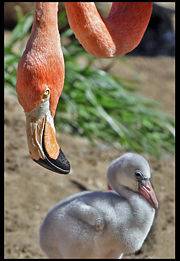
Flamingos frequently stand on one leg. The reason for this behavior is not fully known. One common theory is that tucking one leg beneath the body may conserve body heat, but this has not been proven. As well as standing in the water, flamingos may stamp their webbed feet in the mud to stir up food from the bottom.
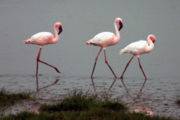
Another strange thing about their legs is that what looks like the knees are actually the ankles. The ankle joint allows the leg to rotate and bend backwards. To eat, flamingos wade out into the water, turn themselves completely upside-down, and — looking backwards — scoop up algae, insects, and shrimp with their oddly-shaped beaks. Their legs, which are longer than the rest of their bodies, help them wade out into deeper waters, where they can reach food sources other birds can’t, while their webbed feet support them on the soft mud.
This video explains more about the flamingos: how the flamingo gets its pink color, and whether its knees really do bend backwards.
Check out our most popular games!
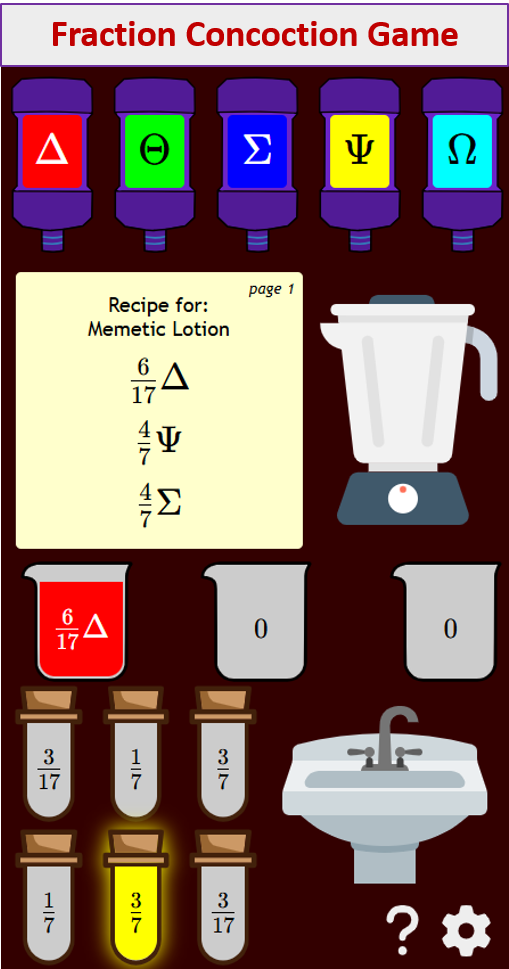
Fraction Concoction Game:
Master fractions in the lab: mix, add, and subtract beakers to create the perfect concoction!
Fact Family Game:
Complete fact families and master the link between addition & subtraction and multiplication & division.

Number Bond Garden:
Clear the board by matching number pairs that sum to ten in this garden-themed mental math puzzle.

Online Addition Subtraction Game:
Practice your addition and subtraction skills to help the penguin find its mummy.

We welcome your feedback, comments and questions about this site or page. Please submit your feedback or enquiries via our Feedback page.