Percent Yield & Percent Purity
In these lessons, we will consider how to calculate the percent yield from a reaction and the percent purity of the product obtained.
Related Pages
Percentage Yield and Purity
Quantitative Chemistry
Stoichiometry Lessons
More Chemistry Lessons
What Is Yield & Purity?
The yield is the amount of product you obtain from a reaction. Suppose we own a factory that makes fertilizers or paint. We will want the highest yield possible, for the lowest cost.
If we have a factory that makes medical drugs then the yield will still be important, but the purity of the product may be even more important. This is because the impurities may harm the people using the drugs.
How to calculate the percent yield?
The formula for percent yield is:
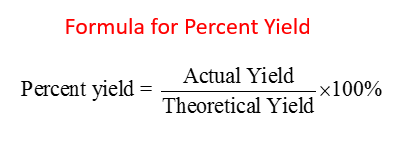
Example:
The medical drug aspirin is made from salicylic acid. 1 mole of salicylic acid gives 1 mole of aspirin.
Given that the chemical formula for salicylic acid is C7H6O3 and the
chemical formula for aspirin is C9H8O4.
In an experiment, 100.0 grams of salicylic acid gave 121.2 grams of aspirin. What was the percent yield?
Solution:
Step 1: Calculate
the Mr (relative molecular mass) of the substances.
Ar : C = 12, H = 1, O = 16
So, Mr : salicylic acid = 138, aspirin = 180.
Step 2: Change the grams to moles for salicylic acid.
138 g of salicylic acid = 1 mole
So, 100 g = 100 ÷ 138 mole = 0.725 moles
Step 3: Work out the calculated mass of the aspirin.
1 mole of salicylic acid gives 1 mole of aspirin
So, 0.725 moles gives 0.725 moles of aspirin
0.725 moles of aspirin = 0.725 × 180 g = 130.5 g
So, the calculated mass of the reaction is 130.5 g
Step 4: Calculate the percent yield.
The actual mass obtained is 121.2 g
So, the percent yield = 121.2 ÷ 130.5 × 100% = 92.9%
How to calculate the percent yield of a chemical reaction?
Example:
Consider a 3.52-g sample of CaCO3 (99.87% pure) in a flask and a 100.0 mL sample of
vinegar (5% acidity) in a graduated cylinder. The combined mass of both reagents and containers
is 255.98 g. After swirling the reaction mixture for about twenty minutes, the combined mass of
the reaction mixture and containers is found to be 254.46 g. What is the percent yield of carbon
dioxide in this experiment?
How to solve Theoretical, Actual and Percent Yield Problems?
How to find percent yield for chemical experiments?
This chemistry tutorial cover the difference between actual, theoretical and percent yields and
include examples of how to calculate theoretical and percent yields.
The theoretical yield is the maximum amount of product that can be obtained in a chemical reaction. It is calculated from the limiting agent.
The actual yield is the amount of product actually obtained from a chemical reaction. It must be experimentally determined and is never more than the theoretical yield.
Example:
If 16.0 g of CaCO3 are decomposed and 7.54 g of CaO are obtained, what is the percent yield of CaO obtained?
Step 1: Always check to make sure the equation is balanced.
Step 2: Calculate the theoretical yield of CaO.
How to calculate the limiting reactant and the percent yield?
The concepts of limiting reagent, theoretical yield, and percent yield are discussed. A sample problem
that resembles a typical test question is included.
Example:
32g of O2 reacts with 11g of C3
a) What is the limiting reagent?
b) What is the theoretical yield of H2O(g)?
c) Experiment gives 10g H2O, what is the percent yield?
Explain the concept of a limiting reactant (or a limiting reagent) in a chemical reaction
How to calculate the limiting reactant and the percent yield in a chemical reaction?
How to find the Percent Purity?
When we make something in a chemical reaction, and separate it from the final mixture, it will still have small amounts of other substances mixed with it. It will be impure.
The percent purity of a sample describes what proportion of that sample, by mass, is composed of a specific compound or element.
The formula for percent purity is:

Example:
The aspirin from the above experiment was not pure. 121.2 g of solid was obtained, but analysis
showed that only 109.2g of it was aspirin. Calculate the percent purity of the product.
Solution:
Percent purity = 109.2 ÷ 121.2 × 100% = 90.0%
Example:
Chalk is almost pure calcium carbonate. We can work out its purity by measuring how much carbon
dioxide is given off. 10 g of chalk was reacted with an excess of dilute hydrochloric acid.
2.128 liters of carbon dioxide gas was collected at standard temperature and pressure (STP).
The equation for the reaction is
CaCO3 (s) + 2HCl (aq) → CaCl2 (aq) + H2O (l) + CO2 (g)
Solution:
Step 1: Calculate the Mr of calcium carbonate.
Ar: Ca = 40, C = 12, O = 16)
Mr of CaCO3 = 100
Step 2: Calculate the grams from the volume.
1 mole of CaCO3 gives 1 mole of CO2
1 mole of gas has a volume of 22.4 liters at STP.
22.4 liters of gas of gas is produced by 100 g of calcium carbonate
and 2.128 liters is produced by 2.128 ÷ 22.4 × 100 = 9.5 g
Step 3: Calculate the percent purity.
There is 9.5 g of calcium carbonate in the 10 g of chalk.
Percent purity = 9.5 ÷ 10 × 100% = 95%
How to calculate the percent purity of the original sample?
Example:
We have 13.9 g sample of impure iron pyrite. The sample is heated to produce iron(III) oxide and sulfur
dioxide. If we obtained 8.02 g sample of iron(III) oxide, what was the percentage of iron pyrite in the
original sample?
How to find the Percentage Purity?
Example:
When dilute hydrochloric acid is added to 5.73 g of contaminated calcium carbonate 2.49g of carbon
dioxide is obtained. Find the percentage purity of the calcium carbonate.
How to find the Percentage Purity (harder question)?
Example:
1 g of marble chip was dissolved in 25 ml of 1.3 mol of hydrochloric acid. The unreacted acid was
then neutralized by 14 ml of 1 mol of sodium hydroxide. Calculate the percentage, by mass, of
calcium carbonate in the marble chip.
| Check out our most popular games! | ||
|---|---|---|
 Fraction Concoction |
 Fact Family Game |
 Number Bond Garden |
 Online Addition Subtraction Game |
 Penguin Solitaire |
 Sawayama Solitaire |
 Ark Solitaire |
 Eldritch Invasion |
 Shenzhen Solitaire |
Check out more Solitaire games here.
We welcome your feedback, comments and questions about this site or page. Please submit your feedback or enquiries via our Feedback page.