

Past Continuous Tense
More Lessons on English
Verbs have different forms, called tenses. The tense of a verb tells us when the action happens. The past continuous tense indicates an action that took place continuously in the past. It is usually used with the past tense.
In these lessons, we will learn
- Forms of Past Continuous Tense
- When we can use the Past Continuous Tense
- Negative Forms of Past Continuous Tense
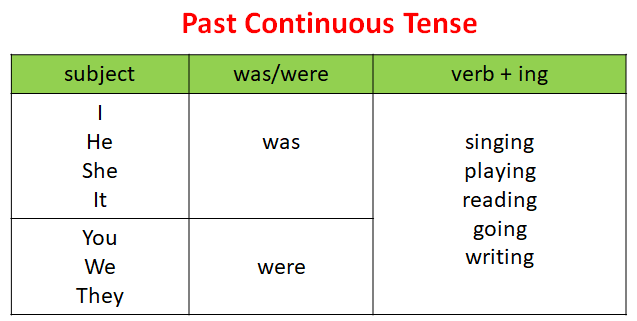
Forms of Past Continuous Tense
was + present participle = past continuous
were + present participle = past continuous
Examples:
She was cleaning the room.
I was stacking the chairs.
They were waiting for the bus.
We were listening to the music.
When can we use the Past Continuous Tense?
We use the past continuous tense to describe a past action that happened over a period of time.
Examples:
He was finishing his homework.
I was sweeping the corridor.
We often use the past continuous together with the simple past in the same sentence. The word when is usually used.
Examples:
She was cooking dinner when I came home.
When I met James, he was looking for his dog.
When she was sleeping, the phone rang.
We can use the word while to indicate two parallel actions that are happening at the same time.
Examples:
Ben was singing while Sarah was dancing.
What were they doing while she was crying?
She was doing her work while waiting for Paul to come.
Negative Forms of Past Continuous Tense
We form the negative by adding not after was/were.
Was/were + not + present participle
Contraction (or short form):
was not = wasn’t
were not = weren’t
Examples:
She was not paying attention, when the teacher called her.
She wasn’t paying attention, when the teacher called her.
You were not listening.
You weren’t listening.
This video explains how to make and use the past continuous tense. This video demonstrates how to make and use the past continuous tense.
The differences between past tense and past continuous tense. This video gives is an introduction to the past progressive tense in English, which describes an action that was in progress at some point in the past. This tense is very useful if you want to recount events or tell stories about things that have happened to you. Past Continuous vs Past Perfect vs Past Perfect Continuous - English Tenses
In this English grammar lesson you will learn how and when to use the Past Continuous, the Past Perfect and the Past Perfect Continuous.
You will also learn when to use these tenses instead of the Past Simple tense.
| Check out our most popular games! | ||
|---|---|---|
 Fraction Concoction |
 Fact Family Game |
 Number Bond Garden |
 Online Addition Subtraction Game |
 Penguin Solitaire |
 Sawayama Solitaire |
 Ark Solitaire |
 Eldritch Invasion |
 Shenzhen Solitaire |
Check out more Solitaire games here.
We welcome your feedback, comments and questions about this site or page. Please submit your feedback or enquiries via our Feedback page.