Pairs Of Angles
Related Pages
Angles
Types Of Angles
More Geometry Lessons
In these lessons, we look at how pairs of angles can relate to each other in several ways. Some examples are complementary angles, supplementary angles, vertical angles, alternate interior angles, alternate exterior angles, corresponding angles and adjacent angles.
Pairs of angles are formed when two lines intersect or when a transversal line crosses two or more other lines. Understanding these pairs is crucial in geometry. Here are the common types of angle pairs.
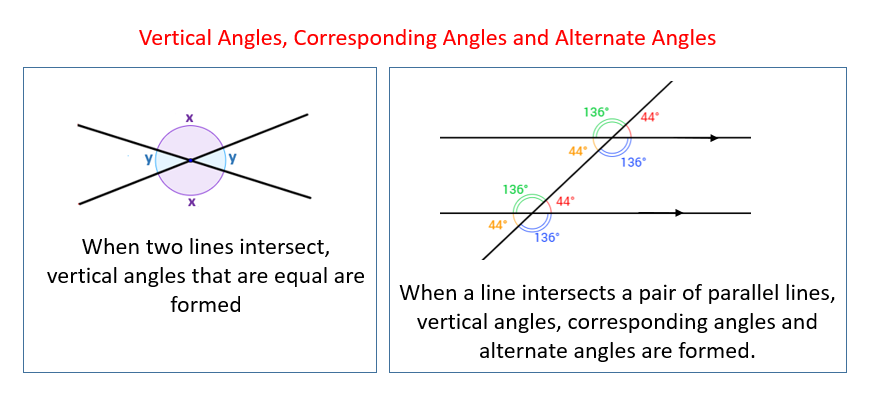
The following diagrams show how vertical angles, corresponding angles, and alternate angles are formed. Scroll down the page for more examples and solutions.
-
Printable & Online Angle Worksheets
Printable
Types of Angles (Acute, Obtuse, Right)
Angles on a Straight Line
Vertical Angles
Complementary Angles
Supplementary Angles
Complementary & Supplementary Angles
Angles at a Point
Calculate Adjacent AnglesOnline
Types of Angles
Angles in a Straight Line
Angles at a Point
Complementary Angles
Supplementary Angles
Complementary Angles
Two angles are called complementary angles if the sum of their degree measurements equals 90 degrees (right angle). One of the complementary angles is said to be the complement of the other.
The two angles do not need to be together or adjacent. They just need to add up to 90 degrees. If the two complementary angles are adjacent then they will form a right angle.
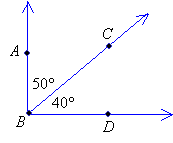
∠ABC is the complement of ∠CBD
Supplementary Angles
Two angles are called supplementary angles if the sum of their degree measurements equals 180 degrees (straight line). One of the supplementary angles is said to be the supplement of the other.
The two angles do not need to be together or adjacent. They just need to add up to 180 degrees. If the two supplementary angles are adjacent then they will form a straight line.
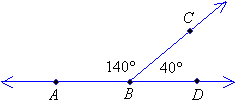
∠ABC is the supplement of ∠CBD
Vertical Angles
Two pairs of angles are formed by two intersecting lines. Vertical angles are opposite angles in such an intersection. Vertical angles are equal to each other.
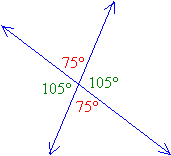
Very often math questions will require you to work out the values of angles given in diagrams by applying the relationships between the pairs of angles.
Example 1:
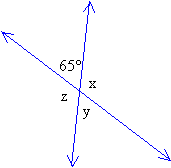
Given the diagram below, determine the values of the angles x, y and z.
Solution:
Step 1: x is a supplement of 65°.
Therefore, x + 65° = 180° ⇒ x = 180° – 65° = 115°
Step 2: z and 115° are vertical angles.
Therefore, z = 115°
Step 3: y and 65° are vertical angles.
Therefore, y = 65°
Answer: x = 115°, y = 65° and z = 115°
How To Use Complementary, Supplementary, And Vertical Angle Pairs Property To Solve For X?
Alternate Interior Angles
When a line intersects a pair of parallel lines alternate interior angles are formed. Alternate interior angles are equal to each other.
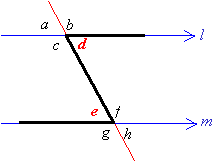
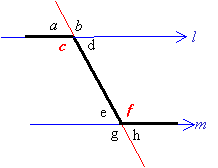
One way to find the alternate interior angles is to draw a zigzag line on the diagram. In the above diagrams, d and e are alternate interior angles. Similarly, c and f are also alternate interior angles.
Example 1:
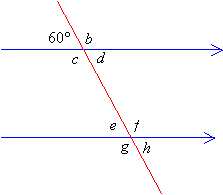
Given the diagram below, determine the values of the angles b, c, d, e, f, g and h.
Solution:
Step 1: b is a supplement of 60°.
Therefore, b + 60° =180° ⇒ b = 180° – 60° = 120°
Step 2: b and c are vertical angles.
Therefore, c = b = 120°
Step 3: d and 60° are vertical angles.
Therefore, d = 60°
Step 4: d and e are alternate interior angles.
Therefore, e = d = 60°
Step 5: f and e are supplementary angles.
Therefore, f + 60° =180° ⇒ f = 180° – 60° = 120°
Step 6: g and f are vertical angles.
Therefore, g = f = 120°
Step 7: h and e are vertical angles.
Therefore, h = e = 60°
Answer: b = 120°, c = 120°, d = 60°, e = 60°, f = 120°, g = 120°and h = 60°
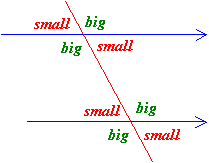
From the above example, you may notice that either an angle is 60° or it is 120°. Actually, all the small angles are 60° and all the big angles are 120°. In general, the diagram will be as shown below. The small and big pair of angles are supplementary (i.e. small + big = 180°). Therefore, given any one angle you would be able to work out the values of all the other angles.
How To Find Alternate Interior Angles?
If two parallel lines are intersected by a transversal then alternate interior angles are congruent.
Alternate Exterior Angles
One way to remember alternate exterior angles is that they are the vertical angles of the alternate interior angles. Alternate exterior anglesare equal to one another.
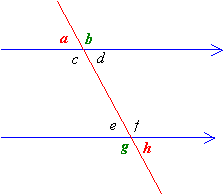
∠a and ∠h are alternate exterior
angles and they are equal to one another.
∠b and ∠g are alternate exterior angles and they are equal to one another.
How To Find Alternate Exterior Angles?
If two parallel lines are intersected by a transversal then alternate exterior angles are congruent.
Corresponding Angles
When a line intersects a pair of parallel lines corresponding angles are formed. Corresponding angles are equal to each other.
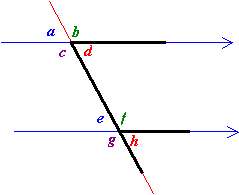
One way to find the corresponding angles is to draw a letter F on the diagram. The F can also be facing backwards.
In the above diagram, ∠d and ∠h are corresponding angles.
There many other corresponding pairs of angles in the diagram:
∠b and ∠f;
∠c and ∠g;
∠a and ∠e.
How To Find Congruent Corresponding Angles?
Adjacent Angles
When two angles are next to one another, they are called adjacent angles. Adjacent angles share a common side and a common vertex.
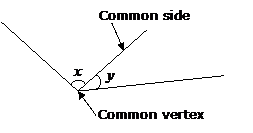
Example:
∠x and ∠y are adjacent angles.
How To Find Adjacent Angles?
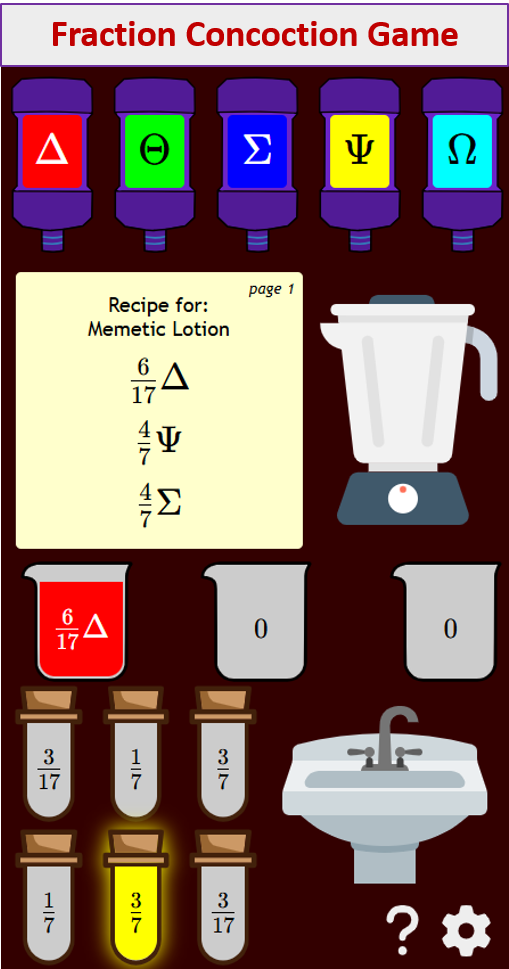
Try out our new and fun Fraction Concoction Game.
Add and subtract fractions to make exciting fraction concoctions following a recipe. There are four levels of difficulty: Easy, medium, hard and insane. Practice the basics of fraction addition and subtraction or challenge yourself with the insane level.
We welcome your feedback, comments and questions about this site or page. Please submit your feedback or enquiries via our Feedback page.