Inverse Of A Function
In these lessons, we will learn what is a one-to-one function, what is the Inverse of a Function and how to find the Inverse of a Function. Many examples with step-by-step solutions will be shown.
Related Pages
Function Notation
Functions
Graphs Of Functions
More Lessons for Algebra
Math Worksheets
What is a one-to-one function?
If a function is defined so that each range element is used only once, then it is a one-to-one function.
- Every y-value is only paired with one x-value.
- A horizontal line test helps determine graphically whether a function is one-to-one. If the horizontal line intersects the graph of a function at more than one point then it is not one-to-one.
- Only one-to-one functions have inverse functions.
What is the Inverse of a Function?
We have learned that a function f maps x to f(x).
The inverse of f is a function which maps f(x) to x in reverse.
The inverse of the function f is denoted by f-1.
The inverse of a function is found by interchanging its range and domain. The domain of F becomes the range of the inverse and the range of F becomes the domain of the inverse of F. The inverse of a function is not always a function and should be checked by the definition of a function. A function only has an inverse if it is one-to-one.
How to find the inverse of a function?
The steps involved in getting the inverse of a function are:
Step 1: Determine if the function is one to one.
Step 2: Interchange the x and y variables. This new function is the inverse function
Step 3: If the result is an equation, solve the equation for y.
Step 4: Replace y by f-1(x), symbolizing the inverse function or the inverse of f.
We can perform this procedure on any function, but the resulting inverse will only be another function if the original function is a one-to-one function.
The following examples illustrates these steps.
Example:
Find the inverse of each of the following functions:
- f = {(1,2), (-2,3), (5,-2)}
- y = x3 + 2
- \(y = \frac{2}{{x - 4}}\)
How to find the inverse of a function, step by step examples
Find the Inverse of a Square Root Function with Domain and Range
Example:
Let \(f(x) = \sqrt {2x - 1} - 3\). Determine the domain and range. Then find f-1(x).
How to find the inverse of a function or show that the inverse does not exists
- Replace f(x) with y.
- Switch x’s and y’s.
- Solve for y.
- Replace ‘y’ with f-1(x)
Examples:
Find the inverse of
\(f(x) = \sqrt {x + 4} - 3\)
\(y = \frac{{5x - 3}}{{2x + 1}}\)
Find the inverse of the function if one exists
\(f(x) = \frac{{8 - {x^2}}}{5}\)
This video shows algebraically that the above function does not have an inverse.
Find the Inverse Function of an Exponential Function
Example:
f(x) = 3e2x
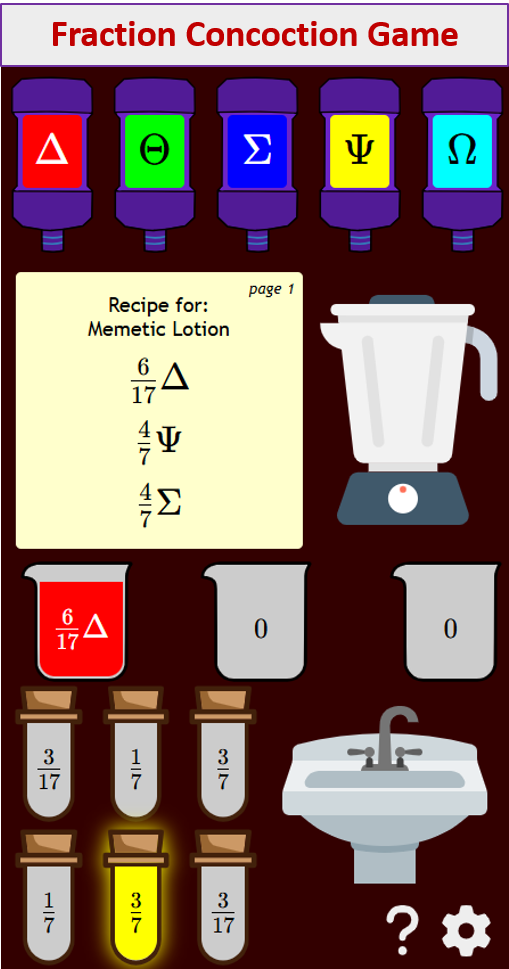
Try out our new and fun Fraction Concoction Game.
Add and subtract fractions to make exciting fraction concoctions following a recipe. There are four levels of difficulty: Easy, medium, hard and insane. Practice the basics of fraction addition and subtraction or challenge yourself with the insane level.
We welcome your feedback, comments and questions about this site or page. Please submit your feedback or enquiries via our Feedback page.