Function Notation
Related Pages
Functions
Graphs Of Functions
More Lessons for Algebra
Math Worksheets
Function notation is a way to represent and work with functions in mathematics. It provides a clear and concise way to express the relationship between inputs (independent variables) and outputs (dependent variables). Function notation is widely used in algebra, calculus, and other areas of mathematics.
In this lesson, we will look into the notation for functions and how to obtain the value of a function.
What is a Function?
A function is a rule that assigns exactly one output to each input. In other words, for every input x, there is exactly one corresponding output y.
What is function notation?
Functions are given letter names.
The names are of the form f(x) which is read “f of x”. The letter inside the parentheses,
usually x, stands for the domain set.
The entire symbol, usually f(x), stands for the range set.
The ordered-pair numbers become (x, f(x)).
The following diagram shows what is function notation. Scroll down the page for more examples and solutions of function notations.
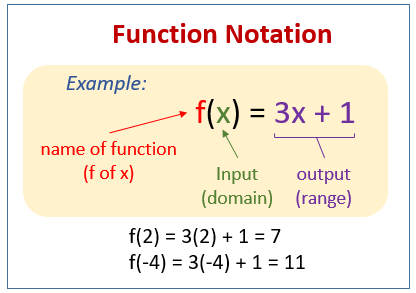
Function notation uses the symbol f(x) to represent the output of a function f when the input is x.
f is the name of the function.
x is the input (independent variable).
f(x) is the output (dependent variable).
Example:
Given f(x) = x2 + 3x – 1, find
a) f(1)
b) f(–1)
c) f(a)
d) f(x – 1)
Solution:
a) f(1) = (1)2 + 3(1) – 1 = 3
b) f(–1) = (–1)2 + 3(–1) – 1 = –3
c) f(a) = a2 + 3a – 1
d) f(x – 1) = (x – 1)2 + 3(x – 1) – 1
= x2 – 2x + 1 + 3x – 3 – 1 = x2 + x –3
Example:
Give g(x) = x2 + 2, find
a) g(a + b)
b) g(x2)
Solution:
a) g(a + b) = (a + b)2 + 2
= a2 + 2ab + b2 + 2
b) g(x2) = (x2)2 + 2 = x4 + 2
Videos
Function Notation
Throughout mathematics, we find function notation. Function notation is a way to write
functions that is easy to read and understand.
Functions have dependent and independent
variables, and when we use function notation the independent variable is commonly x, and
the dependent variable is f(x).
In order to write a relation or equation using function
notation, we first determine whether the relation is a function.
Function Notation
How to use the function Notation?
A basic description of function notation and a few examples involving function notation.
Example:
If g(t) = t2 - 2t + 1
- g(3t)
- 5g(-1)
- solve g(t) = 1
If f(x) = 5x -2, h(x) = x2 - 3f(x)
- f(2x - 1)
- -f(a)
- Solve f(-x) = h(x) + 2
Why Use Function Notation? (Advantages)
- Clarity and Specificity:
It clearly states the input variable. For example, f(x) immediately tells you the function operates on x.
It’s more precise than just “y”. If you have multiple functions, you can name them differently (e.g., f(x), g(x), h(t)). - Easy Evaluation:
It simplifies showing the evaluation of a function for a specific input. - Directly Shows Input-Output Relationship:
When you see f(5), you immediately know that 5 is the input value for the function f
| Check out our most popular games! | ||
|---|---|---|
 Fraction Concoction |
 Fact Family Game |
 Number Bond Garden |
 Online Addition Subtraction Game |
 Penguin Solitaire |
 Sawayama Solitaire |
 Ark Solitaire |
 Eldritch Invasion |
 Shenzhen Solitaire |
Check out more Solitaire games here.
We welcome your feedback, comments and questions about this site or page. Please submit your feedback or enquiries via our Feedback page.