Digit Word Problems - Interchanging of digits
Related Pages
Different types of Digit Word Problems
Integer Problems
Integers
In a previous lesson, we have looked at examples of Digit Word problems that focus on the relationship between the digits themselves. Digit Word Problems
In this lesson, we will consider examples of Digit Word Problems that involve the interchanging of digits or digit reversal and the relationship between digits and the number.
Types of Digit Word Problems
In this lesson, we will look at two types of Digit Word Problems.
These problems emphasize the place value of the digits (tens, units, hundreds, etc.) and how they contribute to the number’s value. They often require you to express the number in its expanded form. For example, a two-digit number can be represented as 10x + y, where ‘x’ is the tens digit and ‘y’ is the units digit. The number 37 can be written as (10 × 3) + 7.
1. Reversing Digit Problems (or interchange digits):
These problems involve reversing the digits of a number and comparing the resulting number to the original. Common phrases include:
“If the digits are reversed, the number is increased/decreased by…"
“The number is 18 more than the number with its digits reversed…"
Example: A two-digit number is such that when the digits are reversed, the new number is 27 greater than the original number. The sum of the digits is 9. Find the original number.
2. Relationship Between Digits and the Number:
These problems connect the digits to the value of the number itself. They might use phrases like:
“The number is equal to a certain multiple of the sum of its digits…"
“The number is a certain number more than ten times the units digit…"
Example: A two-digit number is 6 times the sum of its digits. The tens digit is 1 less than the units digit. Find the number.
How to solve Digit Word Problems?
Steps for Solving Digits Problems:
- Define variables to represent the digits. For example, ‘x’ is the tens digit, ‘y’ is the units digit etc.
- Set up equations:
Translate the given information into equations. Look for clues like:
“The sum of the digits is…"
“The tens digit is twice the units digit…"
“If the digits are reversed, the number is increased/decreased by…"
“The number is equal to a certain multiple of the sum of its digits…" - Solve the equation or system of equations.
- Check the solution to ensure it makes sense in the context of the problem. Digits must be whole numbers between 0 and 9. If you get a fractional answer, there might be an error in the problem or your calculations.
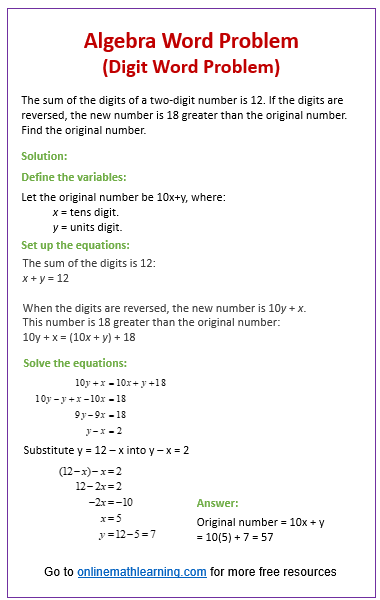
The following diagram shows how to solve a digit word problem that involve digit reversal and the relationship between digits and the number. Scroll down the page for more examples and solutions.
Algebra Worksheets
Practice your skills with the following Algebra worksheets:
Printable & Online Algebra Worksheets
Number Reversal Digit Problems
Example:
The sum of the digits of a two-digit number is 11. If we interchange the digits then the new
number formed is 45 less than the original. Find the original number.
Solution:
Step 1:
Assign variables
Let x = one’s digit and t = ten’s digit
Sentence: The sum of the digits of a two-digit number is 11.
x + t = 11
Isolate variable x
x = 11 – t (equation 1)
Step 2:
Convert digits to number
Original number = t × 10 + x
Interchanged number = x × 10 + t
Sentence: If we interchange the digits then the new number formed is 45 less than the original.
Interchanged = Original – 45
x × 10 + t = t × 10 + x – 45
10x + t = 10t + x – 45
10x – x + t = 10t – 45 (–x to both sides)
10x – x = 10t – t – 45 (– t to both sides)
10x – x + 45 = 10t – t (+ 45 to both sides)
10t – t = 10x – x + 45 (Rewrite equation with t on the left hand side)
Combine like terms
10t – t = 10x – x + 45
9t = 9x + 45 (equation 2)
Substitute equation 1 into equation 2
9t = 9(11 – t) + 45
9t = 99 – 9t + 45
Isolate variable t
9t + 9t = 99 + 45
18t = 144

The ten’s digit is 8. The one’s digit is 11 – 8 = 3
Answer: The number is 83.
Videos
How to use Systems of Equations to solve Reversing Digits Word Problem?
Reversing digits word problem
Problem:
The sum of two digits of a 2-digit number is 11. Reversing the digits increase the number by 45.
What is the number?
Example:
The sum of two digits of a 2-digit number is 13. Reversing the digits increase the number by 45.
What is the number?
Example:
The sum of the digits of a two digit number is 9. When the digits are reversed the new number is 9
less than three times the original.
Examples:
-
The sum of the digits of a 2-digit number is 10. The tens digit is 4 times the ones digit. Find the number.
-
A 2-digit number is 10 times the sum of its digits. The tens digit is 2 greater than the units digit. Find the number.
-
The sum of the digits of a 2-digit number is 14. If 18 is added to the number, the result is the number with its digits reversed. Find the original number.
-
The sum of the digits of a 2 digit number is 9. If the digits are reversed, the new number is 9 less than 3 times the original number. Find the original number.
Check out many other Algebra Word Problems
Age Word Problems, Average Word Problems, Coin Word Problems, Consecutive Integer Word Problems, Digit Word Problems, Distance Word Problems, Fraction Word Problems, Geometry Word Problems, Integer Word Problems, Interest Word Problems, Lever Word Problems, Mixture Word Problems, Money Word Problems, Motion & Distance Word Problems, Number Sequence Word Problems, Proportion Word Problems, Quadratic Equation Word Problems, Ratio Word Problems, Symbol Word Problems, Variation Word Problems, Work Word Problems.
| Check out our most popular games! | ||
|---|---|---|
 Fraction Concoction |
 Fact Family Game |
 Number Bond Garden |
 Online Addition Subtraction Game |
 Penguin Solitaire |
 Sawayama Solitaire |
 Ark Solitaire |
 Eldritch Invasion |
 Shenzhen Solitaire |
Check out more Solitaire games here.
We welcome your feedback, comments and questions about this site or page. Please submit your feedback or enquiries via our Feedback page.