Construct a 30˚Angle from a 60˚Angle
In these lessons, we will learn how to construct a 30-degree angle from a 60-degree angle.
Related Pages
Constructing Angles
Construct 45° Angles
More Geometry Lessons
We can use the angle bisector method to construct some other angles from existing angles.
Examples:
A 30° angle can be obtained by bisecting a 60° angle.
A 15° angle can be obtained by bisecting a 30° angle.
A 45° angle can be obtained by bisecting a 90° angle.
A 22.5° angle can be obtained by bisecting a 45° angle.
Example:
The figure shows a point B on a straight line. Construct an angle of 30° at point B.

Solution:
Construct a 60° angle, and then construct an angle bisector to obtain a 30° angle.
Step 1: Stretch the compasses to any width. Put the sharp end of the compasses at point B and draw an arc on the line. Label the point where the arc intersects the line as point C.
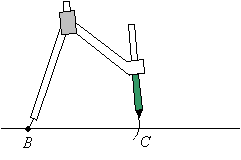
Step 2: While keeping the sharp end of the compasses at point B, move the compasses away from C and draw a second arc above the line about mid-way between points B and C.
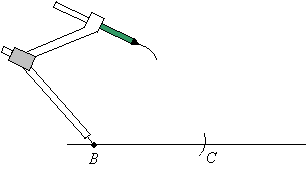
Step 3: Without changing the width of the compasses, place the sharp end of the compasses at point C and draw an arc to intersect the second arc.
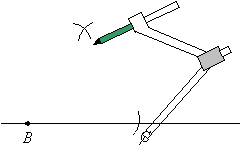
Step 4: Draw a line from point B to the point of intersection of the 2 arcs. Angle ABC is 60˚.
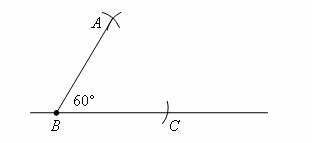
Step 5: We now need to Bisect angle ABC. Put the sharp end of your compasses at point B and make one arc on the line BC (point S) and another arc on line AB (point T).
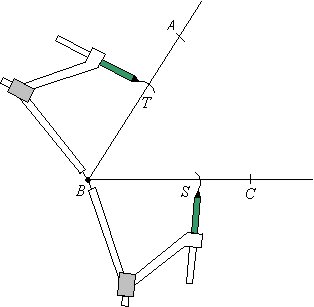
Step 6: Without changing the width of your compasses, put the sharp end of the compasses at S and make an arc within the lines AB and BC. Do the same at T and make sure that the second arc intersects the first arc.
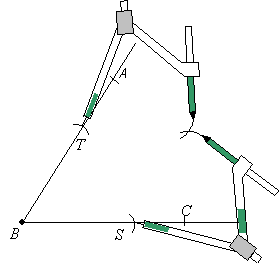
Step 7: Draw a line from point B to the points of intersection
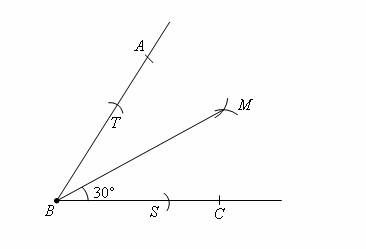
of the 2 arcs. This line MB bisects  .
Angle MBC is 30 degrees.
.
Angle MBC is 30 degrees.
How To Construct A 45 Degree Angle Using A Compass And Ruler
Constructing a 45-degree angle can be done by first constructing a 90-degree angle and then bisecting
this 90-degree angle. Make sure you know how to construct an angle bisector and a 90-degree angle
before you attempt constructing a 45-degree angle.
How to construct a 30 degree angle using a pencil, ruler and a pair of compasses only?
How to construct an angle of 30 and 60 degrees?
Try out our new and fun Fraction Concoction Game.
Add and subtract fractions to make exciting fraction concoctions following a recipe. There are four levels of difficulty: Easy, medium, hard and insane. Practice the basics of fraction addition and subtraction or challenge yourself with the insane level.
We welcome your feedback, comments and questions about this site or page. Please submit your feedback or enquiries via our Feedback page.