Geometry: Angles
Related Topics:
More Geometry Lessons
Geometry Worksheets
Geometry Games
In these lessons, we will learn the following:
- How to form an Angle
- Naming an Angle
- Measuring Angles with a protractor
- Angles around a point (with worksheets)
How to form an Angle
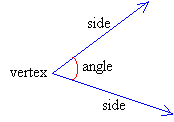
In geometry, an angle consists of two rays that share the same endpoint. The point where the rays intersect is called the vertex of the angle. The two rays are called the sides of the angle.
Naming An Angle
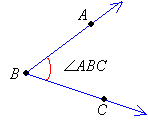
You can name an angle by specifying three points: two on the rays and one at the vertex.
The angle below may be specified as angle ABC or ∠ABC. The vertex point is always given in the middle.
How to name an angle?
The vertex is the point where the two rays meet to form an angle.
Angles can be named in three ways:
- By three capital letters, with the vertex letter in the middle. ∠ABC or ∠CBA
- By one capital letter ∠B. This can only be used if ∠B is the only angle it could be.
- By one lower case letter or number written in the middle of the angle.
Have a look at the following video for more examples on how to name angles
How to name an angle using three letters
Measuring Angles
The size of an angle is measured in degrees with the use of a protractor.
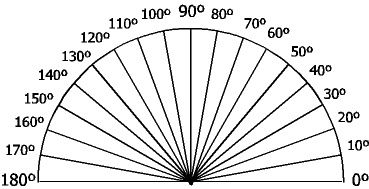
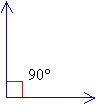
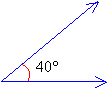
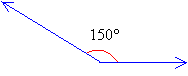
A straight line has an angle of 180°

Worksheets for Angles in a straight line
How to use a protractor to measure an angle?
How to Measure a Reflex Angle Using a Protractor?
Angles Around A Point
The sum of angles around a point will always be 360 degrees.
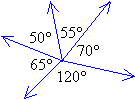
In the diagram above, the sum of the angles is 70° + 55° + 50° + 65° + 120° = 360°
Example 1: Given the diagram below, determine the value of the angle a.
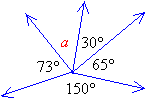
Solution:
Step 1: Get the sum of the known angles.
30° + 65° + 150° + 73° = 318°
Step 2: Subtract sum of known angles from 360°
360° – 318° = 42°
Answer: Angle a is 42°
Worksheets for Angles Around a Point
What are angles around a point?
It will also give some examples of finding angles around a point.
Problem Solving: Angles Around a Point
This video discusses relationships among angles around a point.
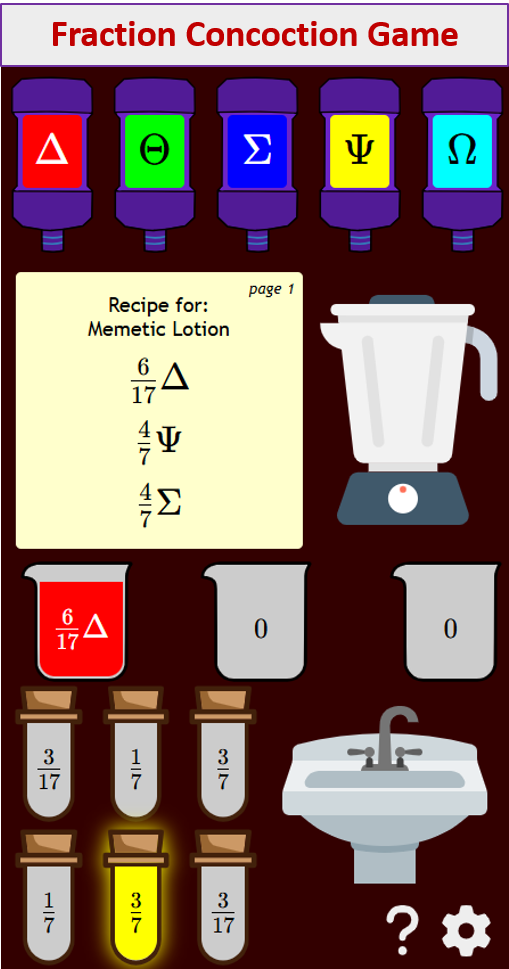
Try out our new and fun Fraction Concoction Game.
Add and subtract fractions to make exciting fraction concoctions following a recipe. There are four levels of difficulty: Easy, medium, hard and insane. Practice the basics of fraction addition and subtraction or challenge yourself with the insane level.
We welcome your feedback, comments and questions about this site or page. Please submit your feedback or enquiries via our Feedback page.