Zero Property of Multiplication
Related Pages
Commutative Property
Identity Property Of Addition, Multiplication
More Lessons for Arithmetic
Math Worksheets
These lessons, with videos, examples, and solutions, help Grade 6 students learn about the Multiplication Properties: commutative property, associative property, identity property, zero property.
Multiplication Properties
Multiplication has several core properties that are essential for understanding how numbers behave and for simplifying calculations in mathematics, especially in algebra.
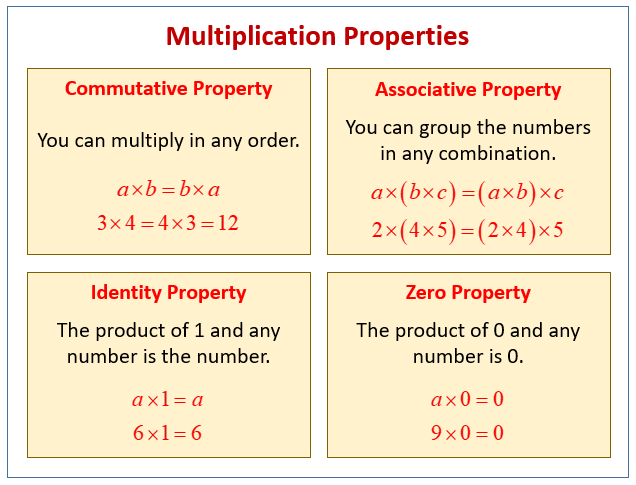
The following diagram gives Multiplication Properties: identity property, zero property, commutative property, and associative property. Scroll down the page for more examples and solutions on how to use the multiplication properties.
Multiplication Worksheets
Practice your skills with the following Multiplication worksheets:
Printable & Online Multiplication Worksheets
Here are the main properties of multiplication:
1. Commutative Property of Multiplication
Definition: The order in which you multiply numbers does not change the product.
Rule: a × b = b × a
Why it’s useful: Allows you to rearrange factors to make calculations easier.
Check out this lesson on Commutative Property
2. Associative Property of Multiplication
Definition: The way in which factors are grouped in a multiplication problem does not change the product. This property applies when multiplying three or more numbers.
Rule: (a × b) × c = a × (b × c)
Why it’s useful: Helps in simplifying complex multiplication problems by allowing you to choose the most convenient order for multiplying.
Check out this lesson on Associative Property
3. Identity Property of Multiplication (Multiplicative Identity)
Definition: The product of any number and one (1) is that number itself.
Rule: a × 1 = a and 1 × a = a
Why it’s useful: The number 1 is called the multiplicative identity because it “identifies” the original number; multiplying by 1 doesn’t change its value. This is particularly useful in algebra for creating equivalent expressions.
Check out this lesson on Identity Property
4. Zero Property of Multiplication (Multiplicative Property of Zero)
Definition: The product of any number and zero (0) is zero.
Rule: a × 0 = 0 and 0 × a = 0
Why it’s useful: Allows for quick simplification of expressions and is fundamental in solving equations (e.g., if a product is zero, at least one of the factors must be zero).
5. Distributive Property of Multiplication over Addition (and Subtraction)
Definition: This property links multiplication with addition (or subtraction). It states that multiplying a number by a sum (or difference) is the same as multiplying that number by each term in the sum (or difference) and then adding (or subtracting) the products.
Rule:
a × (b + c) = (a × b) + (a × c)
a × (b − c) = (a × b) − (a × c)
Why it’s useful: Simplifying algebraic expressions, solving equations, and performing mental math.
Check out this lesson on Distributive Property
Multiplication Properties
Multiplication properties: identity property, zero property, commutative property, and associative property.
Commutative Property: Changing the order of the factor does not change the product.
Associative Property: Changing the grouping of the factors does not change the product.
Identity Property: The product of 1 and any number is the number.
Zero Property: The product of 0 and any number is 0.
What is the zero property of multiplication?
The zero property of multiplication states that any number times zero has a product of zero.
Zero Property of Multiplication
Commutative and Zero Properties of Multiplication
| Check out our most popular games! | ||
|---|---|---|
 Fraction Concoction |
 Fact Family Game |
 Number Bond Garden |
 Online Addition Subtraction Game |
 Penguin Solitaire |
 Sawayama Solitaire |
 Ark Solitaire |
 Eldritch Invasion |
 Shenzhen Solitaire |
Check out more Solitaire games here.
We welcome your feedback, comments and questions about this site or page. Please submit your feedback or enquiries via our Feedback page.