Zero & Positive Exponent Game
Related Pages
Printable Math Worksheets
Online Math Quizzes
Math Games
Math Worksheets
Exponent is a shorthand instruction for multiplication. A “power” consists of two specific parts:
The Base (b): This is the factor—the actual number being multiplied.
The Exponent (n): The small number up top that tells you how many times to use the base in multiplication.
Zero & Positive Exponent Game
Welcome to the Power-Up Lab. This game is designed to test your mastery of exponents through a sci-fi “core calibration” interface. Scroll down the page for a detailed explanation.
How to Play the Zero & Positive Exponent Game
Phase 1: Configuration
Before you begin, you must set the parameters of your “Power Core” on the Main Menu:
Max Base: Sets the highest possible number that will be used as the large bottom number.
Max Exponent: Sets the highest possible power (the small top number).
Standard Mode: Problems will use exponents from 1 up to your chosen maximum.
With 0 Mode: Adds the Zero Rule into the mix, meaning you will see problems with an exponent of 0.
Phase 2: Solving Problems
Once the game starts, you’ll see a large number (the Base) and a smaller number (the Exponent), such as 53. You must fill in two data points to “Calibrate the Core”:
-
Expanded Form
This shows the logic behind the power.
Standard: Type the base multiplied by itself the number of times shown in the exponent. Use * or x for multiplication (e.g., for 53, type 5x5x5).
The Identity Rule (x1): If the exponent is 1, the expanded form is just the base itself (e.g., 5).
The Zero Rule (x0): If the exponent is 0, the expanded form is 1. -
Calculated Value
This is the final result of the math.For 53 (5 × 5 × 5), you would enter 125.
Phase 3: Feedback & Scoring
After clicking Calibrate Core, the system provides a status report:
Power Optimal: You got both the expansion and the value correct. Your success ratio (Correct/Attempted) will increase.
Grid Failure: One or both of your entries were incorrect. The system will provide a hint or the correct result so you can recalibrate for the next round.
Accuracy Tracking: Check the top-right corner to see your Success Rate. Aim for 100% stability
The Three Golden Rules
In your Power-Up Lab game, we focused on these three scenarios:
Standard Multiplication (x^n): The “n” tells you how many times to write the base.
Example: 2^4 = 2 × 2 × 2 × 2 = 16.
The Identity Rule (x1): Any number to the power of 1 is just itself. The cloning machine hasn’t actually started yet; you just have the original number.
Example: 1001 = 100.
The Zero Rule (x0): This is the one that feels like a “glitch,” but it’s vital. Any non-zero number to the power of 0 is always 1.
The Logic: Think of it as a pattern. Every time you decrease an exponent, you divide by the base.
23 = 8
22 = 4 (divided by 2)
21 = 2 (divided by 2)
20 = 1 (divided by 2)
The video gives a clear, step-by-step approach to practice long division.
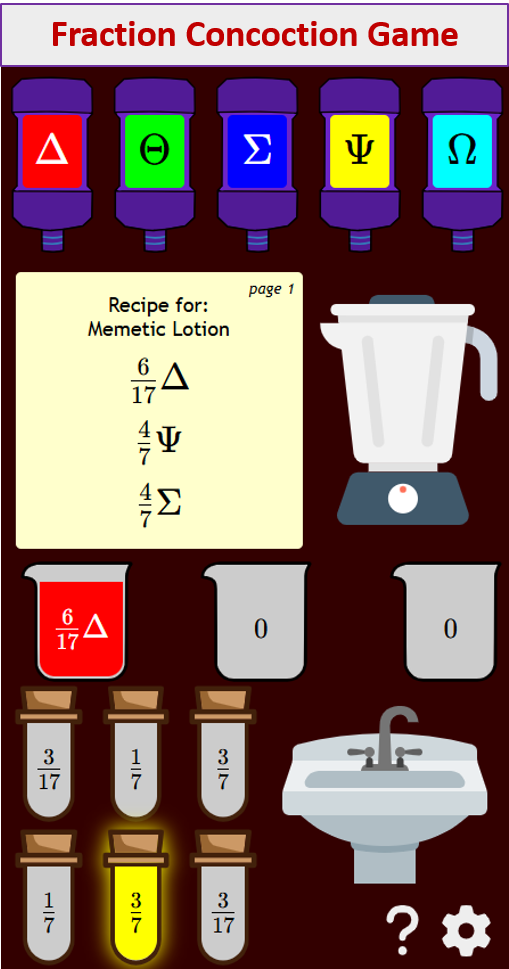
Try out our new and fun Fraction Concoction Game.
Add and subtract fractions to make exciting fraction concoctions following a recipe. There are four levels of difficulty: Easy, medium, hard and insane. Practice the basics of fraction addition and subtraction or challenge yourself with the insane level.
We welcome your feedback, comments and questions about this site or page. Please submit your feedback or enquiries via our Feedback page.