Words to Equations Game
Related Pages
Printable Math Worksheets
Online Math Quizzes
Math Games
Math Worksheets
Translating words into algebraic equations is like learning a new language. You are taking verbal phrases (English) and turning them into mathematical syntax (Numbers, Variables, and Operations).
Words to Equations Game
This game is a comprehensive tool designed to help you master the translation of English phrases into algebraic logic. Scroll down the page for a more detailed explanation.
How to Play the Words to Equations Game
- Choosing Your Difficulty
When you launch the game, you’ll be presented with two distinct paths:
Easy (Multiple Choice): You are given four equations. One is correct, and the others are common “trap” answers (like wrong order or wrong operation). This is great for learning to spot common mistakes.
Hard (Type it in!): You must use your keyboard to construct the equations. There are no hints, and you must be precise with your symbols and order.
- Identify the “Equals” Sign
In an equation (unlike a simple expression), there is always a balance. Look for specific “anchor” words that represent the equal sign (=):
“Is”
“Equals”
“Results in”
“Is the same as”
- Translate the Operations
Break the sentence into chunks based on the four main operations. Watch out for “turn-around” phrases that change the order of the numbers.
| Math Symbol | Verbal Keywords | Example |
| + | Sum, plus, increased by, more than | "5 more than x is 12" → x + 5 = 12 |
| - | Difference, minus, less than, decreased by | "Difference of x and 3 equals -2" → x - 3 = -2 | Multiplication (×) | product, twice (2), triple (3) | "Product of 4 and y is the same as 18" → 4y = 18 | Division (/) | quotient, ratio, half, divided by | "Quotient of z and 2 results in 14" → z/2 = 14 |
- Handle Grouping (Parentheses)
If you see phrases like “times the sum of” or “twice the difference of,” the game is telling you to use parentheses. The addition or subtraction must happen before the multiplication.
Example: “3 times the sum of x and 4 is 42” → 3(x + 4) = 42.
- Winning Strategy
Step 1: Read the whole sentence first to find the “is” (the =).
Step 2: Identify the variable (usually x, y, n, or w).
Step 3: Translate the left side of the “is."
Step 4: Translate the right side of the “is."
Step 5” Check for turn-arounds: If you see “less than,” make sure you put the subtraction at the end of that side.
- Scoring and Results
The Score Counter at the top tracks your progress (Correct / Total played).
Step-by-Step Translation Strategy
If you have a long phrase, follow these steps:
Step 1 Identify the Variable: Look for “a number” or a specific letter (x, n, y).
Step 2 Circle the Operators: Find words like “times,” “sum,” or “less than."
Step 3 Check for Order: Is there a “turn-around” word?
Step 4 Write the Expression: Assemble the parts like a puzzle.
The video gives a clear, step-by-step approach to write algebraic equations.
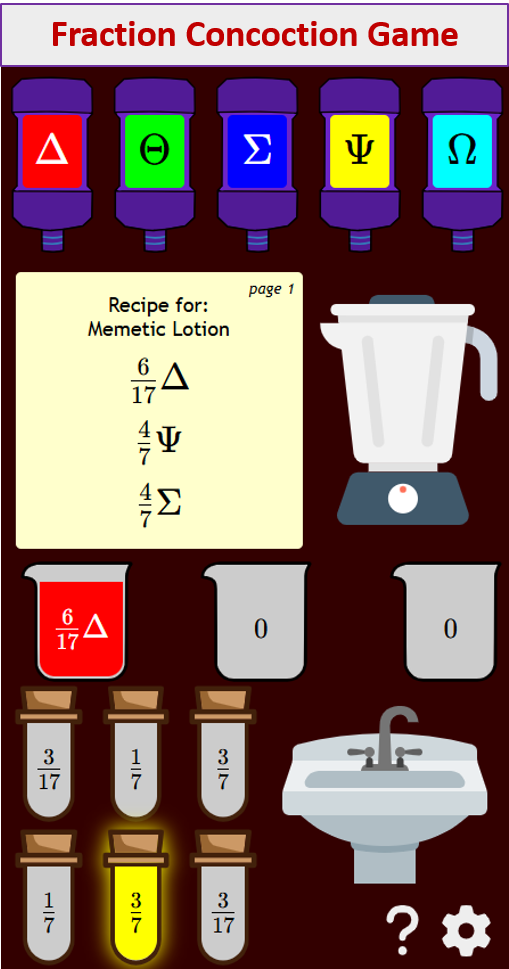
Try out our new and fun Fraction Concoction Game.
Add and subtract fractions to make exciting fraction concoctions following a recipe. There are four levels of difficulty: Easy, medium, hard and insane. Practice the basics of fraction addition and subtraction or challenge yourself with the insane level.
We welcome your feedback, comments and questions about this site or page. Please submit your feedback or enquiries via our Feedback page.