Loading magic...
Word Problem Game (Mixed Op)
Related Pages
Printable Math Worksheets
Online Math Quizzes
Math Games
Math Worksheets
This Word Problem (Mixed Op) Game/Worksheet is a great way to put your skills to the test in a fun environment. By practicing, you’ll start to work out the answers efficiently.
Share this page to Google Classroom
Word Problem Quiz/Game (Mixed Op)
These problems deliberately mix operations in sequences that require careful reading. Scroll down the page for a more detailed explanation.
This game is designed for third and fourth graders to practice reading and solving 2-step multiplication, division, addition and subtraction word problems. It involves different types of mixed operation word problems.
Word Problem (Mixed Op)
Score
0
Question
1/10
🏰
Ready to Solve?
Read carefully and pick the correct number!
🌟
Quest Complete!
You are a math wizard!
Final Score
0/10
How to Play the Word Problem Game
- Look at the Problem: Read the problem carefully, solve it and select one of the answers.
- Check Your Work: If you selected the right answer, it will be highlighted in green. If you are wrong, it will be highlighted in red and the correct answer will be highlighted in green.
- Get a New Problem: Click “Next Problem” for a new problem.
Your score is tracked, showing how many you’ve gotten right. - Finish Game When you have completed 10 questions, your final score will be displayed.
Mixed Operation Word Problems
Mixed operation word problems are math stories that require you to use more than one type of calculation (Addition, Subtraction, Multiplication, or Division) to find the final answer. The challenge lies in translating “human language” into “math language.”
The “Clue Word” Dictionary
The first step is identifying which operation to use based on the vocabulary in the story.
Operation: Addition (+)
Action: Combining groups
Common Clue Words: Total, Sum, Altogether, Combined, In all, Plus
Operation: Subtraction (-)
Action: Finding a difference or “leftovers”
Common Clue Words: Remaining, Left, How many more, Difference, Fewer
Operation: Multiplication (×)
Action: Repeating equal groups
Common Clue Words: Each, Times, Per, Product, Twice (x2)
Operation: Division (÷)
Action: Splitting into equal groups
Common Clue Words: Shared, Divided, Each (when finding a unit), Cut into, Half
The Step-by-Step Strategy
To solve these without getting overwhelmed, follow this workflow:
R - Read (and Visualize)
Read the problem twice. Imagine the scenario.
Example: “Sarah had 5 boxes of 8 pencils. She gave 12 pencils to her friend. How many does she have left?"
Mental Image: I see 5 boxes. I see pencils inside. I see someone taking some away.
I - Identify the “Hidden” Step
Most mixed problems have a “hidden” question you must answer before the final one.
Hidden question: How many pencils did she start with in total? (5 × 8 = 40).
P - Plan the Equation
Write out the operations in order.
(Number of boxes × Pencils per box) - Pencils given away = Answer
(5 × 8) - 12 = ?
S - Solve and Check
40 - 12 = 28.
Check: Does 28 make sense? Yes, it is less than 40 but more than 0.
Common Problem Patterns
The “Buy and Lose” (Multiplication + Subtraction)
The Story: You buy multiple items, then some are lost, broken, or given away.
Example: “A baker makes 4 trays of 12 cookies. He drops 6 cookies. How many are left?"
Math: 4 × 12 - 6 = 42
The “Split the Total” (Addition + Division)
The Story: Two groups are combined, then the total is divided among people or containers.
Example: “Tom has 15 red marbles and 25 blue marbles. He puts them equally into 5 bags."
Math: 15 + 25 ÷ 5 = 8
The “Budget & Remainder” (Multiplication + Subtraction)
The Story: You have a set amount of money, buy several of the same item, and find the change.
Example: “You have $50. You buy 3 books for $12 each. How much money do you have left?"
Math: 50 - 3 × 12) = 14
This video gives a clear, step-by-step approach to explain how to solve addition, subtraction, multiplication, and division word problems.
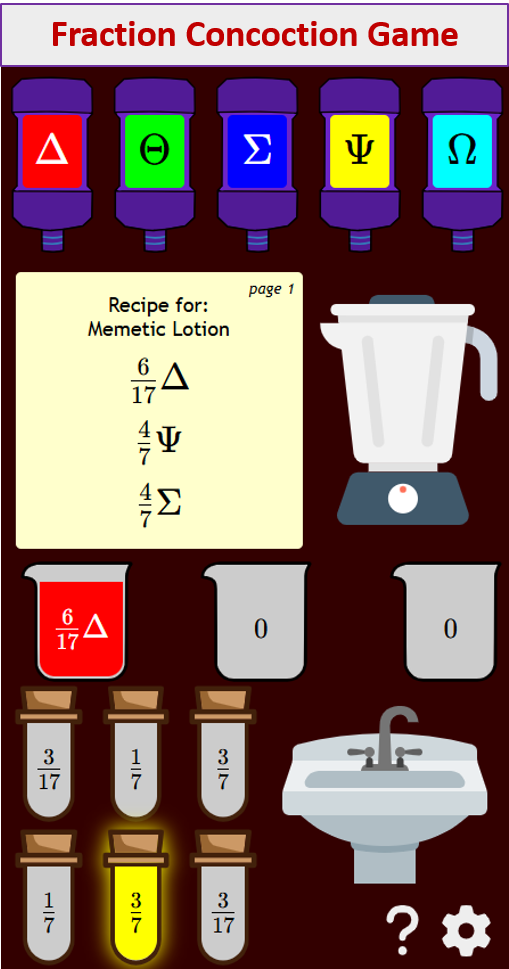
Try out our new and fun Fraction Concoction Game.
Add and subtract fractions to make exciting fraction concoctions following a recipe. There are four levels of difficulty: Easy, medium, hard and insane. Practice the basics of fraction addition and subtraction or challenge yourself with the insane level.
We welcome your feedback, comments and questions about this site or page. Please submit your feedback or enquiries via our Feedback page.