Solve Rational Equations
Related Topics:
Algebra Word Problems
Common Core (Algebra)
Common Core for Mathematics
Common Core: HSA-REI.A.2
Examples, solutions, videos and lessons to help High School students learn how to solve simple rational and radical equations in one variable, and give examples showing how extraneous solutions may arise.
Suggested Learning Targets
- Solve simple rational and radical equations in one variable and provide examples of how extraneous solutions arise.
How to solve rational equations A rational equation is an equation that contains one or more rational expressions (fractions where the numerator and/or denominator are polynomials, and the variable appears in the denominator).
The main strategy to solve them is to eliminate the denominators to turn the rational equation into a polynomial equation (linear or quadratic, usually), which you can then solve using standard algebraic techniques.
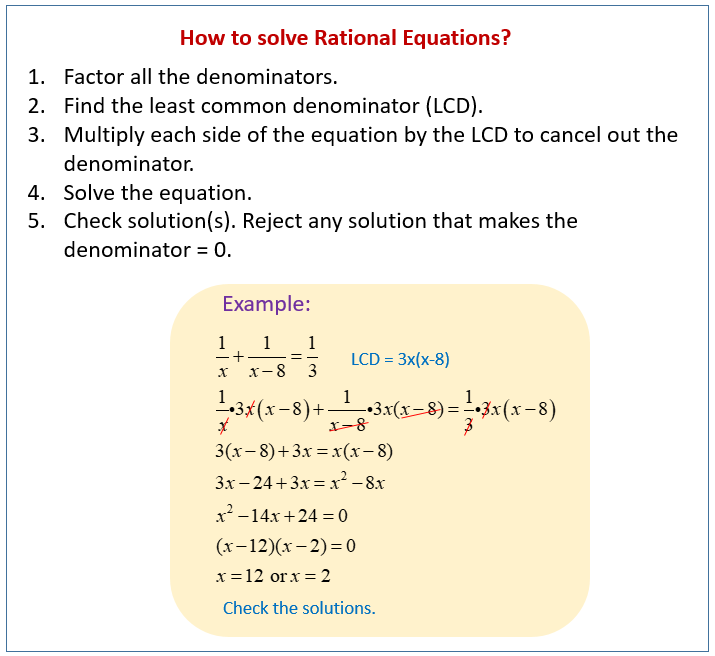
The following figure shows how to solve rational equations. Scroll down the page for more examples and solutions.
Algebra Worksheets
Practice your skills with the following worksheets:
Printable & Online Algebra Worksheets
Steps to Solve Rational Equations:
- Factor all denominators (if necessary).
This helps you identify all the unique factors that make up your denominators. - Identify Restrictions (or Excluded Values).
Determine what values of the variable(s) would make any denominator in the original equation equal to zero. These values are called restrictions or extraneous values, and they cannot be solutions to the equation because division by zero is undefined. If you get one of these values as a solution later, you must discard it. - Find the Least Common Denominator (LCD) of all terms.
- Multiply every term on both sides of the equation by the LCD.
- Simplify and solve the resulting polynomial equation.
- Check for Extraneous Solutions.
Compare the solutions you found in Step 5 with the restrictions you identified in Step 2. Any solution that matches a restriction must be discarded. If all solutions are extraneous, then the equation has no solution. - Verify remaining solutions (optional but recommended).
Substitute your valid solutions back into the original equation to ensure they make the equation true.
Videos
Extraneous Solutions to Rational Equations
Examples:
Solve and eliminate any extraneous solutions:
x2/(x + 2) = 4/(x + 2)
Solve a Rational Equation with Extraneous Solution
Solve a rational equation by multiplying both sides by the LCD and check the answers for extraneous solutions.
Solve 4(x - 3)/(x2 - 36) = 1/(6 - x) + 2x/(6 + x)
Solving Rational Equations
This video explains how to solve rational equations.
Examples:
- 2/3 - 5/6 = 1/t
- (x + 2)/(x - 6) = (x - 1)/(x + 2)
- x/(x + 3) - x/(x - 2) = 10/(x2 + x - 6)
- 4y/(y + 2) - 3y/(y - 1) = (y2 - 8y - 4)/(y2 + y - 2)
Ex 1: Solving Rational Equations.
Examples:
- 2x/15 - 1/6 = x/5
- 5/(x - 3) = 4/(x + 2)
Ex 2: Solving Rational Equations.
Examples:
- 2/5x - 3 = 4/x
- 2x - 16/x = 4
Ex 3: Solving Rational Equations.
Examples:
- (x + 4)/x = 6/(x - 4)
- 5/(x - 7) = -2x/(x + 3)
Ex 4: Solving Rational Equations.
Examples:
- x/(x - 2) - x/(x2 - 4) = (x + 3)/(x + 2)
- 5/(x - 3) = 4/(x + 2)
Ex 5: Solving Rational Equations.
Examples:
- (x - 3)/(x + 6) + (x - 2)/(x - 3) = x2/(x2 + 3x - 18)
- 5/(x - 3) = 4/(x + 2)
Applications of Rational Equations I
The video explains application problems that use rational equations. Part 1 of 2.
Applications of Rational Equations II
The video explains application problems that use rational equations. Part 2 of 2.
| Check out our most popular games! | ||
|---|---|---|
 Fraction Concoction |
 Fact Family Game |
 Number Bond Garden |
 Online Addition Subtraction Game |
 Penguin Solitaire |
 Sawayama Solitaire |
 Ark Solitaire |
 Eldritch Invasion |
 Shenzhen Solitaire |
Check out more Solitaire games here.
We welcome your feedback, comments and questions about this site or page. Please submit your feedback or enquiries via our Feedback page.