Solving Exponential Equations With Different Bases
Related Pages
Solving Exponential Equations With The Same Base
Logs And Exponential Equations
More PreCalculus Lessons
More Algebra Lessons
Grade 10 Math Lessons
These lessons help PreCalculus students learn how to solve exponential equations with different bases.
How to solve exponential equations with different bases
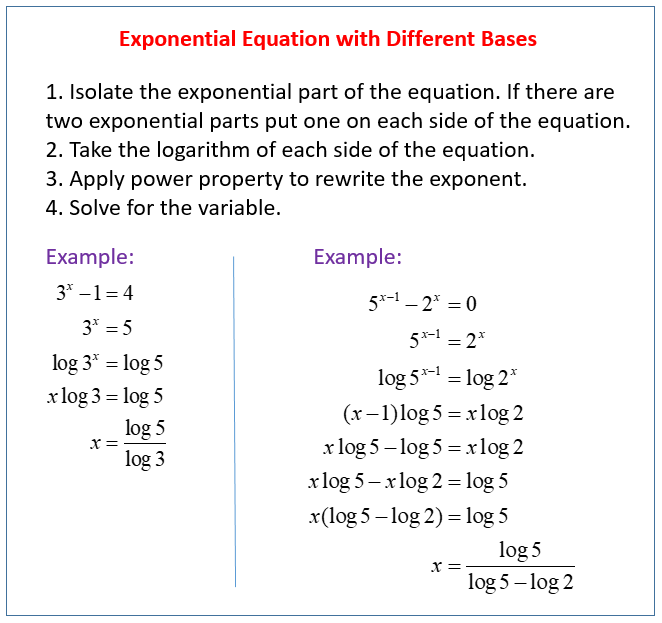
When you have an exponential equation of the form ax = by where a and b are different bases and cannot easily be converted to the same base, the most effective strategy is to take the logarithm of both sides of the equation.
You can use any base logarithm, but log10 (common log) or ln (natural log) are typically preferred because they are readily available on calculators.
The following diagram shows the steps to solve exponential equations with different bases. Scroll down the page for more examples and solutions.
Logarithm Worksheets
Practice your skills with the following worksheets:
Printable & Online Logarithm Worksheets
Key Logarithm Property Needed
The crucial property that makes this work is the Power Rule of Logarithms:
logb(Mp)=p logb(M)
This rule allows you to bring the exponent down as a multiplier, turning the exponential equation into a more manageable algebraic equation.
Videos
How to solve exponential equations using logarithms?
- Isolate the exponential part of the equation. If there are two exponential parts put one on
each side of the equation.
- Take the logarithm of each side of the equation.
- Solve for the variable.
- Check your solution graphically.
Example:
Solve the exponential equations. Round to the hundredths if needed.
(a) 7x - 1 = 4
(b) 3•2x - 2 = 13
(c) (2/3)x = 53 - x
(d) 5x - 3 = 32x + 1
How to solve exponential equations with different bases?
When it’s not convenient to rewrite each side of an exponential equation so that it has the same base, you do the following:
- Take the log (or ln) of both sides
- Apply power property
- Solve for the variable
Example:
Solve for x.
a) 6x = 42
b) 7x = 20
c) 82x - 5 = 5x + 1
d) 3x = 5x - 1
How to use change of base formula to solve basic exponential equations?
Example:
Solve by writing as a log equation and then using the change of base formula. Round to 4 decimal places.
a) 5x = 476
b) 4•3x = 984
How to solve exponential and logarithmic equations?
Principle used: logaag(x) = g(x)
Examples:
- Solve for x: 88x + 7 = 9
- Solve for x:
a) 61 - 2x = 3
b) 1 + 3(42x + 3) = 8 - Solve for x: log24x + log2x = 2
- Solve for x:
a) log35 + log2(x + 4) = 2
b) log4x + log4(x + 3) = 1
How to solve exponential equations that are not one-to-one?
Examples:
34x - 5 = 17
| Check out our most popular games! | ||
|---|---|---|
 Fraction Concoction |
 Fact Family Game |
 Number Bond Garden |
 Online Addition Subtraction Game |
 Penguin Solitaire |
 Sawayama Solitaire |
 Ark Solitaire |
 Eldritch Invasion |
 Shenzhen Solitaire |
Check out more Solitaire games here.
We welcome your feedback, comments and questions about this site or page. Please submit your feedback or enquiries via our Feedback page.