Simple Probability
Related Pages
Probability Of An Event
More Lessons On Probability
More Lessons for Grade 6 Math
Math Worksheets
These lessons, with videos, examples and step-by-step solutions, help Grade 6 students learn about simple probability with one event.
Simple Probability
Simple probability is the most basic form of probability. It deals with the likelihood of a single event occurring in an experiment where all possible outcomes are equally likely.
How to determine the probability of simple events, flipping a coin, rolling a 6-sided die, or drawing a card?
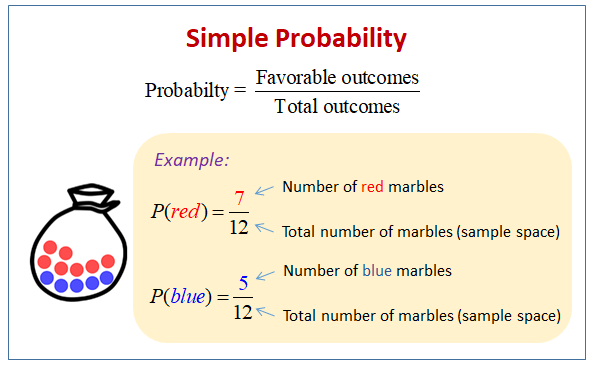
The following diagram shows the formula and an example of simple probability. Scroll down the page for more examples and solutions for simple probability.
Probability Worksheets
Practice your skills with the following worksheets:
Printable & Online Probability Worksheets
Important Notes:
- Range of Probability: A probability value will always be between 0 and 1 (inclusive).
P(E)=0: The event is impossible (it will never happen).
P(E)=1: The event is certain (it will always happen).
Probabilities can also be expressed as percentages (e.g., 0.5 = 50%). - Equally Likely Outcomes: This formula assumes that each outcome in the sample space has an equal chance of occurring.
- All possible probabilities add up to 1.
Key Concepts in Simple Probability
- Experiment: A process that leads to a well-defined set of possible outcomes (e.g., flipping a coin, rolling a die, drawing a card).
- Outcome: A single possible result of an experiment (e.g., getting “Heads” when flipping a coin, rolling a “3” on a die).
- Sample Space (S): The set of all possible outcomes of an experiment (e.g., for a coin flip, S = {Heads, Tails}; for a die roll, S = {1, 2, 3, 4, 5, 6}).
- Event (E): A specific outcome or a set of outcomes that you are interested in (e.g., the event of getting an “even number” when rolling a die would be {2, 4, 6}).
- Favorable Outcome: An outcome that satisfies the conditions of the event you are interested in.
Simple Probability 1
This video introduces the very basics of Simple Probability, or the likelihood that a single
event will occur. Worked-out examples include flipping a coin and rolling a 6-sided die.
Simple Probability 2
This is the second video on Simple Probability, or the likelihood that a single event will occur.
Worked-out examples include flipping a pair of coin and drawing a card out of a deck of 52 cards.
Simple Probability
How to determine the probability of simple events, such as a spinner landing on a space or a
die roll showing a number greater than 3.
Simple Probability
| Check out our most popular games! | ||
|---|---|---|
 Fraction Concoction |
 Fact Family Game |
 Number Bond Garden |
 Online Addition Subtraction Game |
 Penguin Solitaire |
 Sawayama Solitaire |
 Ark Solitaire |
 Eldritch Invasion |
 Shenzhen Solitaire |
Check out more Solitaire games here.
We welcome your feedback, comments and questions about this site or page. Please submit your feedback or enquiries via our Feedback page.