Significant Figures
What are Significant Figures?
Significant figures (often shortened to “sig figs” or “SF”) are the digits in a number that carry meaningful contribution to its precision or accuracy. They tell you how precisely a measurement was made or how reliably a calculated value is known.
In many instances exact numbers are not necessary or even desirable. In those circumstances approximations are given and the numbers can be approximated to a given number of significant figures (s.f.).
The following table gives the rules for identifying significant figures. Scroll down the page for more examples and solutions.
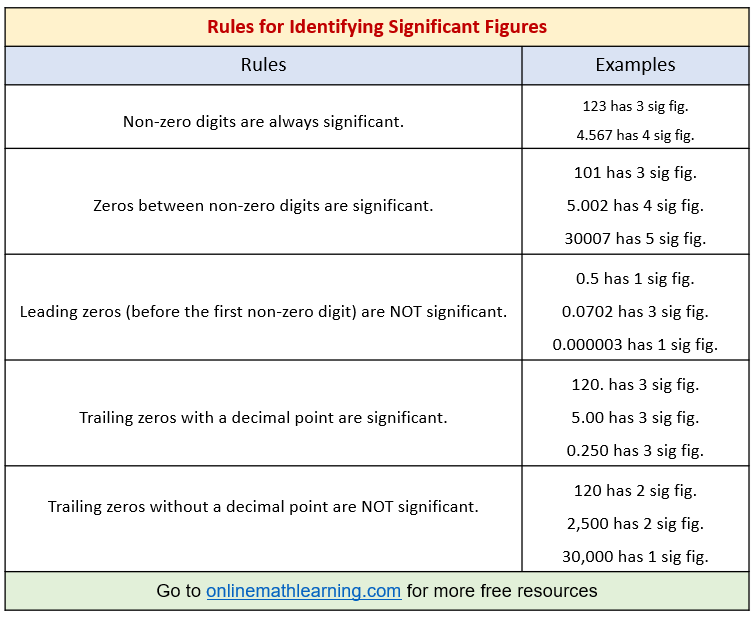
Rules for Identifying Significant Figures These rules help you count the number of significant figures in any given number:
- Non-zero digits are always significant.
- Zeros between non-zero digits are significant (sometimes called “sandwich zeros”).
- Leading zeros (zeros before non-zero digits) are NOT significant. They are just placeholders for the decimal point.
- Trailing zeros (zeros at the end of a number):
a) Are significant if there is a decimal point explicitly shown.
b) Are NOT significant if there is no decimal point shown.
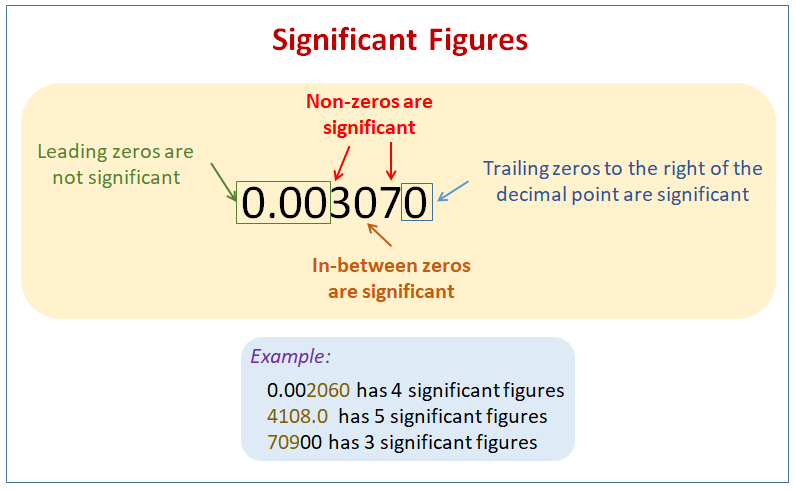
The following diagram shows how to determine the number of significant figures in a given number. Scroll down the page for more examples and solutions using significant figures.
In scientific and engineering contexts, understanding significant figures is crucial because:
- They reflect precision: When you take a measurement, the precision of your measurement is limited by the instrument you use. Significant figures communicate that level of precision. For example, a balance that reads “2.3 g” is less precise than one that reads “2.300 g.”
- They prevent misleading accuracy: It’s incorrect to report a calculated answer with more precision than the least precise measurement used to obtain it. Significant figures ensure that your final answer doesn’t imply a higher level of accuracy than is actually warranted.
GCSE Maths - Rounding to Decimal Places and Significant Figures
Using a Calculator and Significant figures
GCSE Maths revision Exam paper practice & help
Rounding & Estimating One Significant Figure
Basic Maths Core Skills GCSE
Significant Figures and rounding
GCSE Maths revision Exam paper practice & help
| Check out our most popular games! | ||
|---|---|---|
 Fraction Concoction |
 Fact Family Game |
 Number Bond Garden |
 Online Addition Subtraction Game |
 Penguin Solitaire |
 Sawayama Solitaire |
 Ark Solitaire |
 Eldritch Invasion |
 Shenzhen Solitaire |
Check out more Solitaire games here.
We welcome your feedback, comments and questions about this site or page. Please submit your feedback or enquiries via our Feedback page.