Sigma Notation
Related Topics:
More Lessons for A Level Maths
Math Worksheets
A collection of videos, activities and worksheets that are suitable for A Level Maths.
What is the Sigma Notation?
Sigma notation (also called summation notation) is a concise way to represent the sum of a series of terms. It uses the Greek capital letter sigma (Σ) to indicate summation.
The following diagram shows the Sigma Notation. Scroll down the page for more examples and solutions using the Sigma Notation.
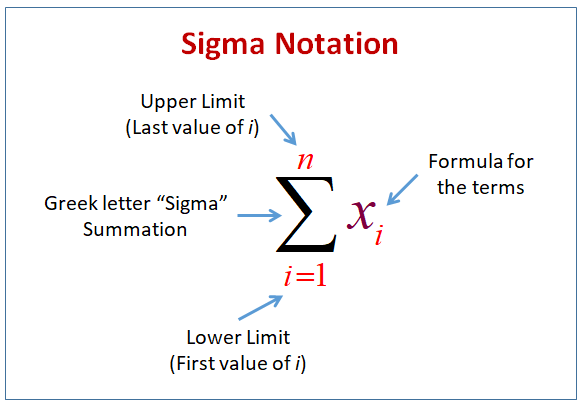
Where:
Σ (Sigma): The summation symbol, indicating that we need to sum the terms that follow.
i: The index of summation or variable of summation. It’s a variable that takes on integer values within a specified range. Any letter can be used as the index (e.g., j, k, n).
m: The lower limit of summation. This is the starting integer value for the index i.
n: The upper limit of summation. This is the ending integer value for the index i. The summation proceeds until i reaches n.
xᵢ: The general term or summand. This is an expression that depends on the index i. For each integer value of i from m to n, we evaluate this expression, and then we add all these resulting values together.
Series : Sigma Notation : ExamSolutions : A-Level Maths
In this tutorial you are shown the meaning behind sigma notation for the sum of a sequence called a series.
Series & Sigma notation (1) FP1 Edexcel A-Level
Series & Sigma notation (2) FP1 Edexcel A-Level
Sequences / Sigma Notation: C1 Edexcel June 2013 Q4
Sequences and Series 7 - Sigma Notation Arithmetic Series
| Check out our most popular games! | ||
|---|---|---|
 Fraction Concoction |
 Fact Family Game |
 Number Bond Garden |
 Online Addition Subtraction Game |
 Penguin Solitaire |
 Sawayama Solitaire |
 Ark Solitaire |
 Eldritch Invasion |
 Shenzhen Solitaire |
Check out more Solitaire games here.
We welcome your feedback, comments and questions about this site or page. Please submit your feedback or enquiries via our Feedback page.