Examples using Scientific Notation
Related Topics:
More Lessons for Grade 7 Math
Math Worksheets
Examples, solutions, videos, worksheets, and lessons to help Grade 7 students learn how to multiply and divide numbers in scientific notation and to solve applications using scientific notation.
In this lesson, we will learn how to multiply and divide in scientific notation and how scientific notations can be used in some real world applications and examples.
A number is in scientific notation when it is in the form
A × 10n where
- 1 ≤ |A| < 10. This part is called the significand or mantissa.
- n is an integer. This part is the exponent or power of 10.
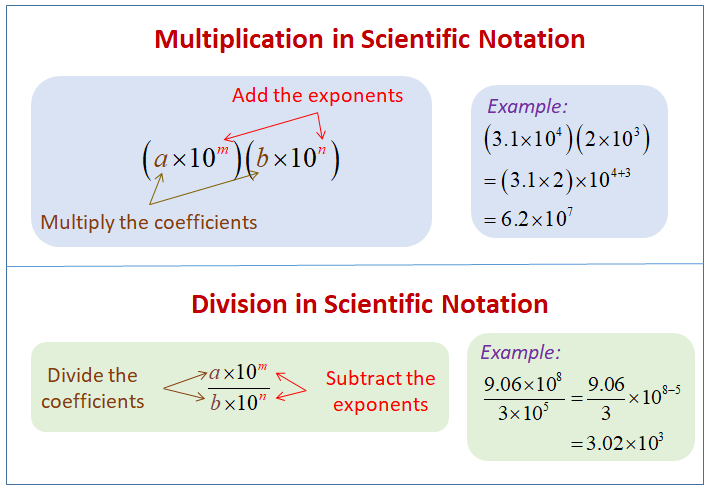
The following diagram shows how to multiply and divide in scientific notation. Scroll down the page for more examples and solutions for multiplication and division in scientific notation.
Scientific Notation Worksheets:
Practice your skills with the following worksheets:
Online & Printable Scientific Notation Worksheets
Multiplication Using Scientific Notation
To multiply numbers expressed in scientific notation (a × 10b) and (c × 10d):
- Multiply the significands (the ‘a’ and ‘c’ parts): Multiply a × c.
- Multiply the powers of ten (the 10b and 10d parts):
Use the rule 10b × 10d = 10b+d. - Combine the results: The product will be (a × c)× 10b+d.
- Adjust the significand if necessary: The significand (a×c) should be between 1 (inclusive) and 10 (exclusive).
If a × c < 1, move the decimal point to the right until it is between 1 and 10, and decrease the exponent by the number of places moved.
If a × c ≥ 10, move the decimal point to the left until it is between 1 and 10, and increase the exponent by the number of places moved.
Division Using Scientific Notation
To divide numbers expressed in scientific notation \( \frac{ a \times 10^b }{c \times 10^d} \)
- Divide the significands (the ‘a’ and ‘c’ parts): Divide \( \frac{a}{c} \)
- Divide the powers of ten (the 10b and 10d parts):
Use the rule \( \frac{ 10^b }{ 10^d} \) = 10b-d - Combine the results: The quotient will be \( \frac{ a }{ c} \) × 10b-d
- Adjust the significand if necessary: The significand \( \frac{ a }{ c} \) should be between 1 (inclusive) and 10 (exclusive).
If \( \frac{ a }{ c} \) < 1, move the decimal point to the right until it is between 1 and 10, and decrease the exponent by the number of places moved.
If \( \frac{ a }{ c} \) > 10, move the decimal point to the left until it is between 1 and 10, and increase the exponent by the number of places moved.
Multiplication and Division in Scientific Notation
Applications using Scientific Notation
Examples:
- Suppose a state has a $31 billion budget for K-12 schools. If that money is dispersed among 292 school districts throughout the state, how much money will each school district receive?
- According to a 2013 report from the U.S. Bureau of Justice Statistics, approximately 2.2 million Americans are incarcerated in local jails and state and federal prisons. If it costs $25,000 to house each inmate for a year, how much is U.S. spending on incarcerations yearly?
- It is estimated that a single droplet from a sneeze can contain as many as 200 million germs. If a sneeze is composed of 40,000 of these droplets, how many germs are in a single sneeze?
- According to its website, Lucas Oil Stadium in Indianapolis holds approximately 70,000 spectators. How many stadiums would it take to hold the entire U.S. population?
- Recently, a meme on social media was divvying lottery winnings among everyon in the country. If the jackpot was $1.3 billion and the meme estimated a population of 300 million people, hoe much money would each person “win”?
| Check out our most popular games! | ||
|---|---|---|
 Fraction Concoction |
 Fact Family Game |
 Number Bond Garden |
 Online Addition Subtraction Game |
 Penguin Solitaire |
 Sawayama Solitaire |
 Ark Solitaire |
 Eldritch Invasion |
 Shenzhen Solitaire |
Check out more Solitaire games here.
We welcome your feedback, comments and questions about this site or page. Please submit your feedback or enquiries via our Feedback page.