Resultant forces and Vector Diagrams
Related Topics:
IGCSE Physics Lessons
Math Worksheets
A series of free GCSE/IGCSE Physics Notes and Lessons.
Resultant Forces
In physics, the resultant force (also known as the net force or total force) is the single force that represents the combined effect of all the individual forces acting on an object. If you replace all the original forces with this one resultant force, the object would experience the exact same change in motion (acceleration).
Finding the resultant of two forces is essentially a problem of vector addition, as forces are vector quantities, meaning they have both magnitude (strength) and direction. There are several methods to find the resultant of two forces.
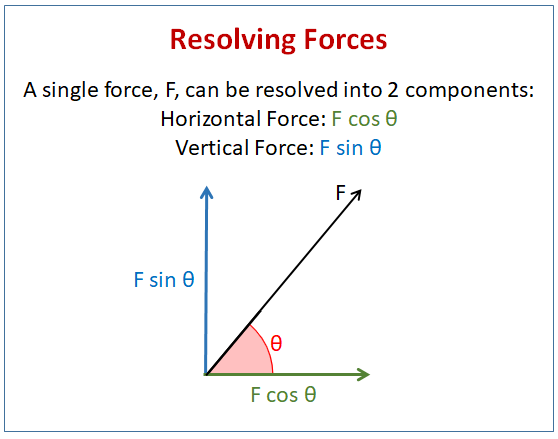
The following diagram shows how to resolve a force. Scroll down the page for more examples and solutions on resultant forces and resolving forces.
How to Calculate the Resultant Force
There are generally two main methods for finding the resultant force:
I. Analytical Method (Component Method)
This is the most common and accurate method, especially for multiple forces or forces acting at angles. It involves breaking down each force into its perpendicular components (usually x and y components) and then summing these components.
- Resolve Each Force into Components: For each individual force (F1, F2,…,Fn), determine its horizontal (x-component) and vertical (y-component).
If a force F acts at an angle θ with respect to the positive x-axis (measured counter-clockwise):
Fx = F cosθ
Fy = F sinθ
Remember to pay attention to the signs based on the quadrant of the angle (e.g., if a force points left, its x-component will be negative). - Sum the Components: Add all the x-components together to get the resultant x-component and add all the y-components together to get the resultant y-component
- Use the Pythagorean theorem, to calculate the magnitude of the resultant force.
- Use the inverse tangent function to calculate the direction of the resultant force.
II. Graphical Method
Head-to-Tail or Parallelogram Method
Videos
Resultant Forces
Describe what is meant by a resultant force.
How to calculate resultant forces acting parallel to each other or in a straight line.
Draw a free-body diagram to show the forces acting on an object.
Vector Diagrams
How to work out the resultant of two forces at an angle by using a vector diagram?
Examples:
- Two forces are acting on an object. One force has a magnitude of 10N and the other force has a magnitude of 8N. The angle between the two forces is 30°. Draw a vector diagram to find the resultant force.
- A force of 280N and a force of 320N are acting on an object. There is an angle of 20° between the forces. Calculate the resultant force.
Resolving Forces
How to take a single force and resolve it into two components, one in the x direction and the other in the y direction?
How to use a vector diagram to resolve a single force into two forces?
Examples:
- A 100N force is acting at an angle of 35° with the horizontal. Determine the horizontal and vertical components of this force.
- A 75N force is acting at an angle of 20° with the horizontal. Determine the horizontal and vertical components of this force.
Resolving vectors - Splitting a Force into Components
Resolving a force is about replacing a force by two forces at right angles to one another that would have the same effect as the single force. The force that replace the single force are called component of that force.
| Check out our most popular games! | ||
|---|---|---|
 Fraction Concoction |
 Fact Family Game |
 Number Bond Garden |
 Online Addition Subtraction Game |
 Penguin Solitaire |
 Sawayama Solitaire |
 Ark Solitaire |
 Eldritch Invasion |
 Shenzhen Solitaire |
Check out more Solitaire games here.
We welcome your feedback, comments and questions about this site or page. Please submit your feedback or enquiries via our Feedback page.