Rectangle Word Problem Game
Related Pages
Printable Math Worksheets
Online Math Quizzes
Math Games
Math Worksheets
This Rectangle Word Problem Game/Worksheet is a great way to put your skills to the test in a fun environment. By practicing, you’ll start to work out the answers efficiently.
Rectangle Word Problem Quiz/Game
This game focuses on solving word problems involving rectangles, covering length, width, area, and perimeter. Scroll down the page for a more detailed explanation.
How to Play the Rectangle Explorer Game
- Look at the Problem: Read the problem carefully. Solve it and select one of the answers.
- Check Your Work: If you selected the right answer, it will be highlighted in green. If you are wrong, it will be highlighted in red and the correct answer will be highlighted in green. A hint will be given to help you find the correct answer.
- Get a New Problem: Click “Next Problem” for a new problem.
Your score is tracked, showing how many you’ve gotten right. - Finish Game When you have completed 10 questions, your final score will be displayed.
How to solve Rectangle Word Problems
Perimeter Problems (The “Boundary”)
The Scenario:
These problems usually involve the “outside” of a shape. Look for keywords like fencing, trim, border, frame, walking around, or edging.
The Logic:
You are adding the distance of all four sides. Because a rectangle has two equal lengths (L) and two equal widths (W), the formula is:
P = 2L + 2W or P = 2(L + W)
Example: “A backyard is 12 ft long and 8 ft wide. How much fencing is needed to go around it?"
Solution: 2(12) + 2(8) = 24 + 16 = 40 ft
Area Problems (The “Surface”)
The Scenario:
These focus on the “inside” space or how much a surface covers. Look for keywords like carpet, grass, paint, tile, fabric, or space.
Example: “A room is 10 ft by 12 ft. How much carpet is needed to cover the floor?"
Solution: $10 × 12 = 120 sq ft.
Working Backward (Missing Dimensions)
Sometimes, the problem gives you the total (Area or Perimeter) and one side, then asks you to find the other side. This requires simple algebra.
Finding Width from Area
If you have the Area, you simply divide by the known side.
\(W = \frac{A}{L}\)
Example: “A garden has an area of 50 sq ft. If the length is 10 ft, what is the width?"
Solution: 50 ÷ 10 = 5 ft.
Finding Width from Perimeter
This is slightly more complex. You must remember that the perimeter contains two of each side.
- Divide the Perimeter by 2 (this gives you one L and one W combined).
- Subtract the known side.
\(W = \left(\frac{P}{2}\right) - L\)
Example: “A frame has a perimeter of 30 in. If the length is 10 in, what is the width?"
Solution: Half of 30 is 15. Then, 15 - 10 = 5 in.
Special Case: The Square
In a square, the length and width are the same (s).
Area of a Square: A = s2 (If you know the area, take the square root to find the side).
Perimeter of a Square: P = 4s (If you know the perimeter, divide by 4 to find the side)
This video gives a clear, step-by-step approach to explain how to find the length and width of a rectangle given the perimeter.
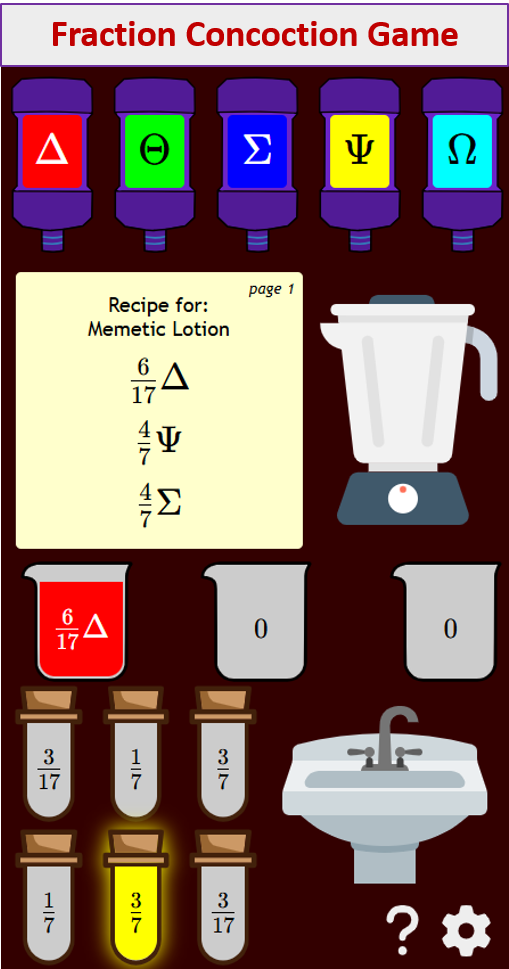
Try out our new and fun Fraction Concoction Game.
Add and subtract fractions to make exciting fraction concoctions following a recipe. There are four levels of difficulty: Easy, medium, hard and insane. Practice the basics of fraction addition and subtraction or challenge yourself with the insane level.
We welcome your feedback, comments and questions about this site or page. Please submit your feedback or enquiries via our Feedback page.