Graphing Rational Functions with Holes
Related Topics:
More Lessons for PreCalculus
Math Worksheets
Examples, videos, worksheets, solutions, and activities to help PreCalculus students learn about graphing rational functions with holes.
How do we find a hole in the graph?
When graphing rational functions, holes, also known as removable discontinuities, occur when a factor is present in both the numerator and the denominator of the function. These common factors cancel out, leaving a simplified function, but they indicate a point where the original function was undefined.
A “hole” in a graph of a rational equation will occur when a value of x causes both the numerator and the denominator to equal 0.
Graphing Rational Functions with Holes
A rational function is a quotient of two functions.
The graph of a rational function usually has vertical asymptotes where the denominator equals 0. However, the graph of a rational function will have a hole when a value of x causes both the numerator and the denominator to equal 0. This occurs when there is a common factor in the numerator and denominator. We can set the common factor to zero and solve for x to find the hole.
The following diagram shows how to graph rational functions with holes. Scroll down the page for more examples and solutions on graphing rational functions.
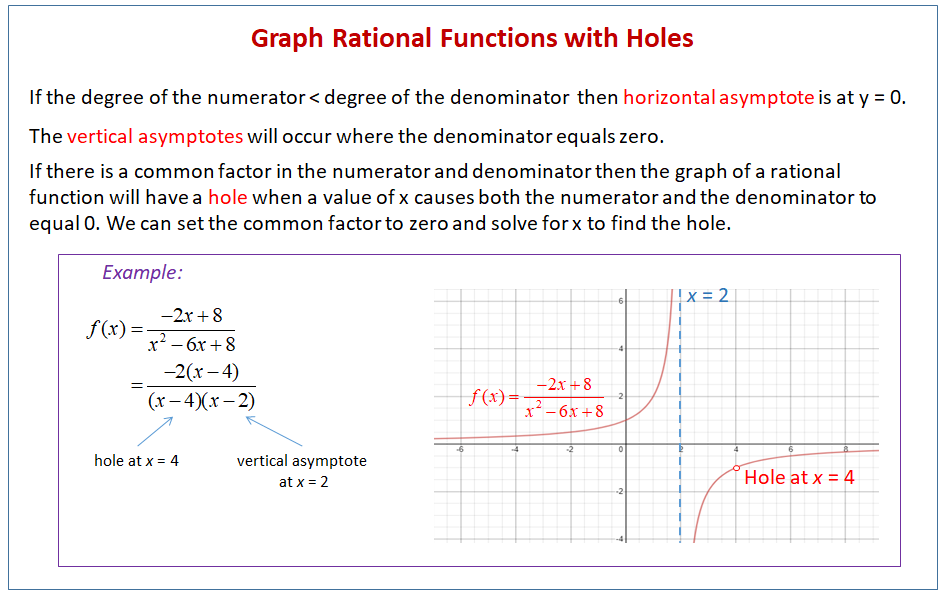
How to graph rational functions with holes?
- Factor the Numerator and Denominator completely.
- Look for any factors that are identical in both the numerator and the denominator. These common factors are what cause the holes.
- For each common factor, set it equal to zero and solve for x. This x-value is where the hole will occur.
For a common factor of \(x - a\), the hole will be at \(x = a\). - Simplify the rational function by canceling out the common factors from the numerator and the denominator. The simplified function represents the graph of the rational function everywhere except at the hole(s).
- To find the y-coordinate of the hole, substitute the x-value(s) found in Step 3 into the simplified rational function. The resulting y-value gives the location of the hole as a coordinate point \((x, y)\).
- Determine Other Features of the Graph using the Simplified Function:
x-intercepts: Set the numerator of the simplified function equal to zero and solve for x.
y-intercept: Set \(x = 0\) in the simplified function and solve for y.
Vertical Asymptotes: Set the denominator of the simplified function equal to zero and solve for x.
Horizontal or Slant Asymptotes: Compare the degrees of the numerator and the denominator of the simplified function.
If degree(N) < degree(D): the horizontal asymptote is \(y = 0\).
If degree(N) = degree(D): the horizontal asymptote is \(y = \frac{\text{leading coefficient of numerator}}{\text{leading coefficient of denominator}}\).
If degree(N) = degree(D) + 1: there is a slant asymptote (found by polynomial long division). - Sketch the Graph:
Plot the intercepts and draw the asymptotes as dashed lines.
Plot the location(s) of the hole(s) as open circles.
Sketch the graph, making sure it approaches the asymptotes and passes through the intercepts.
Remember to skip over the holes.
Graphing rational functions with holes
This video shows how to graph rational functions that have holes.
How to graph a rational function when there is a common factor in the numerator and denominator?
Graphing a Rational Function with a Hole
Holes in Rational Equations
Coordinates of a Hole of a Rational Function
This video shows how to find the coordinates of a hole in the graph of a rational function.
| Check out our most popular games! | ||
|---|---|---|
 Fraction Concoction |
 Fact Family Game |
 Number Bond Garden |
 Online Addition Subtraction Game |
 Penguin Solitaire |
 Sawayama Solitaire |
 Ark Solitaire |
 Eldritch Invasion |
 Shenzhen Solitaire |
Check out more Solitaire games here.
We welcome your feedback, comments and questions about this site or page. Please submit your feedback or enquiries via our Feedback page.