Power Sequence Worksheet/Game
Related Pages
Printable Math Worksheets
Online Math Quizzes
Math Games
Math Worksheets
This Power Sequence Worksheet/Game is a great way to put your skills to the test in a fun environment. By practicing, you’ll start to work out the answers efficiently.
Power Sequence Worksheet/Game
Welcome to Power Sequence Worksheet/Game. This game requires you to fill in the missing term for a Power Sequence: Square or Cube. Scroll down the page for a more detailed explanation.
How to play the Power Sequence Game
-
Identify the Pattern
Each level presents a sequence of numbers that follow one of two possible rules. You won’t be told which one it is, so you have to figure it out by looking at the numbers provided:
Squares (x2): A number multiplied by itself.
Example: 4, 9, 16, 25 (22, 32, 42, 52)
Cubes (x3): A number multiplied by itself twice.
Example: 8, 27, 64, 125 (23, 33, 43, 53) -
Fill the Gap
One of the numbers in the four-part sequence is missing and replaced by a “?” input box.
Analyze the visible numbers: If you see 36 and 49, you know you’re looking at 62 and 72.
Determine the missing step: If the sequence is 36, 49, ?, 81, the missing number must be 82.
Input and Verify: Type your answer and click Verify (or hit Enter). -
Scoring and Feedback
Correct: You’ll hear a high-pitched “sine” beep, the input will glow Emerald, and your score will increase by 10.
Wrong: You’ll hear a low “triangle” buzz, the input will glow Red, and the box will clear for you to try again.
Skip: If you hit a wall, click Skip to generate a new sequence. -
Tips
The Cube Clue: If the numbers jump very quickly (e.g., from 27 to 64 to 125), it is almost always a Cube sequence.
The First Digit: Most sequences start between 1 and 12 for squares, and 1 and 6 for cubes. If you see a 1, it could be 12 or 13—look at the second number to confirm the power.
Memorize the “Big” Cubes:
43 = 64
53 = 125
63 = 216
Power Sequences
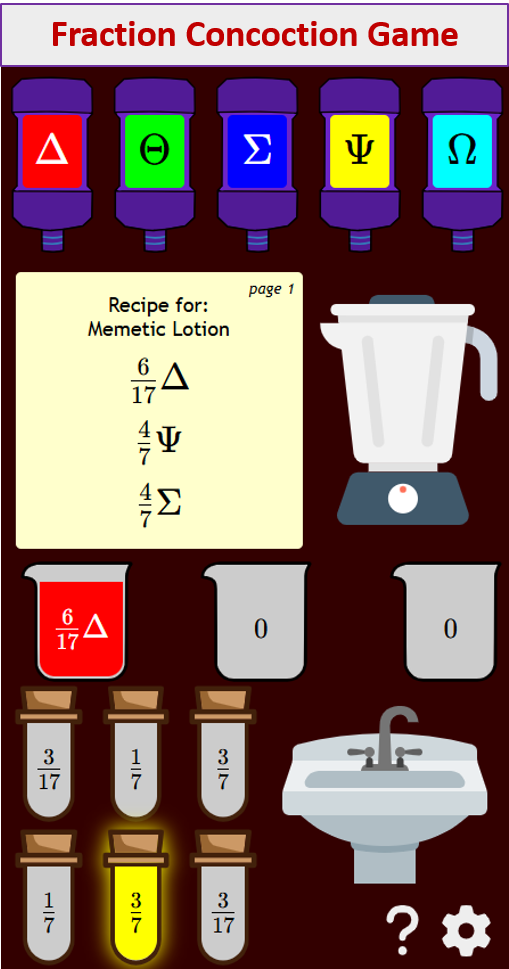
Try out our new and fun Fraction Concoction Game.
Add and subtract fractions to make exciting fraction concoctions following a recipe. There are four levels of difficulty: Easy, medium, hard and insane. Practice the basics of fraction addition and subtraction or challenge yourself with the insane level.
We welcome your feedback, comments and questions about this site or page. Please submit your feedback or enquiries via our Feedback page.