Past Tense - Regular Verbs
Related Topics:
More Lessons for English as a Second Language
Welcome to our collection of English as a Second Language (ESL) tools & resources for students, teachers, and educators.
We have lots of free videos that will help you improve your English and also advice and tips that will help you in English proficiency examinations like TOEFL and IELTS.
In English grammar, regular verbs are verbs that follow a simple, predictable rule to form their past tense and past participle. Unlike irregular verbs, they do not have unique or unexpected spelling changes.
Common Regular Verbs (Past Tense and Past Participle)
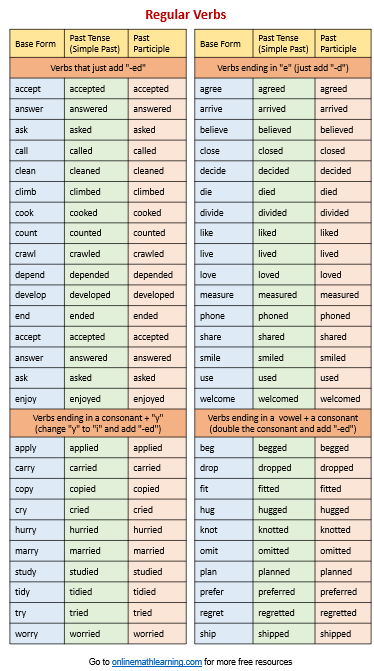
The past tense is used for the simple past, while the past participle is used with auxiliary verbs like “have,” “has,” or “had” to form perfect tenses. The past forms and past participle forms of regular verbs are the same.
The following table gives some of the most common regular verbs and their past forms. Scroll down the page for more examples.
The Rule for Regular Verbs
The rule for forming the past tense and past participle of a regular verb is to simply add “-ed” to the base form of the verb.
Base Form: The basic form of the verb (e.g., walk, talk, look).
Simple Past Tense: Used for actions that were completed in the past (e.g., “I walked to the store”).
Past Participle: Used with auxiliary verbs like have, has, or had to form perfect tenses (e.g., “She has walked this path before”).
For regular verbs, the simple past tense and the past participle are always the same form.
Spelling Rules for Adding “-ed”
While the core rule is to add “-ed,” there are a few minor spelling adjustments to be aware of:
-
Verbs ending in “e”: If the verb already ends in “e,” you just add “-d."
live → lived
love → loved
smile → smiled -
Verbs ending in a consonant + “y”: If the verb ends in “y” preceded by a consonant, you change the “y” to “i” and then add “-ed."
study → studied
try → tried
carry → carried
Note: If the “y” is preceded by a vowel (e.g., play), you just add “-ed” as normal: play → played. -
Verbs ending in a single vowel + a single consonant: If a verb is one syllable and ends in a single vowel followed by a single consonant (excluding “w,” “x,” and “y”), you double the final consonant before adding “-ed."
stop → stopped
plan → planned
drop → dropped
This rule also applies to multi-syllable verbs where the final syllable is stressed.
prefer → preferred
permit → permitted
Videos
The Past Tense - Regular Verbs
This video shows the simple and past tense forms of regular verbs.
Pronunciation of Past Tense Regular Verbs
Pronunciation of regular verbs. The “ed” ending might be a “d” or a “t,” depending on what comes before it. Category:
Regular Verbs in the Past Tense
This video shows how to pronounce regular verbs in the past tense in English.
The Simple Past: Part 1,
Forming the Simple Past
| Check out our most popular games! | ||
|---|---|---|
 Fraction Concoction |
 Fact Family Game |
 Number Bond Garden |
 Online Addition Subtraction Game |
 Penguin Solitaire |
 Sawayama Solitaire |
 Ark Solitaire |
 Eldritch Invasion |
 Shenzhen Solitaire |
Check out more Solitaire games here.
We welcome your feedback, comments and questions about this site or page. Please submit your feedback or enquiries via our Feedback page.