Number Bond Game
Related Pages
Math Games
Addition Games
Addition Worksheets
This Number Bond Game is an interactive and engaging web-based application designed to help users practice and improve their addition and subtraction skills. Number bonds are the building blocks of arithmetic.
Number Bond Game
Number bonds are pairs of numbers that, when added together, make a specific target number. They represent the foundational relationship between numbers and are a core concept in early math education.
This Number Bonds game is an interactive tool designed to help you practice and master number bonds for various target numbers. The game is customizable, allowing you to key in your own target number.
Number Bonds Challenge
What number do you want to make?
Number Bonds
Score: 0 / 0
How to Number Bond Game Game
- Target Number: Key in your target number.
- Solve the Problem A number bond problem will appear, for example, “5 + ? = 10.” The first number is randomly generated, and the second number is what you need to find.
- Enter Your Answer: Type your answer into the input box below the problem.
- Submit Your Answer: Click the “Check” button or press “Enter” on your keyboard to check your answer.
Your score is tracked at the top, showing how many you’ve gotten right out of the total you’ve tried. - Next Problem: Click the “Next” button or press “Enter” on your keyboard to check your answer.
- Change Target Number: Click “Change Target Number” to start with a new target number.
Benefits of Learning Number Bonds
Learning number bonds is incredibly useful because it builds a strong foundation for almost all future math skills. Think of number bonds as the building blocks of arithmetic. When you know them by heart, it’s like having a set of quick facts you can instantly recall, which makes more complex calculations much faster and easier.
Boosts Mental Math Skills: Knowing that 7+3=10 allows you to solve problems like 17+3 instantly. You don’t have to count on your fingers or use a calculator; your brain automatically connects the “7 and 3” bond to the answer. This is a crucial skill for quick calculations in your head.
Foundation for Addition and Subtraction: Number bonds are the inverse of each other. If you know that 10−4=6, you also know that 6+4=10. Mastering these relationships is the first step toward understanding addition and subtraction with larger numbers.
Preparation for Multiplication and Division: As you progress, number bonds extend into multiplication facts (e.g., 5×2=10 and 10÷2=5). The same logic of understanding number relationships applies and makes learning your multiplication tables much more intuitive.
Increases Confidence: When you can quickly solve basic math problems, you feel more confident tackling new challenges. This reduces the frustration and anxiety that can sometimes come with learning more difficult concepts in math.
In short, practicing number bonds is a fantastic way to develop number sense, which is a deep understanding of numbers and how they relate to one another. It’s a skill that will help you throughout your academic journey and in everyday situations, like counting money or splitting a bill.
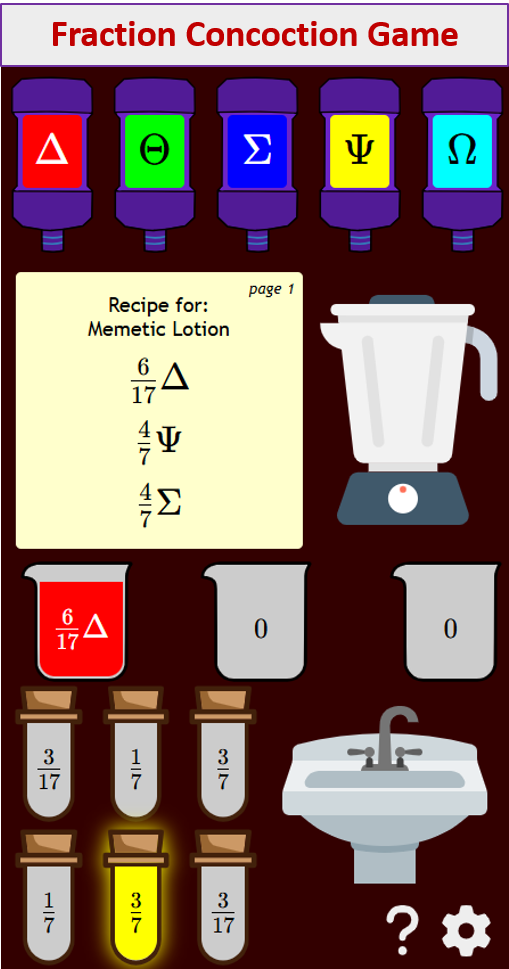
Try out our new and fun Fraction Concoction Game.
Add and subtract fractions to make exciting fraction concoctions following a recipe. There are four levels of difficulty: Easy, medium, hard and insane. Practice the basics of fraction addition and subtraction or challenge yourself with the insane level.
We welcome your feedback, comments and questions about this site or page. Please submit your feedback or enquiries via our Feedback page.